
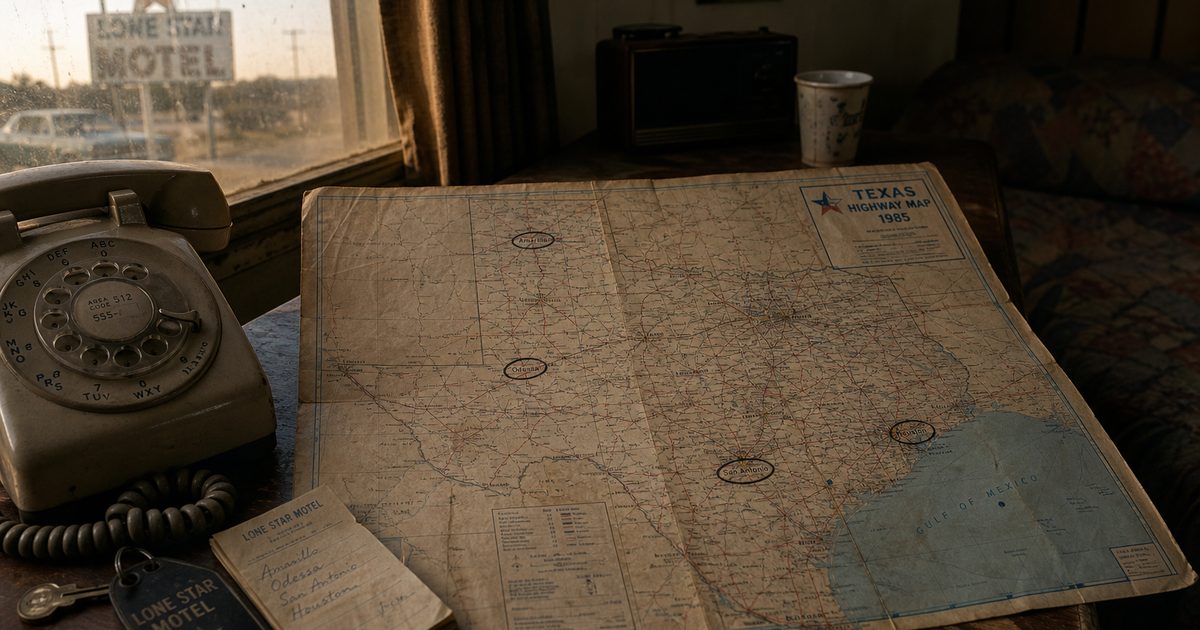
A one-eyed drifter sat in a Texas interrogation room and began to talk.
At first, it sounded like a breakthrough. Then another. Then dozens more. Detectives from around the country came to hear Henry Lee Lucas confess. Families who had waited years for answers were told a killer had finally admitted what he had done. Police departments cleared cases. Reporters wrote about a man who might have murdered hundreds.
That was the version of Henry Lee Lucas that entered American folklore, and later helped inspire Henry: Portrait of a Serial Killer.
The truth was darker in a different way. Lucas was a real killer. But the legend that grew around him became a cautionary tale about police work, false confessions and what can happen when a case becomes too useful to question.
The man behind Henry: Portrait of a Serial Killer
By the time Henry: Portrait of a Serial Killer reached audiences in the late 1980s, Lucas had already become a symbol of the faceless, roaming predator. The film drew loosely from his life and from his association with Ottis Toole, another violent drifter whose name became tangled with his in the public imagination.
That connection gave the movie its power. Henry: Portrait of a Serial Killer film did not feel like glossy fiction. It felt grubby, ordinary and close to real life, which made it harder to shake. The violence happened in apartments, on roads, in rooms that looked familiar. Its horror came from banality.
But the real story behind the movie was never just about one man drifting from place to place and killing at random. It was about how Henry Lee Lucas became something even larger than his crimes.
Born on August 23, 1936, in Blacksburg, Virginia, Lucas grew up in a brutal home. He lost an eye as a child. He spent much of his adult life moving from place to place, doing odd jobs, landing in trouble, disappearing again. None of that made him unique. What made him notorious was what happened after his arrest.
The first killing that was proven
Before the headlines about hundreds of victims, there was one murder no one seriously disputed.
On January 11, 1960, in Tecumseh, Michigan, Lucas killed his mother, Viola. Accounts differ on some details, but he was convicted of second-degree murder in her death. He served about 10 years before being released in 1970.
That crime matters because it is the fixed point in a case that later became foggy with claims, rumors and recycled stories. Lucas was not an innocent man swallowed by bad police work. He had already killed. The problem was what happened when that truth expanded into something much bigger.
Over the next decade, he drifted through the margins of American life. Then, in the early 1980s, two women entered the story whose deaths would help bring everything crashing into focus: Becky Powell and Kate Rich.
Becky Powell, Kate Rich and the crimes that led to his arrest
Becky Powell was 15 years old when she became involved with Lucas. She was also the niece of Ottis Toole, the man often described as Lucas’s companion and sometime accomplice. In 1982, Becky disappeared. So did 82-year-old Kate Rich, a woman Lucas had known in Florida.
These were not abstract names in a growing body count. They were people with families, routines and lives that stopped violently.
Lucas was arrested in Texas in June 1983, initially on a weapons charge. Soon after, investigators began connecting him to the deaths of Powell and Rich. He eventually confessed to killing both women. He was convicted in the Rich case in 1984 and later convicted in Powell’s murder as well.
Those convictions were real. They were not part of the later collapse. But they opened the door to something extraordinary.
Once Lucas started confessing, the flood did not stop.
When Henry Lee Lucas confessed to everything
This was the turning point.
After his 1983 arrest, Lucas began admitting to murder after murder, in state after state. The number attached to his name kept rising until it passed 600. For a time, he was widely described as the most prolific serial killer in American history.
It was a staggering claim. It was also one many people wanted to believe.
Police departments had unsolved cases. Families wanted answers. Investigators wanted closure. Lucas, a drifter with no fixed schedule and a history of violence, seemed to fit almost anywhere. If a woman had vanished near a highway, if a body had been found years earlier, if a case had gone cold, he could be placed near it with a little imagination and a confession.
And he gave them confessions.
The trouble was that many of them did not hold up. Lucas often got facts wrong. In some cases, he was shown photographs, maps or details from police files and then repeated them back. In others, records later showed he could not have been where the crime happened. He was in prison, in another state, or otherwise accounted for.
The more closely the confessions were examined, the less solid they looked.
That is why the Henry Lee Lucas case still matters. Not because he killed hundreds of people. There is no credible evidence that he did. It matters because so many authorities accepted his word with too little skepticism.
The myth of 600 murders
For years, Lucas’s name was tied to a number that seemed almost beyond comprehension. More than 600 murders. Sometimes the figure was repeated as fact. Sometimes it was used to explain the terror surrounding him. It helped turn Henry Lee Lucas into a monster of almost mythic scale.
But myth is exactly what much of it was.
The Texas Rangers created a task force to help sort through Lucas’s claims, and for a time the machinery of confession kept moving. Cases were “cleared” based on his statements. Yet later reviews found that many of those clearances were deeply flawed. Journalists, defense lawyers and some investigators began pulling at the threads. The timeline did not work. The evidence did not work. The confessions often did not work.
Today, estimates of how many people Lucas actually killed vary. He was convicted in multiple murders, and he is generally believed to have killed at least three people. Some sources put the number somewhat higher, but nowhere near the hundreds he claimed.
That gap between proven crimes and confessed crimes is the real heart of the story.
Ottis Toole and the public image of a killing pair
No account of Lucas stays separate from Ottis Toole for long.
The two men were linked in the public mind as a murderous pair wandering across the country. That image shaped books, television coverage and eventually Henry: Portrait of a Serial Killer. Toole was himself a convicted killer, and his relationship with Lucas added another layer of dread to the case. Together, they seemed to embody a particularly American nightmare: violence moving invisibly along highways, through cheap motels and anonymous neighborhoods.
But here too, the public image often ran ahead of what could be proved.
There is no question that both men were violent and that their lives intersected in ugly ways. There is also no question that their names became attached to crimes that remain disputed. In some cases, what was alleged in interviews and confessions was never supported by reliable evidence.
That distinction matters. True crime gets slippery when rumor starts dressing itself as fact.
What the film captured, and what it left out
What made Henry portrait of a serial killer so unsettling was its refusal to turn its central figure into a gothic villain. The man at the center looked ordinary. He moved through everyday spaces. He did not announce himself.
That part rang true.
Lucas was not frightening because he seemed larger than life. He was frightening because he did not. He was a drifter, a handyman, a man people might overlook. The film understood that.
What it could not fully capture was the second half of the story: the institutional failure that followed. The real-life case became one of the clearest examples in America of how false confessions can flourish when investigators reward cooperation, share too much information, or become invested in a suspect’s usefulness.
Lucas reportedly received perks for confessing, including better food, cigarettes, coffee and trips out of prison to help “solve” cases. That does not erase the murders he did commit. It does help explain why the confessions kept coming.
And every weak confession had consequences. Families were told cases were solved when they may not have been. Real investigations stalled. The appearance of certainty replaced the harder work of proving what happened.
Death sentence, commutation and the end of the story
In 1984, Lucas was sentenced to death for the murder of Kate Rich.
Then came another twist. In 1998, Texas Governor George W. Bush commuted that death sentence to life in prison after serious doubts were raised about whether Lucas could have committed the crime in the way prosecutors claimed. Bush later said the evidence left enough uncertainty that he could not allow the execution to go forward.
It was the only death sentence commutation of Bush’s time as governor.
Lucas remained in prison, held at the Ellis Unit near Huntsville, Texas. He died there of heart failure on March 12, 2001, at age 64.
By then, the legend had already started to crack. The Netflix docuseries The Confession Killer would bring it back into public view years later, but the central lesson was already clear: Henry Lee Lucas was both a murderer and the center of one of the most troubling confession scandals in modern American criminal justice.
Why Henry Lee Lucas still matters
Some cases endure because no one knows what happened. This one endures because too many people thought they did.
Henry Lee Lucas inspired Henry: Portrait of a Serial Killer, and the movie helped fix his image in popular culture. But the more important legacy lies outside the film. His case exposed how badly things can go wrong when confession is treated as the finish line instead of the beginning of verification.
The victims deserved better than a story inflated for convenience. Their families deserved real answers, not easy ones.
That is the real story behind Henry Lee Lucas: not just a killer, but a system that too often mistook a willing storyteller for the truth.