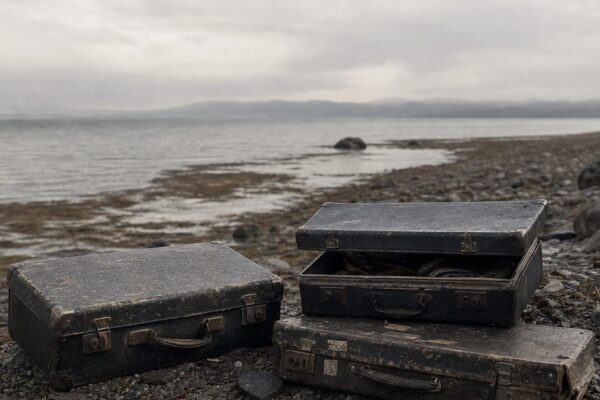

The first suitcase came out of Virginia’s Chesapeake Bay on May 5, 2004. Fishermen opened it and found a man’s dismembered legs.
Six days later, a second case surfaced, holding his head and torso. A third was recovered on May 16 near the Chesapeake Bay Bridge-Tunnel. The matching Kenneth Cole luggage contained the remains of one man, but investigators still needed his name.
Virginia Beach police circulated a forensic artist’s reconstruction of his face. An acquaintance recognized William “Bill” McGuire, a 39-year-old father of two from New Jersey.
Only a week earlier, Bill and his wife, Melanie, had closed on a new house. Now police had to work backward from three suitcases recovered hundreds of miles away-and establish what had happened before he ever moved in.
A house they would never share
Bill was a U.S. Navy veteran who worked as a computer programmer and taught as an adjunct professor at the New Jersey Institute of Technology. He and Melanie lived with their two young sons in an apartment in Woodbridge Township.
Melanie worked as a nurse at a fertility clinic in Morristown. Since 2002, she had also been having an affair with Bradley Miller, a doctor at the clinic.
The relationship remained hidden as the McGuires prepared to buy a home in Warren County. On April 28, 2004, they completed the purchase.
Two days before that closing, Melanie had gone to a gun store in Easton, Pennsylvania, and bought a .38-caliber handgun and ammunition. That purchase would become a central piece of the prosecution’s case.
Prosecutors later argued that Bill was killed in the Woodbridge apartment during the night of April 28 or early on April 29. Their account was that he had been sedated, shot in the head and chest, and then dismembered.
Melanie gave a different explanation for his disappearance. She said they had fought and he had left.
On April 30, she went to court seeking a domestic violence restraining order against him. Under oath, she said she did not know where her husband was. Long before a jury considered the murder charge, that testimony placed her account of his disappearance on the record.
The car in Atlantic City
Once Bill’s remains were identified, detectives began testing that account.
His car had turned up in Atlantic City. Surveillance footage showed someone parking it, although the images did not establish the person’s identity. Melanie acknowledged moving the car but characterized it as a prank.
That explanation raised an obvious question: why move the vehicle of a husband who had supposedly left on his own?
Investigators also examined her travel records. An E-ZPass transaction placed her toll tag in Delaware shortly after Bill disappeared. The record did not establish who was driving or what the journey involved, but prosecutors would use it as part of their reconstruction of her movements.
There were other traces to follow. Investigators recovered evidence involving chloral hydrate, a sedative, from Bill’s car. Searches found on the family computer concerned poisons, methods of killing and firearms. Prosecutors attributed incriminating searches to Melanie; their discovery on a shared computer did not, by itself, establish who had entered them.
The handgun purchase was more direct. A receipt showed that she had bought a weapon shortly before Bill vanished. It was consistent with the type of firearm prosecutors said had been used to kill him.
The murder weapon itself was never recovered. There was no gun for examiners to match conclusively to the bullets. The state would have to persuade a jury through the combined weight of the evidence rather than a single definitive discovery.
Connections inside the suitcases
The luggage had carried more than Bill’s remains into the bay. It also held materials investigators could compare with items from the apartment and Melanie’s workplace.
Forensic examiners compared black plastic bags recovered with the remains to bags collected from the McGuires’ home. Their analysis considered manufacturing marks and the composition of the plastic. Prosecutors presented the similarities as evidence connecting the disposal of Bill’s body to the apartment.
A medical towel recovered with the remains was consistent with towels used at the fertility clinic. That did not make it unique to Melanie, but it supplied another connection the prosecution could place before jurors.
Then there were green fibers associated with a bullet recovered from Bill’s chest. Examiners compared them with material from the couple’s couch. Prosecutors argued that the couch had been used to muffle the shots.
Each finding had limits. A similar towel was not proof of murder; a toll transaction was not proof of a journey carrying a body. Together with the gun purchase, the computer searches and Melanie’s explanations, however, they formed the case investigators were building.
The affair supplied the prosecution’s proposed motive. They argued that she wanted a future with Miller and had killed Bill to make that possible. It was an allegation about her intentions, not something the physical evidence could independently establish.
On June 2, 2005, more than a year after Bill disappeared, police arrested Melanie McGuire for his murder.
Two accounts of the same disappearance
The trial began on March 5, 2007, at the Middlesex County Courthouse in New Brunswick, New Jersey, before Judge Frederick De Vesa.
Prosecutors Patricia Prezioso and Christopher Romanyshyn led jurors through the purchases, forensic comparisons, travel records and statements. Their argument was that Bill had never walked away from his family. Melanie had killed him, disposed of his remains and created a story about an absent husband.
Defense attorney Stephen Turano challenged both the evidence and that reconstruction.
The defense pointed to the lack of blood evidence establishing a killing in the apartment and questioned whether Melanie could have carried out the crime as prosecutors described it. It portrayed Bill as abusive and involved in compulsive gambling, and suggested that people connected to gambling debts might have been responsible.
Those were defense allegations, not established findings about Bill or proof of another killer. But they offered jurors an alternative explanation and challenged the state to rule it out.
Across seven weeks, the courtroom heard sharply different accounts of the marriage and the disappearance. The prosecution asked jurors to see a connected sequence of preparations, killing and concealment. The defense argued that suspicion and circumstantial links did not establish guilt beyond a reasonable doubt.
After approximately 14 hours of deliberation, the jury returned its verdict on April 23, 2007.
Melanie was convicted of first-degree murder, desecration of human remains, perjury and possession of a weapon for an unlawful purpose. Jurors acquitted her on other charges.
On the central allegation-that she had killed her husband-they found her guilty.
The verdict survived the appeals
On July 19, 2007, Judge De Vesa sentenced Melanie to life in prison for murder, with an additional five-year term for perjury. Under the sentence, she must serve approximately 66 years before becoming eligible for parole.
She maintained her innocence and appealed.
On March 16, 2011, a New Jersey appeals court upheld her conviction and sentence. The state Supreme Court declined to hear a further appeal on September 20 that year.
She later sought post-conviction relief, alleging ineffective assistance of counsel and presenting what she described as newly discovered evidence. The petition was denied, and the Appellate Division affirmed that denial on August 7, 2017.
The conviction remained in place.
The case became widely known as the “Suitcase Murder,” a name drawn from how Bill was found. Before those discoveries, he had been a programmer, a teacher and a father preparing to move with his family. His two sons lost him before that move could happen.
Frequently asked questions
Who was Bill McGuire?
William “Bill” McGuire was a 39-year-old Navy veteran, computer programmer and adjunct professor at the New Jersey Institute of Technology. He and Melanie had two sons.
When were his remains discovered?
His remains were recovered from three matching suitcases in Virginia’s Chesapeake Bay on May 5, May 11 and May 16, 2004.
What evidence was used against Melanie McGuire?
The prosecution relied on her handgun purchase, forensic comparisons involving plastic bags, a towel and fibers, computer searches, travel records and her statements. The murder weapon was not recovered.
What motive did prosecutors allege?
They argued that she wanted to leave her marriage and build a life with Bradley Miller, the fertility doctor with whom she was having an affair.
What was her sentence, and has she maintained her innocence?
She received life imprisonment for murder plus five years for perjury, with approximately 66 years before parole eligibility. She has maintained her innocence; her conviction survived appeals and a post-conviction challenge.