The hole was in the vault floor. By the time employees at Brazil’s central bank branch in Fortaleza discovered it on Monday, August 8, 2005, the people who had cut through the reinforced concrete were gone-and so were roughly 3.5 metric tons of banknotes.
Over the weekend, burglars had carried approximately R$164.7 million through a narrow tunnel beneath the city. The haul was worth about US$70 million at the time.
No gunmen had confronted the staff. No shots had been fired. The burglary had passed without an alarm alerting anyone to the removal of the cash.
The route into the vault was now plain to see. Following the money out would take years.
A grass business with something to hide
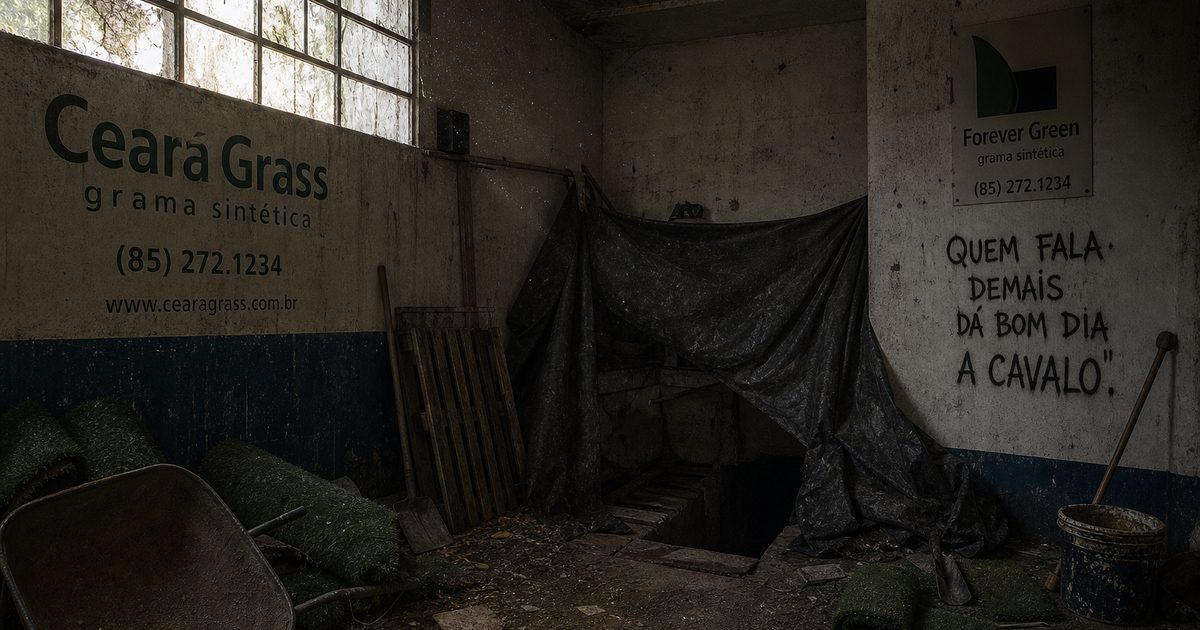
Several months earlier, a new business had appeared at a rented property on Rua 25 de Março, close to the bank. Its name was P.S. de Souza Grama Sintética, and it purported to sell synthetic grass.
The frontage gave the occupants an ordinary reason to be there. Promotional material and branded caps helped make the company look established. A landscaping business also offered a convenient explanation for something that might otherwise have attracted attention: quantities of earth leaving the premises.
Behind that cover, a crew was digging toward the Banco Central do Brasil.
The work began around May 2005 and continued for roughly three months. Estimates of the number involved vary, partly because the wider operation included people accused of financing the burglary, arranging transport and handling the proceeds-not just those who went underground.
The tunnel stretched approximately 75 to 80 meters. Timber supports and plastic lining helped maintain the passage; electric lights and ventilation made sustained work possible in the confined space.
This was not simply a matter of digging until someone reached the right address. The passage had to hold together, reach the vault and remain usable while people carried an immense weight back through it.
Above ground, the business continued to provide cover. Below it, the excavation advanced toward the bank.
The weekend the cash disappeared
The burglars entered the vault during the weekend of August 6-7, 2005, when the branch was closed.
At the end of their tunnel stood a final obstacle: a reinforced-concrete floor reported to be about 1.1 meters thick. They broke through it and gained access to the stored currency. Investigators later recovered equipment associated with the operation, including cutting and drilling tools.
The thieves took used 50-real notes. Unlike newly issued currency, those notes did not provide investigators with a readily usable list of recorded serial numbers to circulate and track.
But choosing the money was only part of the job. Thousands of bundles had to be moved through the opening and along the cramped underground passage.
The physical burden was considerable: roughly 3.5 metric tons, carried out through the same route used to enter.
The bank’s security systems did not stop them. Reports that cameras or motion detectors had failed to detect the intrusion raised questions about possible inside assistance. Those suspicions should not be mistaken for proof that a bank employee helped the burglars.
When staff returned on Monday morning, the crew had already had time to disperse.
The tunnel gave police a route, not an answer
Federal investigators could inspect the passage, examine abandoned tools and work backward from the rented property. They could establish how the burglars had reached the vault.
Identifying everyone involved-and finding the cash-was a different problem.
The false company left leads. So did the arrangements needed to support months of excavation. Investigators examined the property, interviewed witnesses and followed purchases and movements linked to suspects.
Spending after the burglary supplied further opportunities. Vehicle transactions drew scrutiny, while recovered cash, testimony and surveillance helped connect people beyond the digging crew.
The investigation spread outside Ceará, the state whose capital is Fortaleza. The money had not stayed in one place, and neither had the people suspected of taking it.
By the end of 2005, authorities had reported eight arrests and the recovery of about R$20 million.
That was a substantial sum. It was also a small part of what had disappeared from the vault. Cash could be divided, concealed and spent much faster than police could reconstruct every transaction.
A killing after the burglary
Among those investigators identified as important figures was Luis Fernando Ribeiro, known as Fernandinho. Police suspected him of helping finance or organize the operation.
He never stood trial over that alleged role.
In October 2005, Ribeiro was kidnapped in São Paulo and subsequently found dead. Reports described a ransom payment made in an attempt to secure his release. His killing became a separate investigation, with allegations of police involvement.
The distinction matters: suspicion about Ribeiro’s part in the bank burglary did not establish every claim made about him, and the circumstances of his death required their own evidence.
His death also changed the character of the story. The entry into the vault had involved no direct physical attack on bank staff. In the aftermath, suspected access to the stolen fortune exposed people connected to the case to kidnapping, extortion and violence.
The money was not simply waiting somewhere for investigators to discover it. It had become the object of further crimes.
Arrests and sentences, but no complete recovery
Another central suspect was Antônio Jussivan Alves dos Reis, known as Alemão. Authorities identified him as one of the organizers. He was arrested in 2008, nearly three years after the burglary.
By then, the inquiry had expanded well beyond the men believed to have entered the tunnel. Prosecutors pursued allegations against people accused of receiving, concealing or laundering the proceeds.
Those roles were not interchangeable. Someone convicted of laundering money was not necessarily someone who had broken into the vault, and an indictment alone did not establish guilt.
The proceedings produced numerous convictions across separate cases. On August 25, 2015, Alves dos Reis received an 80-year sentence in proceedings concerning money laundering linked to the stolen funds.
The long sequence of arrests and judgments meant the burglary could not reasonably be described as wholly unsolved. Investigators had identified participants, secured convictions and recovered millions.
But court sentences did not bring back most of the cash.
Published accounts commonly put the eventual recovery at around R$32 million-roughly a fifth of the original haul. Totals vary with the reporting date and whether an account includes seized assets as well as cash, but the central outcome is clear: most of the money was not recovered.
What the tunnel could not explain
The Fortaleza bank heist is often remembered for its engineering: a false business, months of concealed excavation and a passage ending beneath a central-bank vault.
That focus can make the aftermath seem like an afterthought. It was not. The public institution lost an enormous amount of money. Investigators spent years pursuing a dispersed network. Separate acts of violence left families dealing with consequences far removed from the initial, apparently bloodless burglary.
The case later inspired the fictionalized Brazilian film Federal Bank Heist, released in 2011, and the Netflix documentary series 3 Tonelada$: Assalto ao Banco Central, released in 2022.
Neither its notoriety nor its many prosecutions produced a complete accounting of the stolen cash.
On that Monday morning in Fortaleza, employees found the opening through which the money had vanished. The tunnel could be measured, photographed and searched. Most of what had passed through it remained beyond recovery.
FAQ
How much money was stolen in the Fortaleza bank heist?
Approximately R$164.7 million, worth about US$70 million at the time. The stolen 50-real banknotes weighed roughly 3.5 metric tons.
How did the burglars enter the bank?
They dug a tunnel approximately 75 to 80 meters long from a rented property operating as a synthetic-grass business, then broke through the vault’s reinforced-concrete floor.
When did the burglary happen?
The break-in took place over the weekend of August 6-7, 2005. Bank employees discovered it on Monday, August 8.
Was the case solved, and how much money was recovered?
Numerous people were convicted in connection with the burglary and its proceeds. Around R$32 million was reportedly recovered, leaving most of the haul unaccounted for.
Was anyone killed during the heist?
No killings or direct attacks on staff were reported during the burglary itself. The aftermath included separate violent crimes, including the kidnapping and killing of suspected organizer Luis Fernando Ribeiro.