
A museum that receives crowds by the hour was breached in minutes.
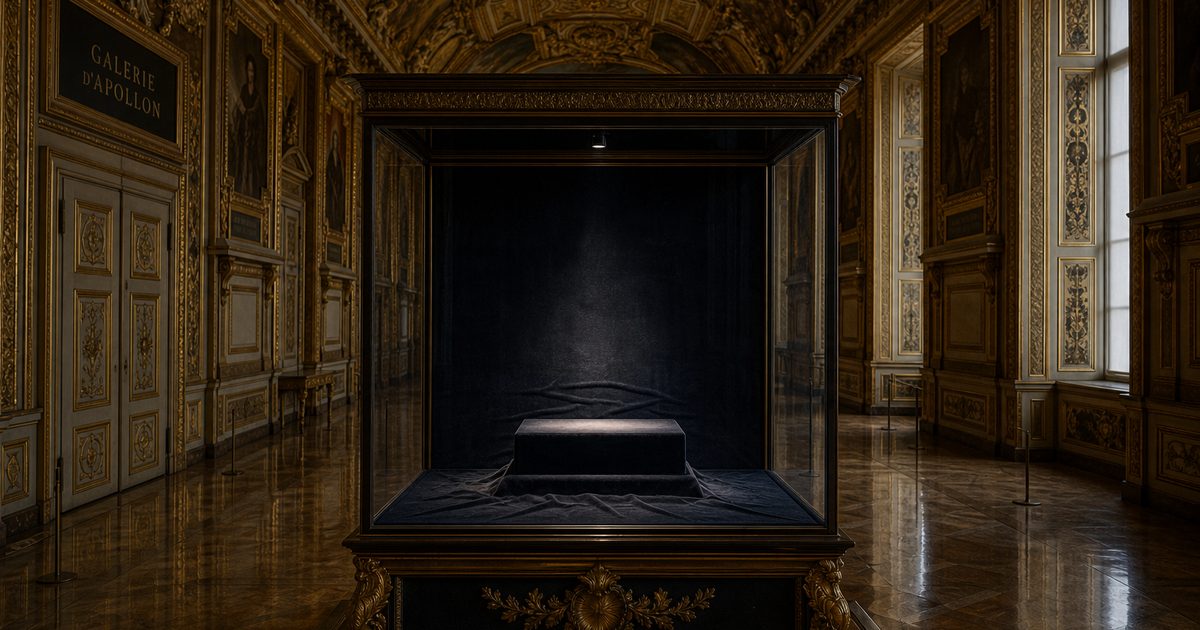
On a Sunday morning, shortly after the Louvre opened, a truck-mounted lift rolled into place beneath a second-floor window of the Galerie d’Apollon. The men inside looked like workers. That was part of the advantage. In broad daylight, with visitors already moving through one of the most famous museums in the world, the lift rose toward the Balcon de Charles IX.
By the time the alarm was sounding through the gallery, the thieves were already inside.
What became known as the Louvre jewelry heist was not a quiet, careful theft. Prosecutors said it was fast, blunt and tightly timed. The intruders cut through a window, rushed the display cases holding part of the French Crown Jewels, and were gone in less than eight minutes. The value of the missing pieces was put at about €88 million. But the real shock in France was not only the price tag. It was the setting. National treasures had been taken from the Louvre in full morning light.
Eight minutes inside the Louvre
The robbery took place on October 19, 2025, in Paris.
The museum had opened around 9 a.m. Roughly half an hour later, the men in the lift made their move. Investigators said they used the cherry picker to reach the second-floor balcony window, then cut through the glass to enter the Galerie d’Apollon, the long ceremonial gallery where the Crown Jewels were displayed.
The alarm went off. That did not stop them.
According to the early account of the case, the intruders threatened guards with power tools and smashed two display cases. Their target was specific: historic jewels associated with the French state, objects that carried political and cultural weight far beyond their market value.
The operation was over almost before it had properly registered. Prosecutors said the men spent about four minutes inside the museum. From approach to escape, the whole thing lasted under eight.
Then came the detail that made the scene feel even more chaotic. During the getaway, the Crown of Empress Eugénie was dropped in the street and damaged. The thieves fled on motorbikes. They also tried to burn the basket of the lift, pouring gasoline onto the cherry picker as they escaped.
Inside the museum, the response was immediate. The Louvre was evacuated and closed.
More than a museum theft
Art crimes are often reduced to numbers: value, insurance, recovery odds. This case resisted that.
The missing pieces were part of the French Crown Jewels, a collection bound up with monarchy, empire and the French state’s long effort to preserve what remained of its ceremonial past. So when the jewels disappeared, the public reaction was not simply that something expensive had been stolen. It was that something symbolic had been exposed.
That is why the Louvre heist quickly became a national embarrassment as well as a criminal investigation. Questions about museum security surfaced almost at once. How could a team arrive with a lift, reach a second-floor window, break in after opening time and get back out with historic jewels before anyone could stop them?
The robbery did not just expose a vulnerable display. It exposed a vulnerable institution.
The first arrests
Investigators moved quickly. Within a week of the theft, two men were arrested in Seine-Saint-Denis: Abdoulaye N., 40, and Ghelamallah A., 36.
French reporting identified Abdoulaye N. as an unlicensed taxi driver known online for motorcycle stunt videos under the name “Doudou Cross Bitume.” Ghelamallah A. was described in reports as unemployed. Some accounts also said he was suffering from Diogenes syndrome, though that claim belongs to reporting around the case and should be treated carefully unless established in court.
Both men were accused in connection with the robbery. In late October 2025, they partially admitted involvement, according to the case material cited by French media.
The investigation widened after that. On November 25, 2025, four more people were arrested. Charges were ultimately filed against five suspects in total. The judicial inquiry continued after those arrests, with investigators still trying to determine who planned the operation, who carried it out, and where the missing jewels had gone.
What the evidence suggested
From the beginning, the case had the feel of a job designed around speed.
Investigators had surveillance footage. They had the damaged crown dropped during the escape. They had the lift used to reach the window, along with tools left behind and evidence of the attempted arson. Piece by piece, the physical evidence supported a simple theory: this was not an improvised break-in. It was planned to the minute.
The disguises mattered. So did the route. A truck-mounted platform gave the thieves direct access to the gallery from outside, bypassing the normal flow of visitors and staff. The motorbikes waiting for the escape suggested the same logic. Get in fast. Take what can be grabbed. Get out before the museum can lock down.
That speed may also explain why not everything went cleanly. One of the most important objects, the Crown of Empress Eugénie, was dropped during the escape. The image of a damaged imperial crown lying in the street became one of the defining details of the case: a symbol of both the thieves’ audacity and the disorder that followed.
The alleged mastermind in the background
As the inquiry developed, another figure began to appear in the prosecution’s theory of the crime.
In later statements, the two accused men described an alleged organizer known as “Jo” from Aubervilliers. That name surfaced more clearly when French newspaper Le Monde published transcripts from the suspects’ questioning on July 13, 2026.
Those transcripts did not settle the case, but they added shape to it.
According to the published questioning, the two men said they had been promised between €15,000 and €25,000 for taking part. If that account is accurate, it suggests a familiar structure in high-value thefts: the men taking the immediate risk may not be the ones expecting the biggest profit.
The same reporting included another striking allegation. “Jo,” they said, was disappointed with the haul and believed more could have been taken.
That remark, if investigators accept it, says a great deal about the mindset behind the robbery. Alarms had sounded. Guards had been confronted. Historic objects had been ripped from one of the world’s best-known museums. Yet the complaint, allegedly, was that the thieves had not taken enough.
It is a cold detail, and it shifts the focus away from cinematic ideas about master criminals. What emerges instead is something more ordinary and more unsettling: a team willing to gamble with irreplaceable objects for money, under instructions from someone still in the background.
Pressure on the Louvre
The fallout did not stop with the arrests.
The museum came under intense scrutiny after the theft, and the pressure reached the top. On February 25, 2026, Louvre president-director Laurence des Cars offered to resign, and a new head was later appointed. A security audit followed. Reports also said the Louvre and other French institutions moved valuable jewelry holdings to the Bank of France for safekeeping.
Those steps mattered because they showed how seriously the breach was taken. This was not treated as a freak event that could be explained away by bad luck. It forced a broader reckoning over how France protects objects that are both financially valuable and historically loaded.
Paris prosecutor Laure Beccuau was among the public officials associated with the case as the inquiry continued.
What remained unsolved
For all the arrests, the central fact of the case barely changed.
The jewels were still missing.
That is what makes the Louvre jewelry theft only partly solved. Investigators identified suspects. They gathered evidence. They obtained statements that, at least according to published reporting, pointed to a wider plan and an alleged mastermind. But the stolen pieces themselves had not been recovered, and the man described as “Jo” remained a key unresolved figure.
There is also a smaller but important point about the stolen items. Some reports initially described nine pieces taken, while later summaries often referred to eight stolen pieces, likely because the Crown of Empress Eugénie was dropped during the escape rather than successfully carried off. In a case built from early reports, arrests and later court material, that distinction matters. It is one reason the record has to be handled carefully.
What does not change is the image the case left behind: a lift rising toward a Louvre window after opening time, alarms sounding through the gallery, display cases broken, and part of France’s Crown Jewels vanishing into the streets of Paris.
Not every major art crime happens in darkness. This one happened in public.
FAQ
When did the Louvre heist happen?
The robbery took place on October 19, 2025, at the Louvre in Paris.
What was stolen from the Louvre?
The target was part of the French Crown Jewels displayed in the Galerie d’Apollon. Early reports said nine pieces were taken, though later summaries often referred to eight stolen items after the Crown of Empress Eugénie was dropped during the escape.
How much were the stolen jewels worth?
The missing jewels were valued at about €88 million.
Were suspects arrested in the Louvre heist?
Yes. Two men were arrested within a week, and five suspects were ultimately charged in connection with the case.
Has the stolen Louvre jewelry been recovered?
No. The missing jewels had not been recovered as the judicial inquiry continued.