By seven o’clock on the morning of June 10, 1912, the Moore household should have been stirring. Instead, the curtains were drawn, the door was locked, and no one had come outside to begin the chores.
Next door, Mary Peckham noticed the silence. She knocked, received no answer, and eventually called Josiah Moore’s brother, Ross.
Ross arrived with a key at about eight. Inside a downstairs bedroom, he found two girls lying in bed. They were Ina May and Lena Gertrude Stillinger, who had spent the night with his brother’s family after a church program.
Ross stepped back outside and told Peckham to summon the town marshal, Henry “Hank” Horton.
When Horton searched the rest of the house, he found six more victims. Josiah and Sarah Moore, their four children, and both visiting sisters had been killed. An axe belonging to Josiah lay in the downstairs bedroom.
Before the morning was over, people would crowd into the house to see what had happened. In their wake, an already difficult investigation would become harder still.
A Sunday evening at church
Only hours earlier, the children had been attending a celebration.
On June 9, the Moores went to the Children’s Day program at their Presbyterian church in Villisca, a small southwestern Iowa town. Sarah, 39, had helped organize the event. Her husband, 43-year-old Josiah, was a local farm-implement dealer.
Their children were Herman, 11; Mary Katherine, 10; Arthur Boyd, seven; and Paul Vernon, five. Joining them were Mary Katherine’s friends, the Stillinger sisters: 12-year-old Lena and eight-year-old Ina.
The girls had permission to stay overnight. After the program ended, the group walked home, arriving at approximately 9:45 to 10 p.m.
The family settled upstairs. The Stillinger sisters shared the downstairs guest bedroom.
Investigators later placed the killings between roughly midnight and five in the morning. The precise time-and the order in which the victims were attacked-was never established.
By daylight, six children and two adults were dead inside a house that, from the street, appeared undisturbed.
The door opens, and the town follows
Peckham’s concern began with an ordinary observation: the family was late getting up. By approximately 7:30 a.m., she had contacted Ross.
His discovery brought Horton to the property. The marshal found the parents in their bedroom and the four Moore children in another upstairs room. Like the Stillinger sisters downstairs, they had been attacked with an axe, largely with its blunt end.
News spread quickly through Villisca. Residents gathered outside; many went in.
Accounts describe a stream of people moving through the rooms before officials brought access under control. Whatever their intentions, those visitors could disturb objects, leave traces, and obscure the distinction between evidence left by the killer and changes made after the discovery.
This was not a scene with nothing to examine. There were marks, objects and apparent efforts to conceal parts of the house. The problem was preserving them-and understanding which details could reliably tell investigators anything.
What the killer left behind
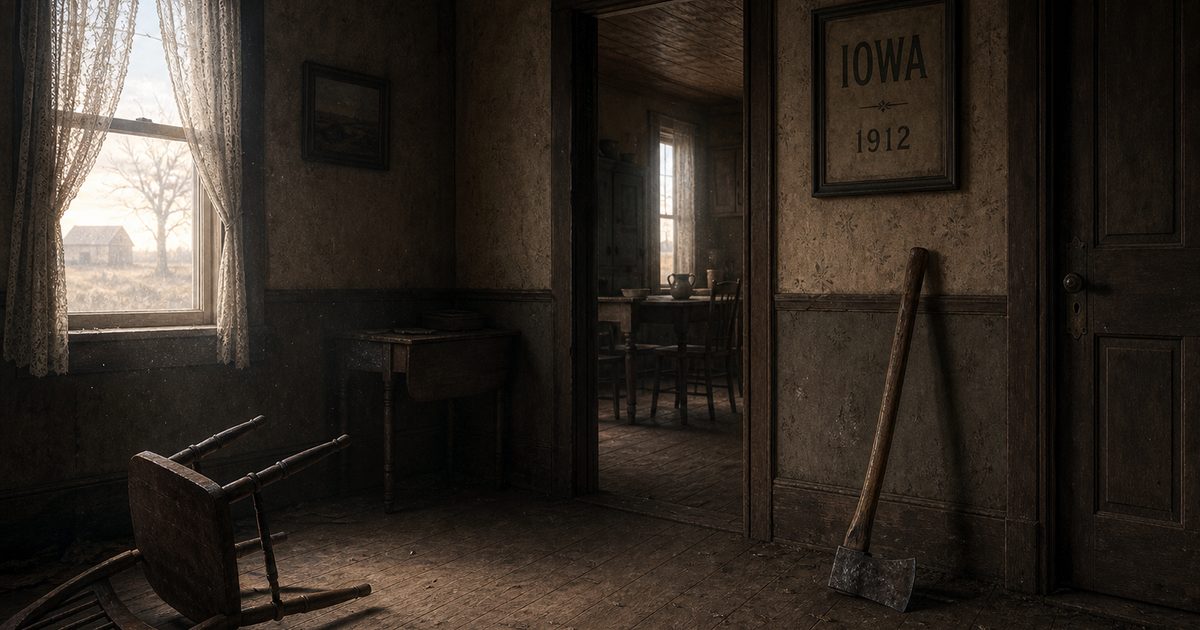
The axe was found near the Stillinger sisters, apparently partly wiped clean. Investigators identified it as Josiah’s.
Upstairs, damage to a bedroom ceiling suggested the weapon had struck it during a swing. The victims’ faces had been covered with bedding or clothing. Mirrors were also reported covered, along with windows in parts of the house.
These details suggested that someone had moved through the rooms doing more than attacking the occupants. They did not establish why.
Two kerosene lamps were found without their glass chimneys. Investigators interpreted their arrangement as a possible means of keeping the light low. A piece of bacon lay near the weapon, and accounts described food and a bowl of bloodied water in the kitchen.
Two cigarette butts reportedly found in the attic encouraged the theory that the assailant had hidden there while the family attended church. But neither their origin nor that proposed sequence was proved.
Lena’s position on the downstairs bed and an injury to her arm led investigators to believe she might have awakened and tried to defend herself. That possibility distinguished her from victims apparently attacked in their sleep, but it did not establish exactly what she had seen or done. Speculation about sexual assault followed; it was not established.
Money remained in the house, making robbery seem an unlikely explanation.
The accumulating details gave investigators questions rather than a clear suspect. Why cover the faces and mirrors? Had someone been waiting inside? Was Josiah the intended target, or had the household been chosen for another reason?
None of those questions received a proven answer.
Grief gives way to accusation
On June 12, thousands gathered in Villisca for the victims’ funeral services. The scale of the loss was difficult to separate from the ordinary lives interrupted: four children from one family, two sisters visiting a friend, and the parents who had brought them home from church.
Investigators pursued local suspects and strangers alike. Railroad worker Andrew Sawyer attracted suspicion but was not charged. Other early leads also failed to produce a case.
One theory grew particularly bitter.
Private detective James Newton Wilkerson accused businessman and Iowa state senator Frank F. Jones of arranging Josiah’s death. Josiah had once worked for Jones before establishing a competing business. Wilkerson alleged that Jones had hired William Mansfield to carry out the killings.
The accusation was never proved.
Mansfield was arrested in 1916, but evidence placing him elsewhere undermined the allegation. A grand jury declined to indict him. He later won damages in a lawsuit against the Burns detective agency.
The public accusations had damaged reputations without establishing responsibility for the eight deaths. Four years after the murders, the investigation still had no conviction.
Then attention returned to a minister who had been in Villisca on the night of the church program.
George Kelly’s confession reaches a courtroom
Reverend George Kelly, a traveling minister, had attended the Children’s Day event and left town early the following morning. His movements and subsequent behavior drew investigators’ interest.
Authorities arrested him in May 1917. Later that year, after prolonged questioning, he signed a confession.
For a case burdened by uncertain physical evidence and failed leads, it appeared to be the breakthrough investigators needed. But Kelly withdrew the statement, and its reliability became central to the prosecution.
His defense challenged the interrogation and raised questions about his mental health. A confession existed; whether it was a truthful account was another matter.
Kelly’s first trial, in September 1917, ended with a hung jury. Prosecutors tried him again that autumn.
In November, the second jury acquitted him.
The verdict did not identify the killer. It meant the prosecution had failed to prove that Kelly was responsible. His confession could not be treated as a settled explanation of what had happened inside the Moore house.
An unsolved case, not an established theory
Later researchers considered whether the killings belonged to a wider series of nighttime axe attacks. Some proposed Henry Lee Moore, a convicted murderer unrelated to the Villisca family.
In their 2017 book, The Man from the Train, Bill James and Rachel McCarthy James argued that a man they identified as Paul Mueller was responsible for numerous killings, including those in Villisca. That remains an authors’ theory, not a legally established solution.
No one has been convicted of the Villisca axe murders.
The house was restored in the 1990s and opened to visitors. Its rooms remain a physical connection to the case, but they cannot supply what the investigation never established: who entered that night, what brought the killer there, or how that person escaped.
The last known shared outing of the eight victims was the church program. By the following morning, a neighbor was standing outside their silent home, waiting for someone to answer.
FAQ
When did the Villisca axe murders happen?
The killings occurred overnight on June 9-10, 1912. Investigators generally estimated the attacks took place between midnight and 5 a.m., though the exact time is unknown.
Who were the eight victims?
They were Josiah and Sarah Moore; their children Herman, Mary Katherine, Arthur Boyd and Paul Vernon; and overnight guests Lena Gertrude and Ina May Stillinger.
Who discovered the bodies?
Josiah’s brother, Ross Moore, discovered the Stillinger sisters after neighbor Mary Peckham raised the alarm. Town marshal Henry Horton then searched the house and found the other victims.
Why was the crime scene difficult to investigate?
Townspeople entered before access was properly controlled, compromising potential evidence. Investigators also struggled to determine the significance and origin of several objects found inside.
Was anyone convicted?
No. George Kelly faced two trials in 1917. The first ended with a hung jury, and the second ended in acquittal. The case remains unsolved.