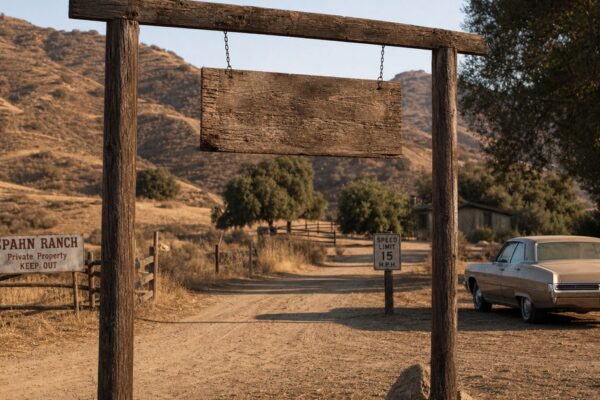
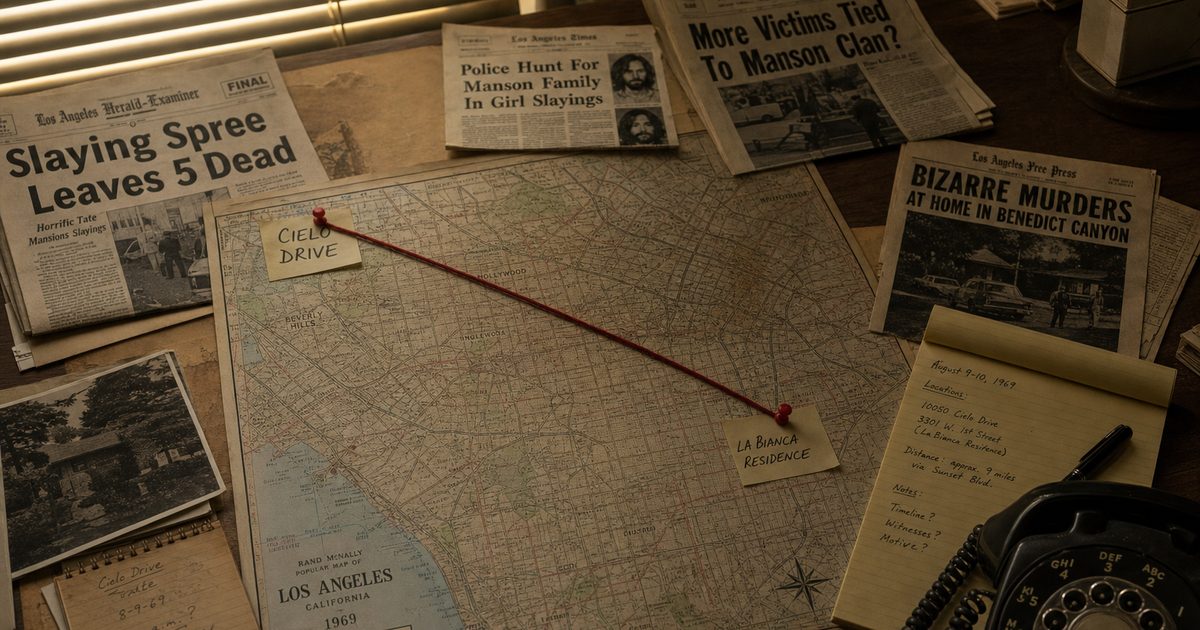
A gate stood at the end of Cielo Drive, high above Los Angeles, where the city lights gave way to canyon dark. Just after midnight, a car climbed the road and stopped. Four members of the Manson Family got out. By sunrise on August 9, 1969, five people at the house would be dead.
What happened over those two nights has been retold so often that the names can start to feel fixed in place, almost historical. But the victims were not symbols when the violence reached them. They were people in a home on a summer night: Sharon Tate, who was heavily pregnant; celebrity hairstylist Jay Sebring; coffee heiress Abigail Folger; writer Wojciech Frykowski; and Steven Parent, an 18-year-old who had simply stopped by to visit the caretaker in the guest house.
The next night, the killing moved to another Los Angeles neighborhood. At 3301 Waverly Drive in Los Feliz, Leno LaBianca and Rosemary LaBianca were attacked in their own home. By then, the city was dealing with something more than a single horrifying crime scene. It was facing a pattern, though police did not immediately understand that.
This is the story of the Tate-LaBianca murders, who took part, how the case came together, and why the question of responsibility stretched beyond the people who held the knives.
The road that led to Cielo Drive
Months before the murders, Charles Manson had already brushed against the address.
On March 23, 1969, he went to 10050 Cielo Drive looking for music producer Terry Melcher, who had previously rented the property. Melcher no longer lived there. Sharon Tate and her husband, director Roman Polanski, did. Accounts differ on exactly whom Manson encountered that day, but what is clear is that he learned Melcher was gone.
That detail mattered later. Most of the people attacked at Cielo Drive had no personal connection to Manson. The house appears to have been the target more than the specific people inside it.
By then, Manson had gathered a circle of followers around him, many of them young and deeply loyal. Among the key names later tied to the case were Charles “Tex” Watson, Susan Atkins, Patricia Krenwinkel, Leslie Van Houten, Linda Kasabian, Bobby Beausoleil, Mary Brunner, and Steve “Clem” Grogan.
Pressure inside the group had been building. On July 25, 1969, musician and teacher Gary Hinman was murdered. Beausoleil was later arrested on August 6 in connection with that killing. Prosecutors would argue that this arrest helped create urgency inside the Family and formed part of the backdrop to what came next.
Two nights later, the violence widened dramatically.
The first night: five victims at Sharon Tate’s house
On the evening of August 8, Manson told Watson to go to Cielo Drive and, in Watson’s later account, destroy everyone there. In the early hours of August 9, Watson drove to the property with Susan Atkins, Patricia Krenwinkel, and Linda Kasabian.
Manson was not at the Tate house that night. That became one of the central facts of the case: he did not physically carry out those killings, yet prosecutors said he had set them in motion.
Steven Parent was the first victim. He was sitting in his car near the property after visiting caretaker William Garretson in the guest house when he was confronted and killed.
Inside the main house, the attack unfolded against four more people. Sharon Tate, Jay Sebring, Abigail Folger, and Wojciech Frykowski were murdered. Polanski was away in Europe at the time.
The crime scene stunned even seasoned investigators. Blood was used to write “PIG” on the front door. The brutality was obvious. The meaning was not.
Housekeeper Winifred Chapman discovered the scene later that morning, on August 9. Panic spread quickly through Los Angeles. But the investigation, at first, did not move cleanly toward the truth.
A second night, a second house
Before the city had absorbed what happened in Benedict Canyon, Manson and several followers were back in a car.
On the night of August 9, Manson, Watson, Krenwinkel, Van Houten, Kasabian, and Grogan drove around Los Angeles. In the early hours of August 10, they arrived at the home of Leno and Rosemary LaBianca.
This time, Manson was there at the start.
According to trial evidence, he entered the house, woke the couple, and tied them up. Then he left, telling others what to do. Watson, Krenwinkel, and Van Houten were convicted of carrying out the killings. Kasabian remained outside. Grogan was present during the drive that night but was not convicted of the LaBianca murders.
The scene at Waverly Drive carried some of the same grim signatures as Cielo Drive. Messages were written in blood, including “DEATH TO PIGS” and the misspelled “HEALTER SKELTER.” “WAR” was carved into Leno LaBianca’s abdomen. The wording would later become crucial to the prosecution’s theory about motive.
The LaBiancas were found later that day, August 10.
Now there were two murder scenes, two neighborhoods, and seven victims. Yet police still did not immediately treat them as one story.
Why the case did not break open right away
That may be one of the strangest parts of the Manson Family murders. In hindsight, the crimes seem inseparable. At the time, investigators were slower to connect them.
The Tate killings were initially viewed through several possible lenses, including a drug-related attack. The LaBianca murders were not immediately folded into the same investigation. Even when a boy found the .22-caliber Hi-Standard revolver used in the Tate murders in Sherman Oaks on September 1 and turned it over to police, the full picture still had not snapped into place.
Meanwhile, law enforcement was circling the Family for other reasons. In October 1969, officers raided Barker Ranch in Death Valley and arrested Manson and others on vehicle theft and arson-related charges. Those arrests briefly collapsed because of an error involving the warrant dates.
The breakthrough came from inside custody, and from people who started talking.
The confessions that changed the investigation
In November 1969, Susan Atkins told cellmates details about the killings while she was in jail on the Hinman case. Those statements became a major break for investigators. Some parts of Atkins’ various accounts changed over time, and not every claim she made was treated as reliable, but her disclosures helped point police toward the people involved in the Tate-LaBianca murders.
Arrest warrants followed.
By December 1969, Manson and Atkins were already in custody on other matters. Watson was arrested in Texas. Krenwinkel was arrested in Alabama after being found asleep in a stranger’s closet. Kasabian surrendered in New Hampshire. By early 1970, the principal defendants had been charged.
Then prosecutors secured the witness they needed most.
Linda Kasabian, who had gone to Cielo Drive and was present during the second night’s drive, was granted immunity in exchange for testimony. She did not take part in the actual killings, according to the prosecution’s case, but she became essential in explaining what happened, who was there, and how the orders were carried out.
Her testimony gave the jury a narrative. Without it, the state’s case would have been far harder to tell.
Who took part in the Tate-LaBianca murders?
The answer depends on what, exactly, is being asked.
If the question is who planned and directed the crimes, prosecutors said Charles Manson was the mastermind. He was convicted of first-degree murder and conspiracy even though he was not present at Cielo Drive during the killings there.
If the question is who went to Sharon Tate’s house, the group was Watson, Atkins, Krenwinkel, and Kasabian.
If the question is who physically killed at the LaBianca home, the convictions centered on Watson, Krenwinkel, and Van Houten, with Manson having entered first, tied up the victims, and directed the attack before leaving.
That distinction mattered in court. The Manson killers were not all charged on identical facts, and not all roles were the same. But together, the evidence showed a conspiracy that stretched across both nights.
The trial that fixed the case in public memory
The Tate-LaBianca murder trial began on June 15, 1970, in Los Angeles Superior Court. Manson, Atkins, Krenwinkel, and Van Houten were tried together. Vincent Bugliosi led the prosecution. Judge Charles H. Older presided.
Watson was tried separately after extradition battles and was convicted in 1971.
The trial itself became notorious. There were outbursts in court. Manson tried to control the room even from the defense table. His followers outside the courthouse echoed his behavior, shaving their heads and carving Xs into their foreheads. At one point, Manson appeared in court with an X cut into his own forehead, saying he had “X’d” himself out of the world.
But for all the spectacle, the case turned on a straightforward legal idea: conspiracy. Prosecutors did not need to prove that Manson personally stabbed anyone at Cielo Drive. They needed to prove that he ordered and orchestrated the murders.
On January 25, 1971, the jury found Manson, Atkins, Krenwinkel, and Van Houten guilty of first-degree murder and conspiracy to commit murder. Watson was later convicted on the same charges.
All received death sentences at first. In 1972, after the California Supreme Court’s decision in People v. Anderson struck down the state’s death penalty law, those sentences were reduced to life imprisonment.
The motive that became famous, and what was actually proven
No account of the Charles Manson murders can avoid “Helter Skelter,” the prosecution theory that Manson believed a coming race war would destroy society and that the killings were meant to help trigger it while shifting blame onto Black people.
That theory became inseparable from the case, and the blood-written messages at the scenes were a key part of it.
But motive is not always as neat as verdicts. Other explanations have long circulated: anger over Terry Melcher, an effort to make it seem the Hinman killer was still free, or a desire to commit murders so chaotic they would command attention. Some of those ideas overlap. Some remain debated.
What the trial established was narrower and firmer. It proved, beyond a reasonable doubt, that the defendants were responsible for the murders and that Manson directed the crimes as part of a conspiracy. It did not require jurors to settle every question about his inner mythology.
What remains beyond dispute is the damage left behind. Seven people were killed over two nights. Families were shattered. A city locked its doors in fear. And the victims’ names became permanently tied to one of the most infamous murder cases in American history.
FAQ
Who were the victims in the Tate-LaBianca murders?
Sharon Tate, Jay Sebring, Abigail Folger, Wojciech Frykowski, Steven Parent, Leno LaBianca, and Rosemary LaBianca were killed over the nights of August 8-10, 1969.
Who actually took part in the Manson Family murders?
At Cielo Drive, Watson, Atkins, Krenwinkel, and Kasabian went to the property. At the LaBianca home, Watson, Krenwinkel, and Van Houten were convicted of the killings, while Manson entered first, tied up the couple, and directed events before leaving.
Did Charles Manson kill anyone himself?
He was not present for the Tate murders. In the LaBianca attack, trial evidence showed that he entered the home and tied up Leno and Rosemary LaBianca, but he was not convicted as the person who physically killed them. He was convicted as the leader of the conspiracy.
How were the Manson killers caught?
A major break came after Susan Atkins spoke to jail cellmates in November 1969. Linda Kasabian’s immunity deal and testimony then helped prosecutors reconstruct both nights in court.
What happened to the convicted defendants?
Manson died in prison in 2017. Susan Atkins died in prison in 2009. Leslie Van Houten was released on parole in 2023. Patricia Krenwinkel and Tex Watson remain incarcerated.