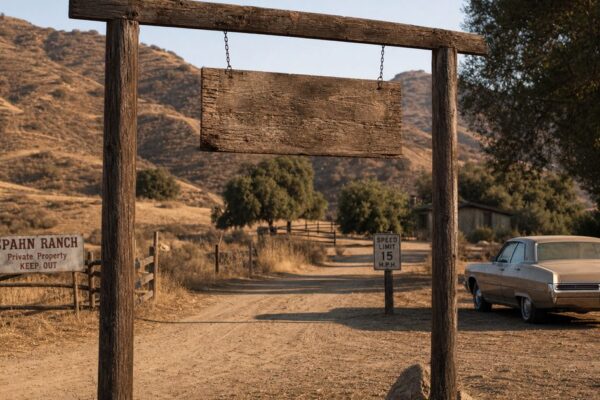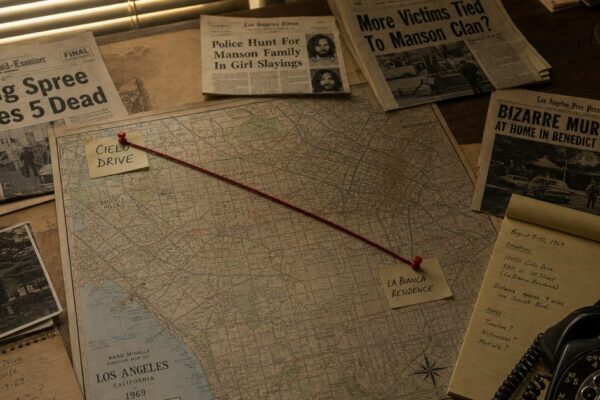
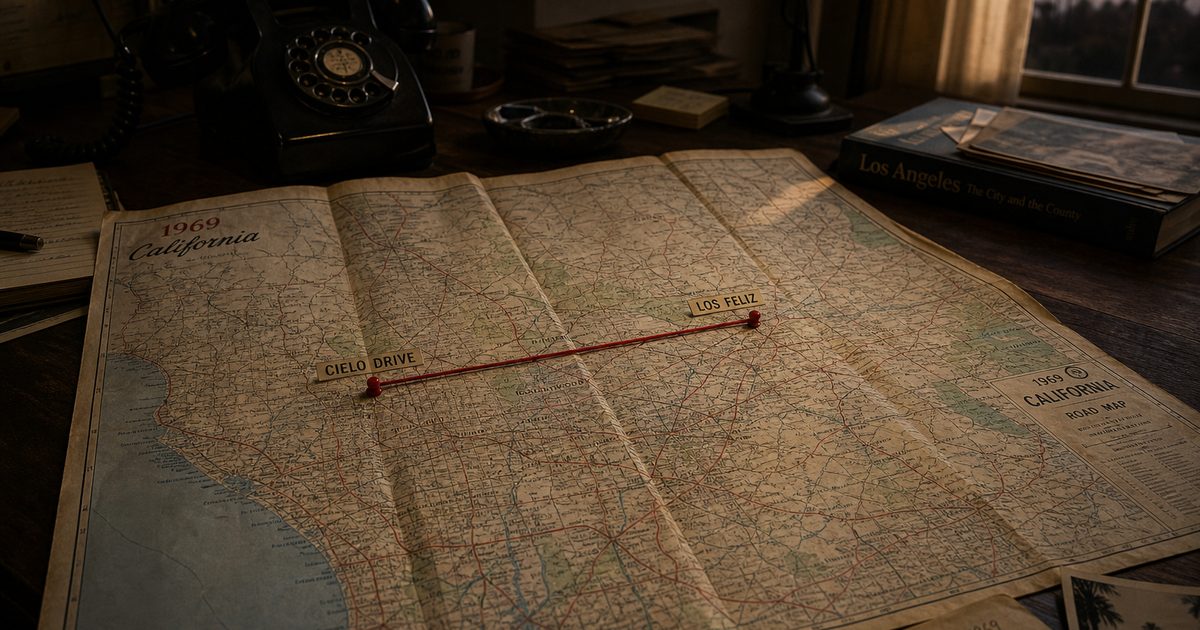
A housekeeper pulled up to 10050 Cielo Drive just after dawn and saw something was wrong before she ever stepped inside. A cut telephone line. Silence. Then the bodies.
By the time Los Angeles woke on August 9, 1969, five people were dead at the Benedict Canyon property. One of them, 18-year-old Steven Parent, was slumped in a car near the gate. Inside the house were actress Sharon Tate, celebrity hairdresser Jay Sebring, Abigail Folger, and Wojciech Frykowski. On the front door, written in blood, was a single word: “PIG.”
Less than twenty-four hours later, the violence happened again. This time it was in Los Feliz, at the home of Leno and Rosemary LaBianca. More blood. More messages on the walls. And, at first, no clear explanation tying the two scenes together.
What became known as the Tate-LaBianca murders did not enter American memory simply because of the brutality. The case endured because the killings seemed to come out of nowhere, because the victims had no real connection to the people who attacked them, and because the story behind the murders was stranger and darker than the city first understood.
The road to Cielo Drive
Before the murders, Charles Manson was a fringe figure drifting around Southern California’s counterculture, a career criminal with musical ambitions and a talent for control. Around him gathered a loose, dependent group of mostly young followers later labeled the Manson Family. They lived communally, used drugs heavily, and moved according to Manson’s demands.
In late July 1969, violence inside that circle had already turned deadly. Musician Gary Hinman was killed after being held captive for days. Bobby Beausoleil was arrested for Hinman’s murder on August 6. That arrest would matter later, because prosecutors argued it helped set the next crimes in motion.
At trial, the state offered more than one motive for what followed. One theory was that Manson wanted new murders committed in a way that might make Hinman’s killing look like part of a wider pattern, potentially helping Beausoleil. Another thread involved the house on Cielo Drive itself. The property had once been rented by record producer Terry Melcher, who had previously shown interest in Manson’s music and then distanced himself. By August, Melcher no longer lived there. The people inside that night were not the targets of any personal feud proven in court.
That is part of what still makes the case so unsettling. The address may have mattered. The people may not have.
On the night of August 8, Manson told Charles “Tex” Watson, Susan Atkins, Patricia Krenwinkel, and Linda Kasabian to go to Cielo Drive and, as trial testimony later put it, destroy everyone there.
The first night at Cielo Drive
The victims inside the house were living ordinary hours before sleep. Sharon Tate was 26 and more than eight months pregnant. Her husband, director Roman Polanski, was away in Europe. With her that night were Sebring, 35; Folger, 25; and Frykowski, 32. Parent, who had been visiting the caretaker in the guest house, was leaving when he encountered the intruders.
He never made it out.
Sometime after midnight, Parent was shot in his car. Watson and the others then entered the property. What followed inside became central to one of the most infamous murder cases in American history, but the horror of that night is best understood in human terms, not lurid ones: people who had gone to bed expecting another summer night in Los Angeles were trapped, terrorized, and killed in their own home.
Tate’s unborn child also died.
When police arrived later that morning, the scene looked chaotic and deliberate at once. There were multiple victims, signs of a frenzied attack, and that blood-written word on the door. But the meaning of it was not yet obvious. Detectives initially explored theories involving drugs and personal disputes. William Garretson, the young man staying in the guest house, was questioned and later released. The city had a massacre, but not a clear story.
That gap mattered. In the first hours, the murders were shocking. In the first days, they were also confusing.
A second attack before the first was understood
The next night, Manson went out with another group: Watson, Atkins, Krenwinkel, Linda Kasabian, Leslie Van Houten, and Steve “Clem” Grogan. This time, according to testimony, Manson selected a house in Los Feliz almost at random after driving through the city.
In the early hours of August 10, 1969, the group entered 3301 Waverly Drive, the home of Leno and Rosemary LaBianca.
Leno LaBianca, 44, was a supermarket executive and business owner. Rosemary LaBianca, 38, ran a clothing boutique. They were not celebrities. They were a married couple at home on a weekend night, which only deepened the fear that spread afterward. If the first murders felt like a nightmare in the Hollywood Hills, the second made it feel as if no neighborhood was safely outside the story.
Evidence later showed that Manson tied up the couple before leaving the house and sending others to carry out the killings. Blood was used again to write messages on walls and surfaces, including “DEATH TO PIGS,” “RISE,” and the misspelled “HEALTER SKELTER” on the refrigerator. “WAR” was carved into Leno LaBianca’s abdomen.
Even after that, investigators did not immediately connect the LaBianca murders to the killings at Cielo Drive.
That failure became one of the most criticized early parts of the investigation. Two murder scenes. Similar staging. Similar blood-written messages. Same city. Same weekend. But the full pattern took time to emerge.
The break did not come from the crime scenes
Police collected physical evidence from both houses, including firearms and knives linked to the attacks. At the Tate scene, investigators found parts from a .22-caliber Hi-Standard revolver associated with Watson. A .22-caliber revolver later recovered in Sherman Oaks was believed to be connected to the murders.
Still, evidence alone did not immediately deliver the whole case.
The breakthrough came from somewhere else entirely: jailhouse talk.
In October 1969, Manson and several followers were arrested at Barker Ranch in Death Valley, initially in connection with vehicle theft and other offenses, not the Tate-LaBianca murders. At that point, authorities still lacked the bridge that could firmly connect the group to the two nights of killing.
That bridge appeared in November. Susan Atkins, jailed on unrelated charges, spoke to fellow inmates about the Tate murders. One of those inmates alerted authorities. Atkins later gave statements, though some of her accounts changed over time. Even so, what she revealed helped investigators begin fitting the pieces together.
By late 1969, the case was moving fast. Watson was arrested in Texas. Patricia Krenwinkel was arrested in Alabama. Leslie Van Houten was arrested in California. Prosecutors now had suspects, cooperating witnesses, and a theory broad enough to explain both crime scenes.
The trial and the theory that defined the case
The murder trial began on June 15, 1970, in Los Angeles Superior Court. Manson, Atkins, Krenwinkel, and Van Houten were tried together. Watson was tried separately after extradition delays. Linda Kasabian, who had gone along on both nights but did not participate in the killings, received immunity in exchange for testifying.
Her testimony was crucial. It gave jurors a witness from inside the group, someone who could describe not just who was present but how Manson directed the others.
Prosecutor Vincent Bugliosi built the case around a motive he called “Helter Skelter,” a phrase taken from the Beatles song. According to the prosecution, Manson believed a race war was coming and thought the murders could help ignite it while shifting blame onto Black people, particularly the Black Panthers. That theory became the public explanation most closely associated with the Manson Family killings.
Not everyone has accepted every part of that motive as the only explanation. Other factors, including Manson’s anger over perceived slights in the music world and the aftermath of the Hinman case, have long been discussed. But in court, the prosecution’s central point was simpler than the mythology that grew around it: Manson directed the murders, and his followers carried them out.
The defendants themselves often turned the courtroom into a spectacle, with outbursts, strange behavior, and efforts to show loyalty to Manson. But for the victims’ families, the case was not theater. It was a long, punishing process of hearing the final hours of their loved ones reconstructed in public.
Verdicts, sentences, and what came after
On January 25, 1971, Charles Manson, Susan Atkins, Patricia Krenwinkel, and Leslie Van Houten were found guilty of first-degree murder and conspiracy to commit murder. On March 29, they were sentenced to death.
Watson was convicted in a separate trial in October 1971 and also sentenced to death.
Those sentences were later reduced. In 1972, after the California Supreme Court temporarily struck down the state’s death penalty, the death sentences in the Tate-LaBianca case were commuted to life imprisonment.
The aftermath stretched on for decades. Sharon Tate’s mother, Doris Tate, became a prominent advocate for victims’ rights and a regular presence at parole hearings. Manson died in prison in 2017. Susan Atkins died in prison in 2009. Watson and Krenwinkel remain incarcerated. Leslie Van Houten was released on parole in 2023 after years of legal battles over her suitability for release. Linda Kasabian, whose testimony helped convict the others, died in 2023.
Why the Tate-LaBianca murders still hold their grip
Plenty of murder cases are famous for a while and then recede. This one never really did.
Part of that is because the Manson murders struck at a particular illusion in Los Angeles: that wealth, fame, or a hillside address could keep chaos outside the gate. Part of it is because the victims seemed so unconnected to the people who killed them. And part of it is because the case quickly grew larger than the facts, wrapped in headlines, myth, and endless retellings.
But stripped of all that, the core remains stark. Over two nights in August 1969, seven people were murdered in two homes by members of a group acting under Charles Manson’s direction. The investigation stumbled before it came together. The trial exposed how control, fear, and ideology inside that group had turned into murder.
That is why the Tate-LaBianca murders still feel so disturbing. Not because of the legend that followed, but because the truth was already terrible enough.
FAQ
Who were the victims of the Tate-LaBianca murders?
The victims were Steven Parent, Sharon Tate, Jay Sebring, Abigail Folger, Wojciech Frykowski, Leno LaBianca, and Rosemary LaBianca. Tate was pregnant, and her unborn son also died.
Did Charles Manson personally kill anyone at Cielo Drive or the LaBianca house?
He was convicted of orchestrating the murders, but it was not proven at trial that he personally killed any of the victims in the Tate-LaBianca murders.
What was the Manson Family?
The Manson Family was a cult-like group led by Charles Manson in California in the late 1960s. Members lived communally and followed Manson’s control, which prosecutors said led directly to the killings.
What did “Helter Skelter” mean in the case?
At trial, prosecutors said Manson believed the murders would help trigger an apocalyptic race war. That theory, called “Helter Skelter,” became the prosecution’s main explanation for motive.
Were the two crime scenes linked right away?
No. Despite similarities between the killings, investigators did not immediately connect the murders at Cielo Drive and the LaBianca home.