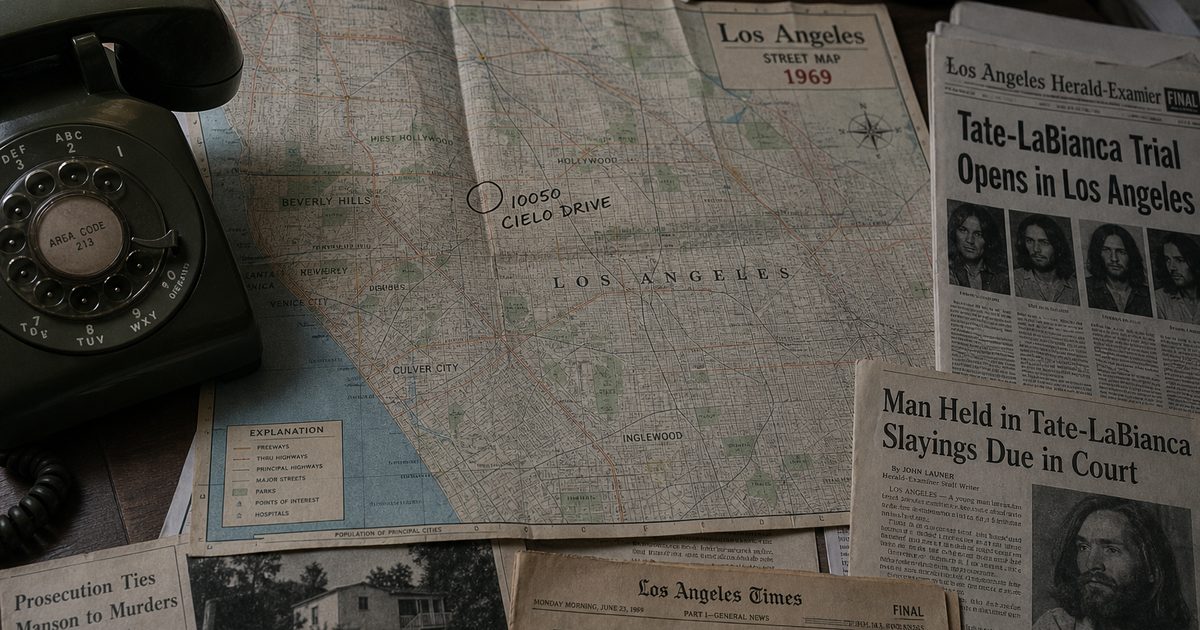
A housekeeper arrived at 10050 Cielo Drive and saw something no one could mistake for an ordinary morning. A body lay near a car. Inside the hillside home, more were waiting. On the front door, written in blood, was a single word: “PIG.”
By the time the sun rose over Benedict Canyon on August 9, 1969, five people were dead. Actress Sharon Tate, eight and a half months pregnant. Celebrity hairstylist Jay Sebring. Wojciech Frykowski, a writer and friend of Tate’s husband Roman Polanski. Abigail Folger, heir to the Folger coffee fortune. And outside, 18-year-old Steven Parent, who had simply stopped by to visit the property’s caretaker before heading home.
The killings at Cielo Drive would become one of the most notorious murder cases in American history. Not just because the victims were young, famous, or well connected. It was the randomness of it, the sense that a quiet home high above Los Angeles had been turned, in a few terrible hours, into a message.
A house with the wrong people in it
The story did not begin with Sharon Tate.
Months earlier, on March 23, 1969, Charles Manson came to the property looking for music producer Terry Melcher, who had once lived there. Melcher was gone by then. Tate and Polanski were renting the house instead. That detail would later loom large, because investigators and prosecutors examined whether the address itself had been chosen for reasons tied to Melcher, though motive in the case has never rested on one explanation alone.
On the night of August 8, Tate was at home with friends while Polanski was away in Europe. Also at the house were Sebring, Frykowski, and Folger. In the guest house, caretaker William Garretson was on the property as well. Steven Parent had visited Garretson and was leaving in his car after midnight.
Around that same time, four Manson followers were driving toward Benedict Canyon: Charles “Tex” Watson, Susan Atkins, Patricia Krenwinkel, and Linda Kasabian.
According to the prosecution’s case, Manson had told them to go to the house and kill everyone there.
The first victim outside the gate
Parent never made it down the hill.
As he sat in his car near the property, Watson confronted him. Parent was shot and killed. He was just 18, a teenager who had nothing to do with the people inside the main house and no connection to the group that had come there.
Then the intruders moved toward the residence.
Kasabian remained outside, acting as lookout. Watson, Atkins, and Krenwinkel went in.
What happened next was established through physical evidence, witness testimony, and later statements, though not every movement inside the house can be reconstructed with perfect certainty. What is clear is that the attack was fast, chaotic, and overwhelming. Tate, Sebring, Frykowski, and Folger were all murdered. Sebring was shot and stabbed. The others were stabbed repeatedly. Rope was found around Tate and Sebring, draped over a ceiling beam, evidence of how the victims had been controlled before the killings escalated.
On the front door, “PIG” was written in blood.
That word mattered. It suggested the murders were meant to do more than kill. They were staged to frighten, confuse, and send a signal.
A crime scene that pointed everywhere and nowhere
When police arrived on the morning of August 9, the scene was so bizarre and so violent that it did not immediately lead them to the right suspects.
Garretson, in the guest house, had heard and understood nothing clearly enough in the night to grasp what had happened. He was initially treated with suspicion before being cleared. Detectives also explored whether the killings were tied to drugs or personal disputes. In the first days, the investigation drifted through possibilities that turned out to be wrong.
That same confusion followed another crucial failure. The Tate murders were not immediately linked to the LaBianca murders, committed the following night on August 10, 1969, by Manson Family members in Los Feliz. In hindsight, the cases were connected by method, by message, and by the people involved. At the time, that connection was missed.
The delay gave the case an even stranger shape. Five people had been killed in a home invasion, yet the victims did not appear to have known their attackers. There was no clean personal motive at the scene. No obvious reason this house, these people, this night.
The break came from inside the Family
The path back to Cielo Drive opened months later, and not through brilliant detective instinct.
In October 1969, members of the Manson Family were arrested at Barker Ranch in Death Valley during an investigation involving stolen vehicles. That did not solve the Tate murders on its own, but it brought law enforcement closer to the group.
The real break came in jail.
In November and December 1969, Susan Atkins made incriminating statements while in custody, including remarks to fellow inmates about the Tate killings. Those statements became a major turning point, though some details Atkins gave over time were inconsistent and not every claim she made was accepted at face value. Even so, investigators now had a route into the case they had lacked before.
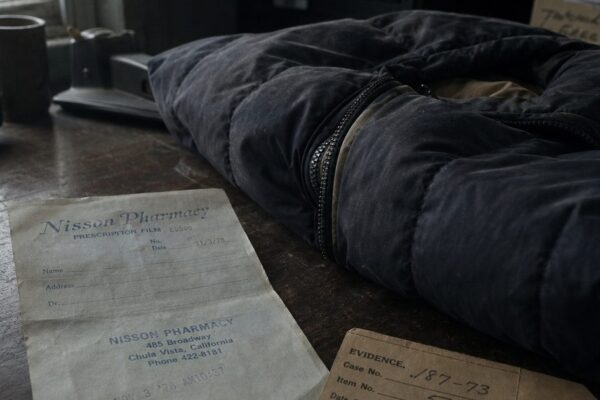
Arrests followed quickly. Watson was arrested in Texas on November 30, 1969. Krenwinkel was arrested in Mobile, Alabama, on December 1. Kasabian was arrested in New Hampshire on December 2. Physical evidence also helped tighten the case: Krenwinkel’s fingerprint was found at the Tate residence.
Then came the witness prosecutors needed most.
Kasabian, who had remained outside during the killings, was granted immunity in exchange for testimony. Her account helped jurors understand how the group traveled to the house, who entered, and how the night unfolded.
Charles Manson and the case prosecutors built
Manson was not at Cielo Drive during the murders. That point has always mattered. He did not personally enter the house or stab the victims there.
But prosecutors argued that he had ordered the attack and shaped the thinking that made it possible.
The state’s theory, presented by prosecutor Vincent Bugliosi, was that Manson was trying to trigger a race war he called “Helter Skelter.” That became the best-known explanation for the killings, though it was not the only motive discussed. Investigators also looked at whether the house had been targeted because of Melcher, and whether the murders were intended in part to resemble the earlier killing of Gary Hinman and help Bobby Beausoleil by diverting suspicion. Those ideas remain part of the case history, but the convictions rested on participation and conspiracy, not on proving a single pure motive beyond debate.
That distinction matters in a case so often swallowed by myth.
The Tate-LaBianca trial
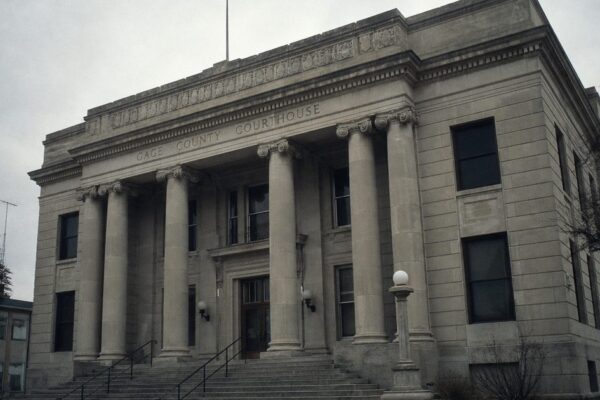
The trial began on June 15, 1970, in Los Angeles Superior Court. Manson was tried alongside Susan Atkins, Patricia Krenwinkel, and Leslie Van Houten, whose charges related to the LaBianca murders. Watson was tried separately after extradition proceedings delayed his case.
The courtroom quickly became a spectacle, but beneath that spectacle the prosecution kept returning to evidence. Kasabian’s testimony. Atkins’ jailhouse admissions. Fingerprints. The sequence of events across two nights of murder.
The defendants tried to seize attention in other ways. They disrupted proceedings, shaved their heads, and marked their foreheads with an “X.” Those images helped define public memory of the trial, but they did not change where the case was heading.
On January 25, 1971, the jury found Manson, Atkins, Krenwinkel, and Van Houten guilty of first-degree murder and conspiracy. On March 29, the jury returned death verdicts. Judge Charles H. Older formally imposed sentence on April 19, 1971.
Watson’s separate trial ended with his conviction on October 21, 1971, for seven counts of first-degree murder. He, too, received a death sentence.
None of those death sentences stood. On February 18, 1972, the California Supreme Court’s decision in People v. Anderson invalidated the state’s death penalty as it then existed, and the sentences were commuted to life imprisonment.
What the murders left behind
The legal case eventually closed. The damage did not.
For the families, the killings were not a cultural symbol or a courtroom drama. They were a permanent loss. Sharon Tate’s mother, Doris Tate, later became a prominent victims’ rights advocate and helped push for stronger rights for crime victims in California parole proceedings.
The convicted killers spent decades in prison. Susan Atkins died in custody in 2009. Charles Manson died in prison in 2017. Watson and Krenwinkel have remained incarcerated, with parole repeatedly denied. Leslie Van Houten was released on parole in 2023 after years of legal battles over her suitability for release.
The house itself did not survive as a landmark. The original Cielo Drive residence was demolished in the 1990s, and the address was changed. But the place remains fixed in the American imagination because of what happened there in a few hours before dawn.
The Tate murders still draw attention because they seem to sit at the intersection of celebrity, cult violence, and random terror. Yet the center of the story is simpler than the mythology built around it. Five people were killed in a home they believed was safe. One of them was a teenager leaving a visit. Another was about to become a mother.
That is what made the crime endure. Not the slogans. Not the folklore. The human fact of it.
FAQ
How many people were killed at Cielo Drive?
Five people were murdered at 10050 Cielo Drive on August 9, 1969: Sharon Tate, Jay Sebring, Wojciech Frykowski, Abigail Folger, and Steven Parent.
Was Sharon Tate pregnant when she was killed?
Yes. Sharon Tate was about eight and a half months pregnant at the time of her murder.
Who carried out the Tate murders?
According to the evidence presented at trial, Tex Watson, Susan Atkins, and Patricia Krenwinkel entered the property and took part in the killings, while Linda Kasabian acted as a lookout and later testified for the prosecution.
Was Charles Manson at the house that night?
No. Charles Manson was not physically present during the Cielo Drive murders. Prosecutors argued, and juries accepted, that he ordered the attack.
What was the motive for the Tate murders?
The prosecution’s main theory was Manson’s “Helter Skelter” plan to incite a race war. Other possible motives, including the house’s past connection to Terry Melcher, have also been discussed, but no single motive explains every part of the crime.