A mother and her small daughter were walking along South Norton Avenue when the child noticed something pale in the vacant lot.
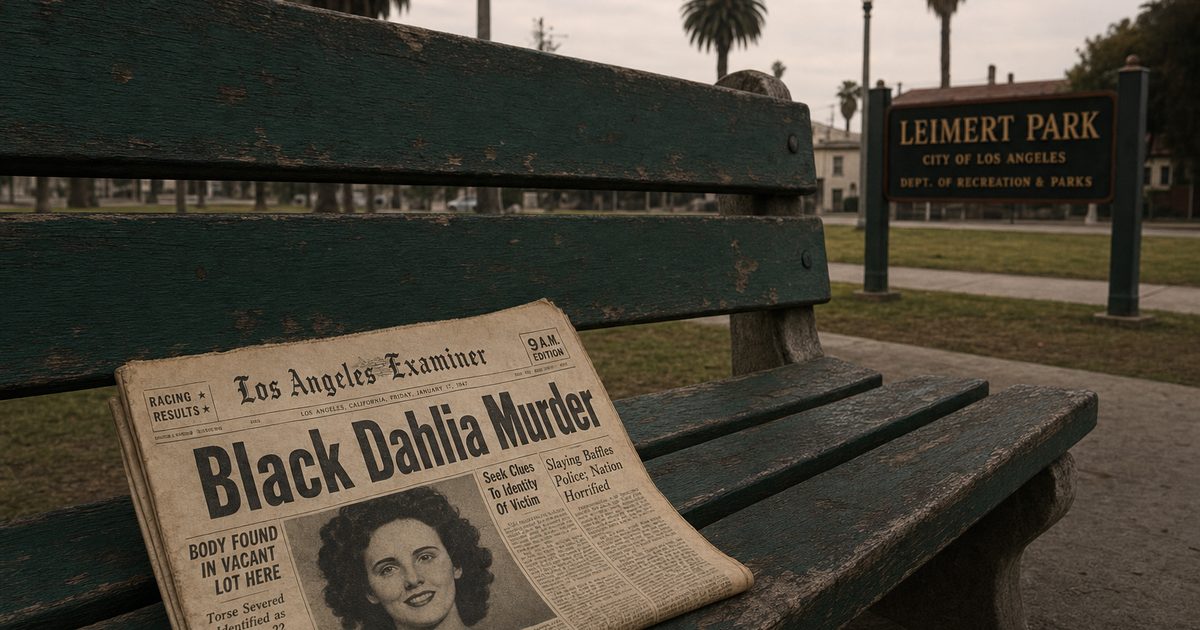
It was the morning of January 15, 1947, in Los Angeles. From a distance, the figure in the grass looked artificial, almost staged, like a store dummy someone had thrown away. When Betty Bersinger got closer, she saw the truth. The body belonged to 22-year-old Elizabeth Short.
By the end of the day, police had a homicide case. Within days, the newspapers had something else: a nickname. They called her the Black Dahlia, and that label would cling to the case so tightly that it nearly swallowed the woman at its center.
The last confirmed hours of Elizabeth Short
Before she became a headline, Elizabeth Short was a young woman moving through California with no real stability and no clear protection around her.
She was born on July 29, 1924, in Boston. In the years before her death, she spent time in Florida, Massachusetts, and California. She had worked different jobs, including waitressing, and had talked about breaking into movies. Like many young women in Los Angeles after the war, she was trying to build a life in a city that sold glamour more easily than it gave it.
Some of the details later used to identify her came from ordinary encounters with bureaucracy. In January 1943, she applied for work at Camp Cooke, and her fingerprints were taken. In July of that year, Santa Barbara police arrested her for underage drinking; again, fingerprints were recorded. Those routine records would become crucial after her death.
Her final known movements are clearer in outline than in feeling. On January 9, 1947, Robert “Red” Manley, a married salesman who had been spending time with her, drove her to the Biltmore Hotel in downtown Los Angeles. That is the last widely accepted confirmed sighting of Elizabeth Short alive.
What happened after she stepped away from Manley’s car has never been proved.
A body left where it would be seen
The killer did not leave Elizabeth Short where she was murdered.
Investigators quickly concluded that the vacant lot in Leimert Park was a dump site, not the place of death. There was no significant blood at the scene. Her body had been washed and carefully positioned. It had also been severed at the waist, a detail that immediately suggested knowledge of anatomy or postmortem handling, though police never proved that the killer was a doctor, surgeon, or mortician.
The injuries were severe, and the case became notorious partly because of them. But the more important fact, from an investigative standpoint, was the deliberateness. Whoever placed her there wanted the body found. Wanted the shock. Wanted the discovery to become part of the crime.
On January 16, Los Angeles County coroner Frederick Newbarr performed the autopsy. Authorities identified her through fingerprints, using FBI records and Soundphoto technology to transmit prints quickly. For a brief moment, it looked as if modern police work might get ahead of the chaos.
It did not.
How the press helped create the Black Dahlia legend
Los Angeles in the late 1940s was already a city fascinated by crime, scandal, and image. Elizabeth Short’s murder landed in that atmosphere like a match in dry brush.
Reporters raced one another for details. They contacted her family. In some accounts, her mother was misled by journalists eager to secure an exclusive before the full truth was even delivered with care. The city learned her name almost at once, but it learned the nickname even faster.
“Black Dahlia” was likely a newspaper invention inspired by the film The Blue Dahlia and by reports that Short liked dark clothing. Whether she ever embraced that image herself mattered less than the fact that the press did. The nickname was dramatic, marketable, and impossible to forget.
That mattered because the coverage did more than describe the case. It shaped it. The murder became public theater while detectives were still trying to establish the basic facts.
The first suspects, and the first dead ends
Ten days after the body was found, the investigation already had too much noise.
On January 19, 1947, police arrested Robert Manley, the last known person confirmed to have seen her alive. It was an obvious lead, and for a moment it looked significant. But suspicion is not proof. Manley was questioned extensively, reportedly took and passed polygraph examinations, and was released. No charges followed.
He was only the beginning.
The LAPD investigated well over a hundred people. Dozens of confessions came in, many from people who plainly had nothing to do with the crime. False confessors are a familiar problem in notorious cases, but in the Black Dahlia murder they were especially damaging. Every new claim pulled attention, time, and manpower away from evidence that was already thin.
The crime scene had also been compromised. Curious onlookers and members of the press moved through the area. In a case where the body had been transported and placed, that contamination made a hard investigation even harder.
Police even looked into whether the injuries suggested medical training. A search warrant was served at the University of Southern California medical school. It produced nothing that solved the case.
The killer, or someone close to the killer, reaches out
Then the case took a darker turn.
On January 24, 1947, an envelope addressed to the Los Angeles Examiner was received containing Elizabeth Short’s personal effects, including an address book and other belongings. The items had reportedly been cleaned with gasoline, apparently to remove fingerprints. There was also a message assembled from clipped words.
That mailing changed the tone of the investigation. It suggested that whoever sent it had direct access to her possessions after her death. Whether the sender was the killer or someone trying to insert themselves into the case, the effect was the same: more fear, more publicity, more uncertainty.
The next day, according to reports from the time, Short’s purse and one of her shoes were found in a trash receptacle some distance away.
Each development seemed to confirm one thing. This was not a spontaneous killing followed by panic. There had been time after the murder. Time to move the body. Time to clean it. Time to sort through her belongings. Time to write.
Why the case never narrowed
The list of names attached to the Elizabeth Short case is long, but long lists can create the illusion of progress where there was very little.
Mark Hansen, a nightclub owner who knew Short, drew police attention. So did Leslie Dillon, a former mortician’s assistant whose background made him seem plausible to some investigators. Dillon later became central to one of the case’s many internal disputes, with arguments over whether police had focused too heavily on him without enough evidence.
Then there was Dr. George Hodel, the suspect most often named in later retellings. Hodel came under scrutiny in the late 1940s and early 1950s, especially after separate allegations involving his daughter led police to investigate him. A wiretap placed on his home captured ambiguous statements that have been debated ever since. Decades later, his son, former LAPD detective Steve Hodel, publicly argued that George Hodel was responsible for the killing.
It is an influential theory. It is not the same thing as a solved case.
Other claims followed over the years: accusations of police corruption, rumors of cover-ups, assertions from people who believed a relative had confessed, and theories linking the killing to other unsolved murders in California and beyond. Some investigators suspected a connection to the February 10, 1947 murder of Jeanne French, later dubbed the “Lipstick Murder.” But suspicion never matured into proof.
That is the pattern that defines the Black Dahlia case. Theories multiplied. Evidence did not.
The woman behind the myth
One reason this murder still grips people is that it sits at the crossroads of several American obsessions: Hollywood, postwar Los Angeles, tabloid crime, and the fantasy that one final clue can still unlock everything.
But the mythology has often obscured the person.
Elizabeth Short was not a noir character written for effect. She was a real young woman whose life ended violently and whose death was turned into a spectacle almost immediately. The nickname made her famous, but it also flattened her. It encouraged generations of retellings to focus on style, rumor, and suspect lore while the victim herself receded into the background.
That imbalance began in January 1947 and never really stopped.
A grand jury later reviewed aspects of police handling of unsolved murders and did not establish misconduct in the way some had alleged. Even so, doubts about missed opportunities and internal failures lingered. The file remained open. No one was ever brought to trial for her murder.
And so the central fact has never changed: the Black Dahlia story is famous not because it was solved, but because it wasn’t.
Why the Black Dahlia murder still remains open
There are unsolved cases that fade because the trail goes cold quietly. This one did the opposite. It grew louder with time.
Books, films, amateur investigations, and competing suspect theories kept pulling it back into public view. James Ellroy’s The Black Dahlia introduced the crime to a new generation through fiction. Later nonfiction works, especially those arguing for George Hodel, revived debate again. Yet none of that changed the official record.
No charges. No conviction. No final answer to who killed Elizabeth Short.
What remains are the fixed points: she was last seen alive on January 9, 1947, at the Biltmore Hotel; her body was found on January 15 in Leimert Park; her belongings were mailed to a newspaper on January 24; and despite one of the most famous investigations in Los Angeles history, the murder was never solved.
That is the truth beneath the legend.
FAQ
Who was Elizabeth Short?
Elizabeth Short was a 22-year-old woman from Massachusetts whose body was found in Los Angeles on January 15, 1947. After her death, newspapers nicknamed her the Black Dahlia.
Why was she called the Black Dahlia?
The name appears to have been created by the press, likely echoing the film The Blue Dahlia and reports that she often wore black.
Was the Black Dahlia murder ever solved?
No. The murder of Elizabeth Short remains officially unsolved.
Who found Elizabeth Short’s body?
Betty Bersinger discovered the body while walking with her young daughter in Leimert Park on the morning of January 15, 1947.
Who were the main suspects in the Black Dahlia case?
Among the best-known suspects were Robert “Red” Manley, Mark Hansen, Leslie Dillon, and Dr. George Hodel. None were charged with the murder.