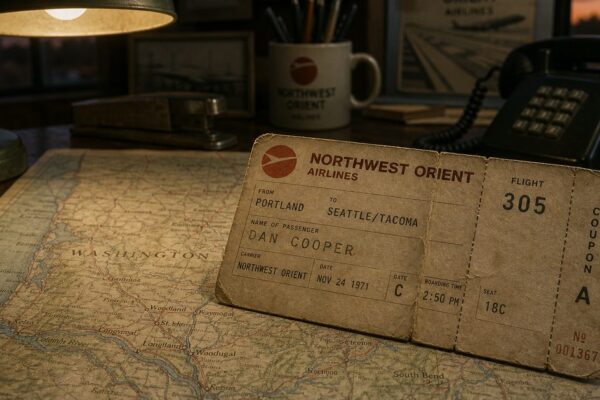

A flight attendant first thought he was flirting.
The man in the dark suit had taken seat 18C on Northwest Orient Flight 305, a short hop from Portland to Seattle on the afternoon of November 24, 1971. He ordered a bourbon and soda. He wore a black clip-on tie and carried a briefcase. Nothing about him stood out in an age when a person could buy a plane ticket with cash, walk to the gate, and board without showing identification.
Then he handed Florence Schaffner a note.
At first, she slipped it into her purse, assuming it was a phone number from another businessman. He leaned toward her and spoke quietly: she should read it. He had a bomb.
That was how the D.B. Cooper hijacking began: not with shouting or panic, but with a few calm words at cruising altitude.
The note on Flight 305
Northwest Orient Flight 305 took off from Portland at 2:50 p.m. with 36 passengers and six crew members on board. In the cockpit were Captain William A. Scott, First Officer William Rataczak, and Flight Engineer Harold E. Anderson. In the cabin were Schaffner, Tina Mucklow, and Alice Hancock.
After Schaffner read the note, the hijacker showed her what was inside the briefcase. She later said she saw red cylinders, wires, and a battery. Whether it was a working bomb was never proved, but in that moment the threat was real enough. Schaffner relayed his demands. He wanted $200,000 in cash, four parachutes, and a fuel truck waiting in Seattle.
The man gave his name as Dan Cooper.
From there, the flight changed shape. The crew had to keep the cabin steady while messages moved between the plane, the airline, and federal authorities. Passengers were largely unaware that the quiet man in sunglasses near the back had turned an ordinary afternoon flight into a hostage situation.
Seattle: ransom on the tarmac
By the time Flight 305 landed at Seattle-Tacoma Airport at 5:39 p.m., the money and parachutes were ready.
The exchange was tense but controlled. Cooper released the passengers. He also let Schaffner go. That left Tina Mucklow in the cabin with him, along with the three-man cockpit crew. The hijacker took the ransom money, 10,000 twenty-dollar bills, their serial numbers recorded by investigators, and kept the plane.
That choice is part of what still makes the Northwest Orient Flight 305 case feel so strange. He had what he asked for. He could have disappeared at the airport. Instead, he ordered the crew back into the air.
His instructions were specific: fly toward Mexico, keep the plane low, keep it slow, and leave the rear airstair accessible. There would be one refueling stop along the way. The aircraft, a Boeing 727, had a feature that mattered enormously that night, stairs at the back that could be lowered in flight.
At 7:40 p.m., the plane took off again into the dark.
The jump into black air
Rain moved across the Pacific Northwest. The air was cold. Below the plane lay rough country: forest, river, and broken terrain in southwestern Washington.
At some point after takeoff, Cooper told Mucklow to join the cockpit and close the door. She was the last person known to have seen him.
At about 8:13 p.m., the crew felt a sudden upward movement from the tail section, enough to suggest the aft stairs had been deployed and someone had gone out. The plane continued on. Fighter jets had been scrambled to follow, but in the darkness and weather they never saw a jump.
When Flight 305 landed in Reno, Nevada, at 10:15 p.m., the rear stairs were down. Cooper was gone.
So were two parachutes and the ransom money.
That was the last confirmed moment in the story of the man the public came to know as D.B. Cooper, though that was not the name he used. “D.B.” came from an early reporting error, and it stuck so completely that the mistake became history.
What he left behind
For someone who vanished so thoroughly, he left behind a surprising trail.
Investigators recovered a black clip-on J.C. Penney tie from his seat, along with a tie clip. They also collected fingerprints from the plane. Several cigarette butts were reportedly recovered as well, though those were later lost, a frustrating break in a case already full of them.
The tie became one of the most discussed pieces of evidence in the Dan Cooper case. Decades later, researchers examining it reported tiny particles on the fabric, including metallic traces that suggested contact with an industrial environment. Those findings fueled theories, but not certainty. They did not identify the hijacker, and they did not prove where he worked.
Another clue turned up in the woods: a placard with instructions for operating the 727’s aft stairs was found near Castle Rock, Washington. It seemed to connect the mystery to the jump itself, though it still did not answer the central question, whether he survived.
That question has always divided the case.
The conditions were brutal. It was night. He jumped into bad weather over unfamiliar ground wearing business clothes and loafers, carrying a bag of cash. Some investigators believed no experienced parachutist would have chosen that equipment or that terrain. Others argued that his demands and his use of the 727’s rear stairs suggested he knew more than he let on.
What can be said with confidence is narrower: he planned enough to ask for parachutes, enough to control the flight, and enough to leave the aircraft in midair.
The riverbank clue that changed nothing, and everything
Nearly a decade later, the mystery stirred again because of a child digging in the sand.
On February 10, 1980, eight-year-old Brian Ingram was with his family on Tena Bar, along the Columbia River near Vancouver, Washington, when he found bundles of decaying cash buried in the sand. The total was $5,800. The bills were twenties. Their serial numbers matched the ransom money from Flight 305.
It was the first major physical link between the hijacking and the world below the flight path.
And yet it solved almost nothing.
The money proved that at least some of the ransom had not stayed with Cooper forever. But how it reached Tena Bar, whether by water, burial, or some other route, remained unclear. It did not show where he landed. It did not show whether he died in the jump or lived long enough to lose, hide, or discard part of the money.
The discovery widened the mystery instead of closing it.
Suspects, theories, and dead ends
Over the years, the FBI examined hundreds of suspects. Some became famous in their own right, at least in true-crime circles.
Richard Floyd McCoy Jr. drew attention because he carried out a similar skyjacking months later. But investigators did not conclude he was the man from Flight 305. Kenneth Christiansen, a former Northwest employee and paratrooper, was also widely discussed and not identified by the FBI as the hijacker. Other names, including Robert Rackstraw and Lynn Doyle Cooper, kept resurfacing in books, documentaries, and amateur investigations.
None was ever proved to be the man who called himself Dan Cooper.
That distinction matters. The D.B. Cooper suspect lists that circulate online can make the case sound closer to solved than it is. It is not. No suspect was ever charged as the hijacker. No body was ever found. No confirmed trace of Cooper himself turned up after the jump.
Why the case never faded
Part of the grip of the D.B. Cooper mystery lies in its timing. The hijacking happened during a period when airport security was loose and skyjackings were far more common than they are now. The crime exposed just how vulnerable commercial air travel could be.
It also helped change that world. In the years that followed, airlines and airports tightened procedures. Passenger screening became more serious. Cash ticket purchases drew more scrutiny. Boeing 727s were eventually fitted with a device nicknamed the “Cooper vane,” designed to prevent the rear stairs from being lowered in flight.
But the hold of the case is not just about aviation history. It is about the shape of the story itself.
No passengers were physically injured, but the crew lived through a bomb threat and a long, controlled ordeal in the air. Then the hijacker stepped out into darkness and left everyone else behind with the fear, the evidence, and the questions.
The FBI named its investigation NORJAK, for Northwest Hijacking, and kept it open for decades. On July 8, 2016, the bureau announced it was closing its active investigation, though it said it would consider credible new physical evidence if any emerged.
So the file was set aside, but the case was not finished. Not really.
A man boarded a flight in Portland under the name Dan Cooper. Somewhere between Seattle and Reno, he disappeared into the night with $200,000. Everything after that is fragments: a tie on a seat, money in river sand, and a name that was never quite right.
FAQ
Who was D.B. Cooper?
“D.B. Cooper” is the name attached to the unidentified man who hijacked Northwest Orient Flight 305 on November 24, 1971. He actually used the alias Dan Cooper.
What happened on Flight 305?
After takeoff from Portland, the hijacker told the crew he had a bomb and demanded $200,000 and four parachutes. In Seattle, the passengers were released. He then ordered the plane back into the air and later jumped from the rear stairs.
Was any of the ransom money ever found?
Yes. On February 10, 1980, Brian Ingram found $5,800 in ransom money at Tena Bar near Vancouver, Washington. The serial numbers matched the bills given to the hijacker.
Did D.B. Cooper survive?
No one knows. He jumped at night in poor weather over rough terrain, and no confirmed trace of him was found afterward.
Is the D.B. Cooper case still open?
The FBI closed its active investigation on July 8, 2016. The bureau has said it may review credible new physical evidence if it appears.