At seven o’clock on the morning of June 10, 1912, Mary Peckham noticed what was missing.
In Villisca, Iowa, a town built on routine, the Moore home should have been awake. There should have been movement in the kitchen, children stirring, a door opening onto the day. Instead there was silence.
Peckham knocked. No answer.
She tried again, then grew uneasy enough to contact Ross Moore, brother of Josiah Moore. When he arrived with a key and let himself in, he stepped into one of the most haunting crime scenes in American history. Before the morning was over, the town knew that eight people inside the house had been killed.
The case would become known as the Villisca Axe Murders. More than a century later, the Moore family murders still sit in that unsettling category of crimes that seem both intimate and impossible to explain: a family home, a church night, children asleep upstairs, and then a slaughter no one could solve.
A normal Sunday night
The evening before had given no warning.
On June 9, the Moore family attended a Children’s Day program at the Presbyterian church. Sarah Moore had helped organize it. She and her husband, Josiah B. Moore, returned home with their four children: Herman, 11; Mary Katherine, 10; Arthur, 7; and Paul, 5. With them came two sisters, Lena Stillinger, 12, and Ina Stillinger, 8, who were spending the night after the event.
The program ended around 9:30 p.m. Witnesses placed the group walking home shortly afterward, reaching the house sometime between about 9:45 and 10:00 p.m.
That timeline matters because it is one of the few solid edges in the story. The family was seen alive. They went home. They settled in for the night.
By sunrise, all eight were dead.
What was found inside the Moore house
After Ross Moore entered, the alarm spread quickly. City Marshal Hank Horton came to the house and searched room by room.
The victims were found in their beds. Josiah and Sarah Moore were in their downstairs bedroom. The four Moore children were upstairs. Lena and Ina Stillinger were in the downstairs guest room. All had been killed with an axe.
Investigators believed most of the victims were attacked while asleep. Lena Stillinger may have been awake or roused during the assault; reports from the case note signs that suggested movement and a possible defensive injury. As with much in this investigation, some details were recorded imperfectly and later repeated with varying certainty, but the broad picture was clear from the start: the killer moved through the house methodically.
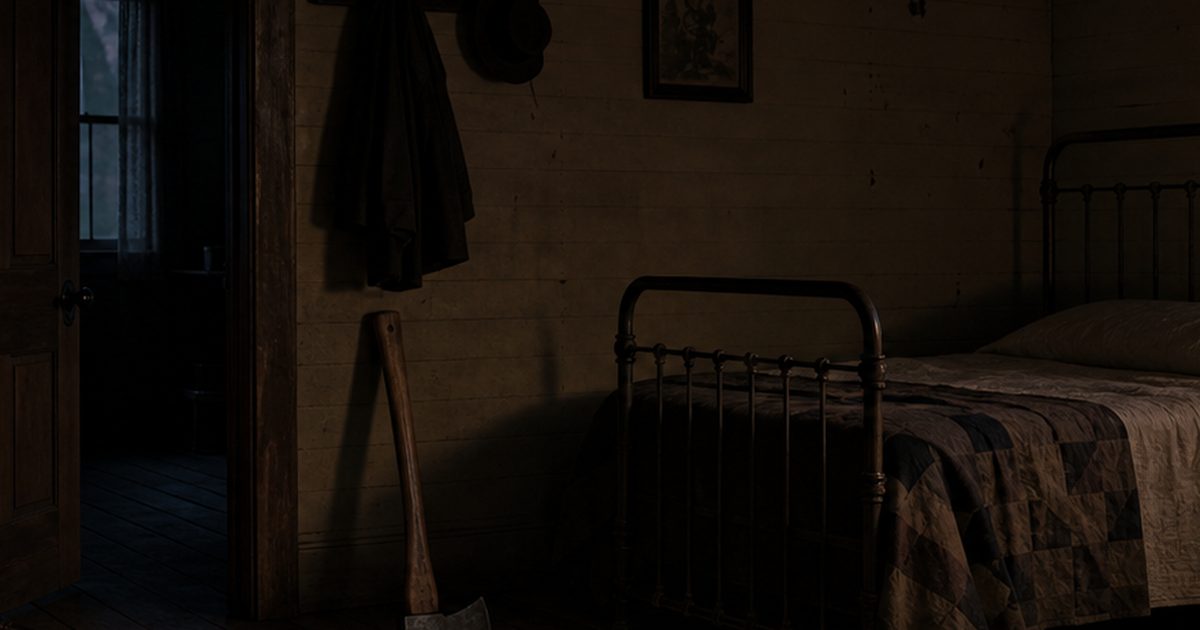
The murder weapon, believed to be Josiah Moore’s own axe, was found in the guest room.
Then there were the details that gave the crime its lasting chill.
Mirrors in the house had been covered. Curtains were drawn. Clothing had been used to block some windows. In the kitchen, investigators found a plate of uneaten food and a bowl or pan of bloody water. A slab of bacon had been taken from the icebox and left near the axe. In the attic, two spent cigarettes were reportedly found. In Josiah and Sarah’s bedroom, there was a gouge in the ceiling, apparently made by the axe.
Those details have fueled decades of speculation. Some investigators believed the killer may have hidden in the house, possibly in the attic, before the family returned from church. That has never been proved, but it remains one of the most discussed theories because it fits the terrible logic of the scene: no sign of a struggle at the front door, no warning, no escape.
The investigation went wrong almost at once
If the killer left a trail, Villisca lost much of it before the day was over.
News spread fast, and so did people. Neighbors, townspeople, and the merely curious came through the house. In an era before modern crime-scene control, the home was not sealed in any meaningful way. Items were touched. The scene was disturbed. Later accounts said even the axe was handled.
That mattered enormously. The Villisca axe murders were always going to be difficult to solve, but the early confusion made it worse. Physical evidence was compromised. Notes were incomplete. Fingerprint evidence, still a developing tool in American investigations at the time, did not produce a clear answer here.
From that point on, the case became a tangle of rumor, local grudges, shifting theories, and suspects who could not be tied firmly enough to the crime.
Reverend George Kelly and the confession that did not hold
The most famous suspect was Reverend George Kelly, an itinerant preacher whose behavior drew attention during the investigation.
Kelly had been in Villisca around the time of the murders. He was known to be unstable, and he later sent bizarre letters that increased suspicion around him. In 1917, five years after the killings, he was arrested.
At one point he confessed.
But the confession did not settle the case. Kelly later recanted, and the circumstances around the statement raised serious questions. He had been interrogated for long periods, and his account contained inconsistencies. He was tried twice in 1917. The first trial ended with a hung jury. At the second, he was acquitted.
That left Villisca where it had started: with a suspect many people found plausible, but not enough proof to convict.
Other suspects, and the problem with theory
Other names drifted through the case, some because of local politics, some because of personal grudges, and some because investigators thought the murders might be linked to similar crimes elsewhere.
One of those names was Frank F. Jones, a prominent Villisca businessman and state senator who had once employed Josiah Moore. Over time, stories circulated about bad blood between the two men and even an alleged affair involving Moore and Jones’s daughter-in-law. Those claims helped keep Jones in the story, but they were never proved, and no evidence established him as the killer or as someone who arranged the crime.
Another suspect was William Mansfield, sometimes linked by private investigator William J. Burns to a string of axe killings in several states. Burns suggested Mansfield might have committed the Villisca murders for hire. But a grand jury did not indict Mansfield in connection with the case, and he had an alibi placing him in Illinois at the time.
Then there was Henry Lee Moore, unrelated to the Moore family despite the name. He was later convicted of killing his mother and grandmother with an axe, and some investigators wondered whether he could be responsible for other unsolved axe murders, including Villisca. That theory, too, remained just that-a theory.
The problem with the Villisca case has always been the same. There are suspects. There are motives people have argued over for decades. There are eerie similarities to other crimes. But none of it closes the gap between suspicion and proof.
Why the Villisca Axe Murders never faded
Some unsolved cases remain alive because the victim was famous or the investigation was corrupt or the mystery seems almost theatrical. Villisca endured for a simpler, sadder reason.
It was a family.
Josiah and Sarah Moore were not passing strangers. Their children were not nameless victims in a newspaper column. Two young guests had been welcomed into the house after church and never went home. The scale of the loss hit hard even in a country that was then more accustomed to death than modern America is. Six of the eight victims were children.
And then there was the setting. A modest house in a small Iowa town. An ordinary Sunday. A church program. A walk home before ten. The kind of night people stop remembering because nothing about it seems important-until it becomes the last normal evening.
That is the real force of the Villisca Axe Murder House in public memory. Not ghost stories, not tourist lore, not the later books and television episodes. Those came afterward. The enduring fact is that eight people were killed in a place that should have been safest.
The case that never closed
The murders remain unsolved.
No one was ever convicted in the Moore family murders. George Kelly was acquitted. Other suspects were investigated and discarded, or never charged at all. Claims that the crime was part of a wider series of axe murders across the Midwest have never been proved conclusively, though the similarities have kept that theory alive.
The house still stands in Villisca. It has been restored and opened to the public, which has kept interest in the case going for generations. But the central mystery has not changed since that morning in 1912.
Whoever entered the house-or perhaps waited inside it-moved through the rooms in darkness, killed eight people, and vanished into a town that woke too late.
That is why the Villisca axe murders still feel unfinished. Not because the story lacks suspects. Because it lacks an answer.
FAQ
Who were the victims of the Villisca Axe Murders?
The victims were Josiah and Sarah Moore, their children Herman, Mary Katherine, Arthur, and Paul, and overnight guests Lena and Ina Stillinger.
When did the Moore family murders happen?
The killings took place during the night of June 9, 1912, into the early morning of June 10, 1912, in Villisca, Iowa.
Was anyone convicted in the Villisca axe murders?
No. Several suspects were investigated, and Reverend George Kelly was tried in 1917, but no one was ever convicted.
What was the murder weapon in the Villisca case?
Investigators said the weapon was an axe believed to belong to Josiah Moore. It was found inside the house, in the guest room.
Is the Villisca Axe Murder House still standing?
Yes. The house still stands in Villisca, Iowa, and operates as a historic site open to visitors.