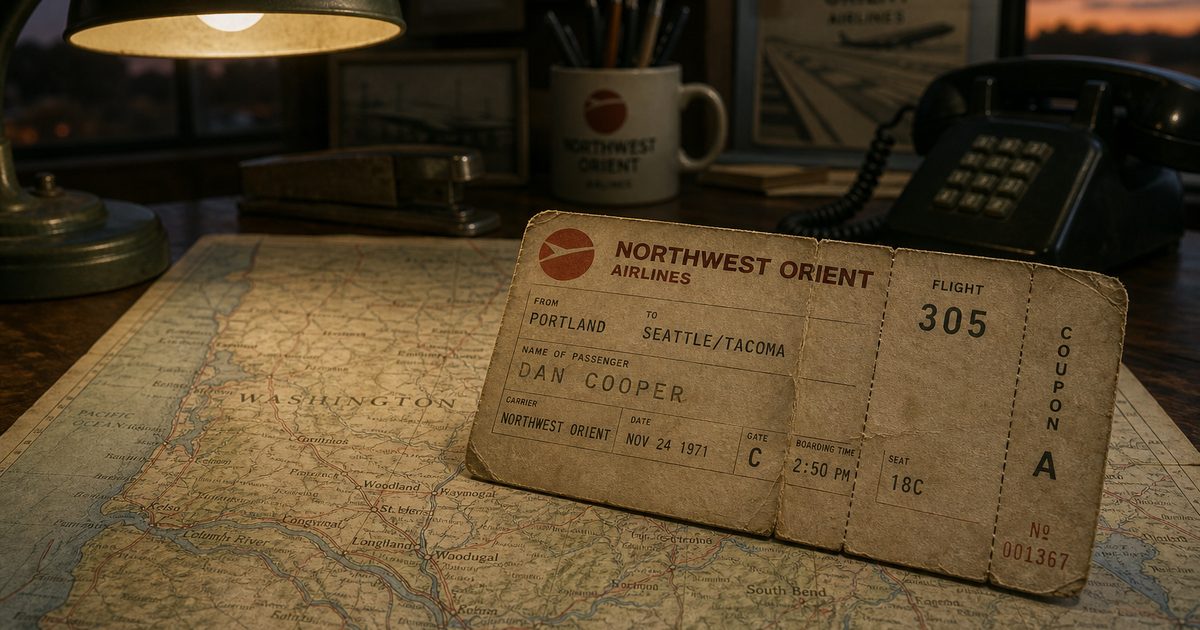
At 2:50 in the afternoon, the man in the dark suit looked like any other holiday traveler. He carried a briefcase, paid cash, and bought a one-way seat from Portland to Seattle for $18.52. The name on the ticket was Dan Cooper. By the end of the night, that small slip of paper would be tied to one of the most enduring mysteries in American crime.
A quiet boarding, a short flight, and a name that stuck
Northwest Orient Airlines Flight 305 left Portland on November 24, 1971, the day before Thanksgiving. In those days, boarding a plane was nothing like it is now. There were no routine airport metal detectors, no modern ID checks, no layers of screening that might have slowed him down or turned him away.
Witnesses later described the passenger as a white man in his 40s, wearing a business suit and raincoat, calm enough not to draw attention. Nothing about him suggested panic or haste. That mattered. The case did not begin with violence in the aisle or chaos at the gate. It began with ordinary details: a cash fare, a briefcase, an alias.
And even that alias became part of the confusion. The man bought his ticket as Dan Cooper. The name the world remembers, D.B. Cooper, came from early reporting errors and never went away.
The note that changed Flight 305
Not long after takeoff, Cooper handed a note to flight attendant Florence Schaffner.
At first, she thought he was just another passenger trying to pass along his phone number. Then he leaned toward her and told her she should read it. The message was blunt: he said he had a bomb. He wanted her to sit beside him.
When she did, he opened the briefcase just enough for her to see what she later described as red cylinders, wires, and a battery. Whether it was a real bomb has never been proved. In that moment, though, no one on the crew had the luxury of treating it as a bluff.
His demands were specific: $200,000 in $20 bills and four parachutes.
That precision shaped everything that followed. This was not a frenzied takeover. It was controlled, almost methodical. The 36 passengers on board did not yet know their short flight had turned into a hijacking, and one that would outlast almost every other case of its kind.
In the cockpit, Captain William A. Scott, First Officer William Rataczak, and Flight Engineer Harold Anderson kept the aircraft moving toward Seattle while Schaffner and fellow flight attendant Tina Mucklow became the crew members closest to the hijacker himself.
Seattle: ransom on the runway
Flight 305 landed at Seattle-Tacoma Airport at about 5:39 p.m.
By then, federal agents and airline officials had been scrambling on the ground. The ransom was assembled in a hurry: 10,000 unmarked $20 bills. The serial numbers were recorded on microfilm. Four parachutes were gathered to meet his demand.
Then came the exchange that made the case stranger still.
Cooper released all 36 passengers, along with Florence Schaffner. In return, he took the money and the parachutes. If his plan had been simply to vanish into a crowd, he had his chance right there on the tarmac. Instead, he wanted the plane fueled and sent back into the air.
That decision is one reason the story still grips people. The hijacking could have ended in Seattle. Instead, it moved into darkness.
At 7:40 p.m., after a delay for refueling, the aircraft took off again. On board now were only the hijacker, Tina Mucklow, the two pilots, and the flight engineer.
Into the night
Cooper told the crew he wanted to head toward Mexico City, with a refueling stop along the way. He also gave instructions that sounded technical enough to suggest he knew something about aircraft: fly low, around 10,000 feet; keep the speed slow, roughly 170 knots; leave the landing gear down; set the wing flaps at 15 degrees.
Some of those details were adjusted by the crew for safety, but the overall picture was clear. He was preparing to leave the plane in flight.
At one point, he sent Tina Mucklow to the cockpit. She was the last known person to see him closely. After that, the crew could only track signs of movement behind them.
At about 8 p.m., a warning light indicated the aft airstair had been activated. Around 8:13 p.m., the crew felt a sudden upward movement in the tail section, enough to suggest a significant change in weight. Somewhere between Seattle and Reno, over the dark, wet country of the Pacific Northwest, Cooper had apparently lowered the rear stairs and jumped.
That is the last confirmed moment in the story.
No witness saw him leave the aircraft. No one on the ground reported seeing him land. After the note, the ransom, and the second takeoff, the case opened into black sky and bad weather.
The search below, and the silence that followed
The next day, November 25, search teams began combing the likely jump area in southwestern Washington. Aircraft searched from above. Investigators on the ground looked for torn fabric, parachute gear, footprints, money, a body, anything that could pin the mystery to one place.
They found nothing.
That silence became one of the strongest facts in the case. A man had boarded a commercial flight under an alias, extorted a fortune, and disappeared along a known flight path without leaving a clear trail behind him.
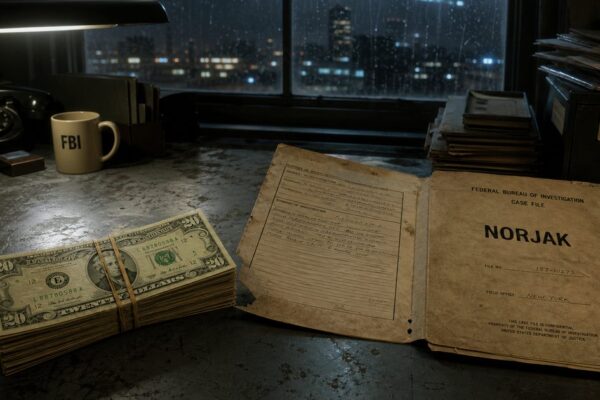
The FBI named its investigation NORJAK, short for Northwest Hijacking. Over the years, agents examined physical evidence, interviewed witnesses, and pursued a long list of suspects. Many names were floated in books, documentaries, and amateur theories. None produced a charge, and none solved the case.
What he left behind
For someone who vanished so completely, Cooper did leave a few things behind.
Investigators recovered a black clip-on tie from his seat, along with a tie clasp. They also collected latent fingerprints from the plane, though later reporting has varied on how useful those prints really were and whether all could confidently be tied to the hijacker. Years later, DNA testing on the tie produced only partial results, not enough to identify him.
The note itself was not preserved. Schaffner had handed it back after reading it, and it disappeared with him.
Agents also collected cigarette butts from the seat area, but those were later lost, one of the most frustrating failures in the evidence trail.
The parachutes added another layer of confusion. Two reserve chutes and two main parachutes had been supplied in Seattle. One reserve was found on the plane, and one of the parachutes had been opened, with shroud lines cut from it. Investigators concluded he appears to have taken two parachutes when he jumped, though exactly why he requested four in the first place has long been debated. One common theory is that he wanted authorities to think he might force a hostage to jump with him, making it less likely they would sabotage the equipment. That remains an inference, not a proved fact.
Every piece of evidence seemed to offer a path forward. None led all the way to a name.
The riverbank discovery
For years, the ransom money seemed as lost as the man who took it.
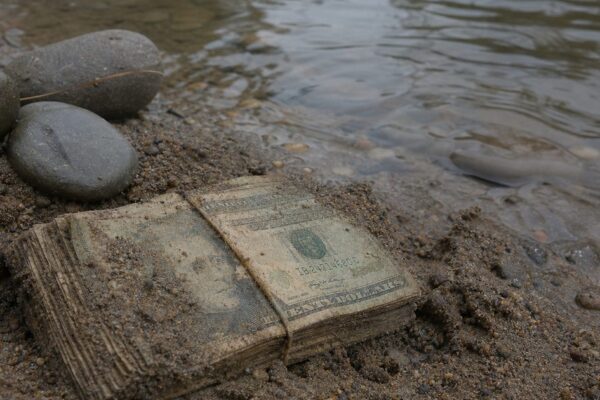
Then, on February 10, 1980, an 8-year-old boy named Brian Ingram was digging in the sand at Tena Bar, on the Columbia River near Vancouver, Washington, when he found three decaying bundles of cash. The bills were $20s. Their serial numbers matched the ransom from Flight 305.
The amount was $5,800.
It was the first major break in years, and it raised almost as many questions as it answered. The money had turned up well south of the presumed jump zone. How it got there, when it arrived, and what that meant for Cooper’s fate have never been settled. Investigators could say with certainty that some of the ransom ended up on that riverbank. Beyond that, the evidence refused to tell a clean story.
The rest of the money has never surfaced in circulation.
Did he survive?
That question has hovered over the case from the start.
The jump happened at night, in November, over rough terrain, in cold rain, with strong wind and limited visibility. Cooper was wearing a business suit and loafers, not survival gear. He may also have taken a non-steerable parachute and left behind one that was easier to control. Those facts have led many investigators to doubt he survived.
The FBI said as much more than once: based on the conditions and the equipment, agents believed the hijacker probably did not live through the jump.
But belief is not proof. No body conclusively linked to the case was ever found. No parachute was recovered in a way that closed the question. And because the man behind the alias Dan Cooper was never identified, the mystery remained open enough for theories to thrive.
The name, the legend, and the facts
The most famous name in the case is not the one on the ticket.
That matters because the real record is often stranger, and more interesting, than the legend built around it. The hijacker was Dan Cooper on paper. He boarded Northwest Orient Flight 305 in Portland. He passed a note. He demanded $200,000 and four parachutes. He released the passengers in Seattle, ordered the plane back into the air, and vanished somewhere between Seattle and Reno.
Those are the hard facts.
Everything after that has to be handled carefully. Suspects have come and gone. Some were plausible. Some were little more than rumor. None has been proved in court. The case remains unsolved.
What is certain is that the hijacking changed aviation. In the years that followed, airport screening tightened dramatically. Airlines adopted new security measures, and Boeing aircraft were fitted with the so-called Cooper vane, a device designed to prevent the rear stairs from being lowered in flight.
In July 2016, the FBI announced it was suspending active investigation of the D.B. Cooper case to focus resources elsewhere, though the bureau said it would still review specific physical evidence if something significant turned up.
So the file was not closed in the usual sense. It was simply left where the story itself has always been left: somewhere between a boarding gate in Portland and an empty stretch of night sky.
FAQ
Who was D.B. Cooper?
D.B. Cooper is the name popularly attached to the unidentified man who hijacked Northwest Orient Flight 305 on November 24, 1971. The alias he actually used to buy the ticket was Dan Cooper.
What was on the D.B. Cooper plane ticket?
It was a one-way ticket for Flight 305 from Portland to Seattle, bought in cash for $18.52 under the name Dan Cooper.
Why is he called D.B. Cooper if the ticket said Dan Cooper?
The better-known name came from an early reporting mistake. The hijacker used Dan Cooper, but D.B. Cooper became the label that stuck in public memory.
Was any of the ransom money ever found?
Yes. On February 10, 1980, Brian Ingram found $5,800 in bundled $20 bills at Tena Bar on the Columbia River, and the serial numbers matched the ransom.
Did D.B. Cooper survive the jump?
No one knows for certain. The FBI said the conditions made survival unlikely, but no conclusive physical evidence has ever resolved his fate.