A flight attendant unfolded the note and saw, in a few plain words, that the afternoon had changed.
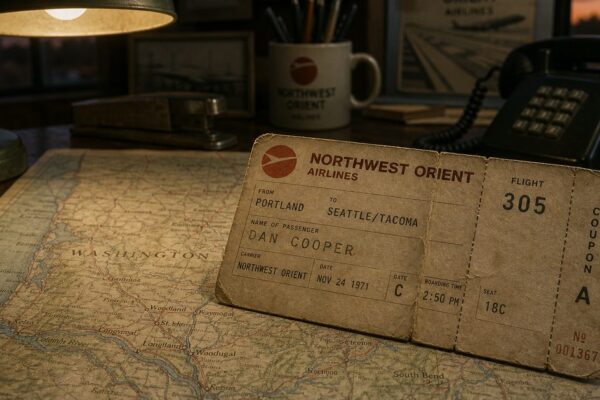
Northwest Orient Flight 305 had left Portland for Seattle on November 24, 1971, carrying 36 passengers on what should have been a short, forgettable trip. The man in seat 18C looked ordinary enough: dark suit, white shirt, black tie, raincoat. He had paid cash for a one-way ticket under the name Dan Cooper. Nothing about him demanded attention until he handed over that note.
At first, flight attendant Florence Schaffner assumed it was a phone number or a clumsy attempt at flirting. Instead, it said he had a bomb.
When she sat beside him, he opened his briefcase just enough for her to glimpse wires and red cylinders. Then he told her what he wanted: $200,000 in $20 bills and four parachutes. Not later. Not after landing and negotiating. He wanted them brought to the plane.
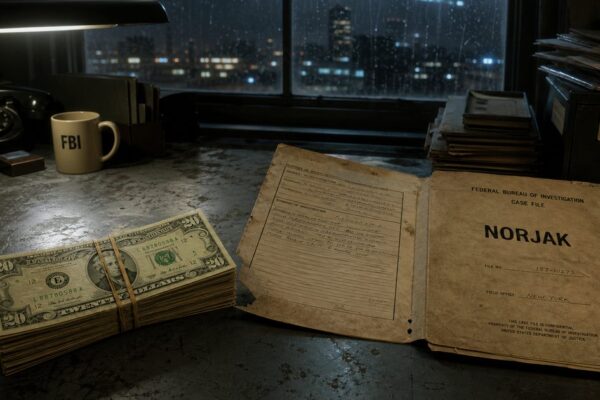
That was the beginning of the case the FBI would call NORJAK, for Northwest Hijacking. It would become the most famous unsolved skyjacking in American history, and the man who called himself Dan Cooper would be remembered by a different name entirely: D.B. Cooper.
A hijacking in an easier age to disappear
Part of what made the crime possible was the time in which it happened. Airport security was loose by modern standards. Passengers were not screened the way they are now. A man could walk onto a commercial flight with a briefcase and a false name and expect little resistance.
On board, the crew moved carefully. Captain William Scott, First Officer William Rataczak, and flight engineer Harold E. Anderson were told what was happening in the cabin. Another flight attendant, Tina Mucklow, soon became the crew member who spent the most time with the hijacker during the long, tense hours that followed.
The plane stayed in the air while authorities in Seattle scrambled to meet the demands. On the ground, the FBI was alerted before the aircraft landed. Investigators began building a case while the crime was still unfolding.
By the time Flight 305 reached Seattle-Tacoma International Airport at 5:39 p.m., the standoff had entered its next phase.
Seattle: money for lives
The exchange on the tarmac was the first major turning point.
Authorities delivered the ransom: 10,000 twenty-dollar bills, totaling $200,000. They also provided four parachutes, as requested. The choice of four mattered. Investigators believed the hijacker may have asked for multiple parachutes to make police think he intended to take hostages with him, which would discourage them from sabotaging the gear.
Once he had the money and parachutes, he released all 36 passengers. They walked away unharmed.
That detail has always sat at the center of the story. For all the fear he created, the hijacker let the passengers go. What remained on the plane was a much smaller group: the three men in the cockpit and Tina Mucklow in the cabin with him.
The FBI had taken one important precaution. The serial numbers on the ransom bills had been recorded on microfilm. If the money surfaced, agents would be able to identify it.
At 7:40 p.m., the Boeing 727 took off again, this time from Seattle into darkness.
The second flight
Now the case narrowed to a few people on a plane and one man with a plan no one could fully see.
He instructed the pilots to head toward Mexico City, with a refueling stop in Reno, Nevada. He also gave specific directions about how the plane should be flown: relatively low altitude, slow speed, landing gear down, wing flaps set at 15 degrees. Those details suggested some familiarity with aircraft, though exactly how much has always been debated. Investigators later considered whether he had military or aviation experience, but no theory was ever proved.
At some point after takeoff, he told Tina Mucklow to go forward to the cockpit and stay there. She did.
That left him alone in the cabin with the ransom and the parachutes.
At about 8:00 p.m., a warning light indicated that the aft airstair had been activated. The Boeing 727 was one of the few commercial aircraft that could lower rear stairs in flight, and that feature became the heart of the escape. Around 8:13 p.m., the crew felt a sudden upward movement in the tail section, consistent with someone jumping.
Somewhere over the dark landscape of the Pacific Northwest, he was gone.
When the plane landed in Reno at 10:15 p.m., the cabin was empty.
The man was gone. So were the money and two parachutes.
What D.B. Cooper left behind
For someone who vanished so completely, he left behind a surprisingly small but important trail.
Investigators recovered a black clip-on tie and a tie clasp from his seat area. They also collected fingerprints from the plane, though the evidentiary value of those prints has long been disputed because the aircraft had been handled by many people. Over time, the tie became one of the most discussed physical clues in the D.B. Cooper case. Later analysis found tiny particles on it, including metallic traces, which led to theories about the kind of work he may have done. But those findings pointed in possibilities, not certainties.
One of the parachutes left on the plane had been opened, and shroud lines had been cut from it. That detail fueled years of argument over what exactly happened before the jump and whether the hijacker made mistakes in the dark.
Even his name slipped away almost immediately. He had bought his ticket as Dan Cooper. Through early reporting, the name was misheard or misreported as D.B. Cooper, and that mistaken version stuck.
The alias became legend. The real person behind it never did.
The hunt called NORJAK
The FBI investigation was enormous. Agents chased leads across the country and beyond. Over the years, more than 800 suspects were considered in connection with the Northwest Orient Flight 305 hijacking.
Some names returned again and again. Richard Floyd McCoy Jr. was often mentioned because he carried out a similar hijacking months later, but the FBI ruled him out in the Cooper case. Other frequently discussed suspects included Kenneth Christiansen, William Gossett, and Robert Rackstraw. None was definitively tied to the crime by the available evidence.
That distinction matters. In a case this famous, suspicion and proof are not the same thing.
There were charges on paper. A federal complaint accused the unknown hijacker of air piracy and violating the Hobbs Act. But there was no arrest, no defendant in court, no trial that could sort rumor from fact.
Instead, the case settled into a strange limbo: one of the most recognizable crimes in America, attached to no confirmed face.
The money in the sand
For years, the story seemed to end in the night sky. Then, almost a decade later, it broke open again on a riverbank.
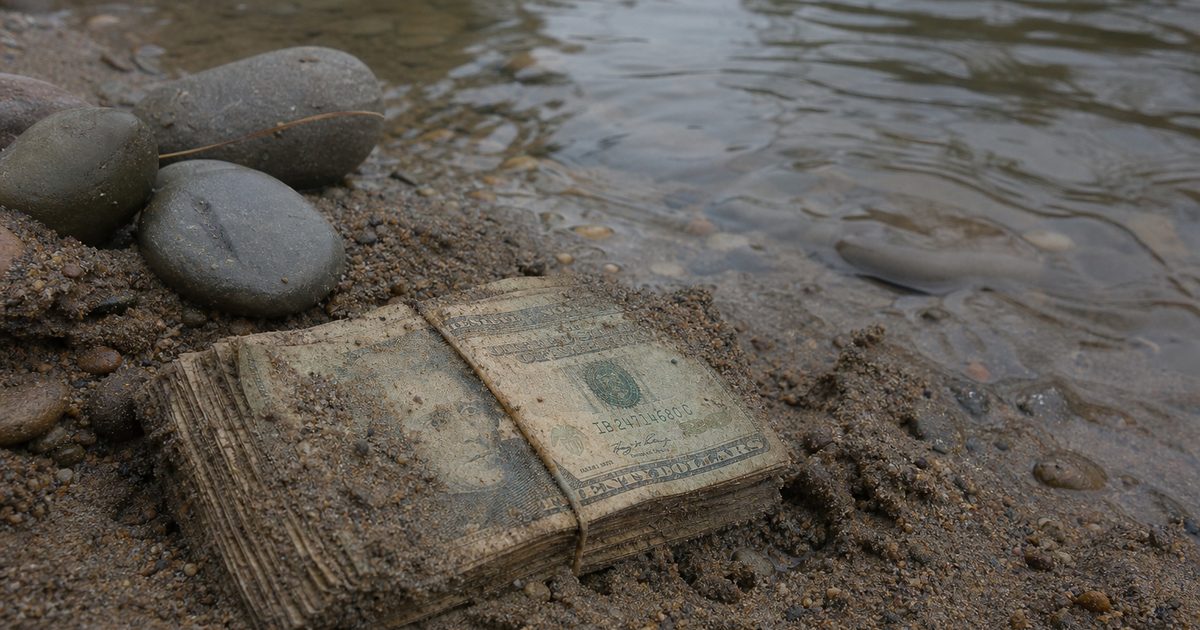
On February 10, 1980, an 8-year-old boy named Brian Ingram was with his family at Tena Bar, along the Columbia River near Vancouver, Washington. While digging in the sand, he found decaying bundles of cash.
The bills were twenties. The total was $5,800.
When investigators checked the serial numbers, they matched the ransom from Flight 305.
It was the kind of discovery that should have answered something. Instead, it deepened the mystery. The money had been found miles from the presumed drop zone. No one could say with confidence how it got there, when it arrived, or what that meant for the hijacker’s fate.
That remains one of the few confirmed pieces of evidence ever found outside the aircraft itself.
The rest of the ransom never turned up in any verified way. Neither did the man who took it.
Did he survive?
That question has hovered over the D.B. Cooper plane hijacking from the start.
The jump was dangerous by any measure: night, bad weather, rough terrain, a business suit, and a parachute descent into an area he may not have known well. Some investigators came to believe he likely did not survive. Others argued that his calm behavior and the precision of his demands suggested preparation.
The truth is narrower than either theory. His fate was never established.
No body conclusively linked to the hijacking was found. No verified confession closed the case. No proven use of the ransom money surfaced beyond the bills discovered at Tena Bar.
So the central question remains exactly where it has always been: not solved, only argued.
How the hijacking changed aviation
The crime did not end with the missing man. It changed the industry he exploited.
After the hijacking, Boeing 727 aircraft were fitted with a device known as the Cooper vane, designed to prevent the aft airstair from being lowered during flight. Broader airline security also tightened in the years that followed, including passenger screening and baggage checks that would have made a crime like this far harder to carry out.
That is part of why the story still holds. It belongs to a narrow window in American air travel, when a man could board under an alias, pass a note, collect a ransom, and step into the dark.
The FBI kept working the case for decades. On July 12, 2016, the bureau announced that it was suspending active investigation of NORJAK, though it said it would consider credible physical evidence if any emerged.
That was not a solution. It was an admission of what the case had become.
A man calling himself Dan Cooper boarded a plane in Portland on November 24, 1971. He extorted $200,000, released his passengers, and disappeared after jumping from the rear stairs of a Boeing 727 somewhere over the Northwest.
Everything beyond that is fragments: a tie, disputed fingerprints, a few bundles of money in the sand, and a name that was never even quite the right one.
FAQ
Was D.B. Cooper ever identified?
No. The hijacker’s true identity was never confirmed, and the case remains unsolved.
How much money did D.B. Cooper take?
He received $200,000 in ransom, all in $20 bills.
Was any of the ransom money found?
Yes. On February 10, 1980, Brian Ingram found $5,800 of the ransom at Tena Bar near the Columbia River.
Did D.B. Cooper survive the jump?
It has never been proven. Investigators debated it for years, but no definitive evidence established his fate.
When did the FBI stop actively investigating the case?
The FBI suspended active investigation on July 12, 2016, while leaving open the possibility of reviewing new physical evidence.