A little after 3 p.m., a flight attendant on a short hop from Portland to Seattle was handed a note she first assumed was a phone number.
It was not.
On November 24, 1971, the man in seat 18C on Northwest Orient Flight 305 leaned close enough to make sure Florence Schaffner understood him. He said he had a bomb. When she sat beside him, he opened his briefcase just enough for her to see what looked like red cylinders and wires. Then he gave his terms: $200,000 in twenty-dollar bills and four parachutes.
That was the beginning of the case the FBI would call NORJAK, short for “Northwest Hijacking.” It is still the only unsolved skyjacking in American history. And even now, after decades of theories, suspects, and folklore, the core of the story remains surprisingly plain. The man who called himself Dan Cooper wanted money, and he had built an escape around getting it.
By the time the public heard about him, a reporting error had turned Dan Cooper into D.B. Cooper. The wrong name stuck. So did the legend. But the real story is less about myth than about a crime carried out in careful stages, with ordinary people trapped inside it.
The note, the bomb threat, and a calm cabin
Flight 305 had left Portland in the afternoon and was bound for Seattle, a routine trip on the day before Thanksgiving. Cooper had paid cash for a one-way ticket. He wore a dark suit, a white shirt, and a black clip-on tie. Nothing about him, at first glance, forced alarm.
Then the note changed the flight.
Schaffner passed the message to the cockpit. The crew alerted authorities while the plane remained in the air. Cooper was not ranting, not making speeches, not demanding attention. He was specific. He wanted the cash and the parachutes waiting in Seattle.
That detail matters because it cuts through much of the mythology. He did not claim a political cause. He did not ask for publicity. He did not try to turn the hijacking into a manifesto. From the start, the demand was practical: money and a way out.
As the Boeing 727 circled to buy time, officials on the ground scrambled. The FBI was notified. Airline staff gathered the ransom. Parachutes were obtained. Inside the cabin, passengers were largely unaware of how serious the situation was.
In Seattle, the first half of the plan worked
At about 5:46 p.m., Flight 305 landed at Seattle-Tacoma International Airport. Authorities delivered what he had asked for: $200,000 and four parachutes. Cooper then released the 36 passengers.
That is one of the clearest moments in the whole case. Once he had the ransom, the passengers were no longer central to his plan. He kept only the crew members he needed: pilot William Scott, co-pilot William Rataczak, flight engineer Harold Anderson, and flight attendant Tina Mucklow.
Northwest employee Al Lee brought the money aboard. The aircraft was refueled. The hijacker gave fresh instructions. He wanted the plane flown toward Mexico City at a low altitude, with the landing gear configured in a particular way and the speed kept slow. The crew later negotiated some of those details, but the broad outline held: he wanted the 727 back in the air, and he wanted conditions that would help him jump.
This was not a standoff spinning out of control. It was a ransom exchange followed by an escape attempt.
Into the night over the Northwest
At around 7:40 p.m., the plane took off again from Seattle. Outside, the weather was bad: rain, darkness, cold, wind. A military aircraft followed at a distance. Inside the cabin, Cooper told Tina Mucklow to go forward to the cockpit and stay there. He was now alone in the rear of the plane with the money and the parachutes.
Sometime after 8 p.m., the crew noticed a warning light indicating the aft airstair had been activated. Not long after, they felt a sudden change in pressure, the kind of movement that suggested the stairs had been lowered. At 8:13 p.m., according to the FBI’s timeline, the aircraft experienced a noticeable upward movement in the tail section. Investigators have long treated that moment as the most likely point when Cooper jumped.
Somewhere over southwest Washington, believed to be near Ariel, he stepped out into the storm and vanished.
That leap is the reason the case never let go of the public imagination. A man boards a plane under an alias, extorts a fortune, then disappears into the dark with a parachute. It sounds almost too neat, too cinematic. Yet the known facts are stark and limited. He jumped. No confirmed trace of him was found on the ground. No arrest followed.
Why did D.B. Cooper hijack the plane?
Strip away the legend and the answer is probably the simplest one.
The evidence points to financial motive. He demanded ransom, not attention. He asked for parachutes because he intended to escape with the money. After the cash was delivered, he released the passengers. Every major step in the hijacking served the same goal.
That does not mean risk played no part. Whoever he was, he was willing to stake his life on a nighttime jump from a Boeing 727 in poor weather. Some have argued that thrill-seeking must have been part of it. Maybe it was. But if so, it appears secondary. The structure of the crime was built around extortion and getaway, not spectacle for its own sake.
The enduring question in the D.B. Cooper motive debate is not whether money mattered. It plainly did. The harder question is what kind of man would decide that this was a reasonable way to get it.
The clues left behind on Flight 305
For someone who vanished so completely, Cooper left behind a surprising amount.
Investigators recovered his black clip-on tie, later identified as a J.C. Penney tie. They found two parachutes left on the plane. They collected fingerprints, though none led to a confirmed identification. Witnesses also said he smoked Raleigh filter-tipped cigarettes, but the cigarette butts collected at the time were later lost, one of several frustrations in the long D.B. Cooper investigation.
For years, many assumed he must have been an experienced parachutist, perhaps with military training. He seemed to know enough about the Boeing 727 to exploit its aft stairs, a feature that made a midair escape possible. The case eventually led to a device known as the “Cooper vane,” installed so those stairs could no longer be lowered in flight.
But some later analysis cut against the image of a flawless professional. He chose a dangerous jump in terrible conditions, wearing business shoes and a trench coat. He also appears to have taken a reserve parachute that was not steerable. One of the reserve chutes left behind had been sewn shut for training use. Those details have led some investigators to doubt that he was the expert many first imagined.
That uncertainty matters. If he was not an elite parachutist, then the hijacking looks less like a master class in technical skill and more like a desperate, high-stakes gamble for cash.
The riverbank discovery that changed the case
For years, the ransom seemed to have disappeared with him.
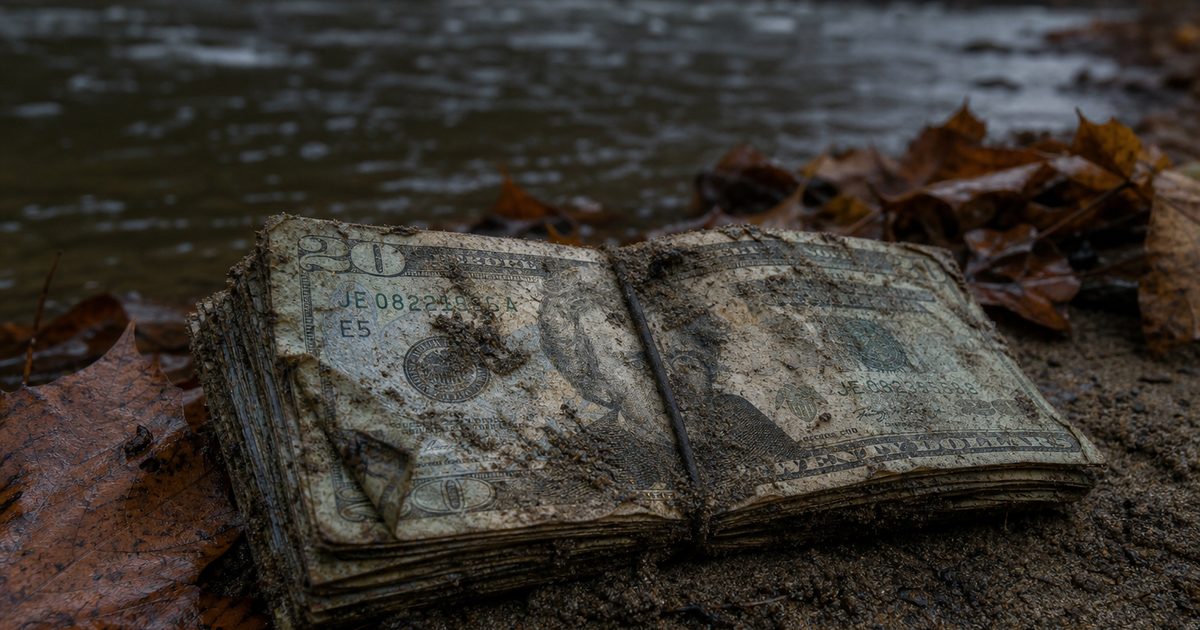
Then, in February 1980, an eight-year-old boy named Brian Ingram was digging in the sand at Tena Bar, on the Columbia River near Vancouver, Washington, when he found decaying bundles of twenty-dollar bills. The amount totaled $5,800. The serial numbers matched the ransom from Flight 305.
It was the first hard sign that at least some of the money had survived the jump, or had been carried somewhere afterward. It was also one of the strangest turns in an already strange case. The find did not identify Cooper. It did not show whether he lived or died. It only deepened the mystery.
How did the money get there? Why only that portion? Where was the rest?
Those questions remain unanswered. But the discovery did reinforce one thing: the ransom was not a side detail. It was the center of the crime.
Suspects, folklore, and an unsolved hijacking
Over the years, investigators examined hundreds of leads and multiple serious suspects. One of the best known was Richard Floyd McCoy Jr., who carried out a similar skyjacking months later. But the FBI ruled him out in the Cooper case. Other names rose and fell. None could be proven to be the man on Flight 305.
That vacuum helped create a strange afterlife. The hijacker became a folk figure in some corners of American culture, which can obscure what actually happened. This was not a harmless prank or a stylish caper. He threatened a commercial flight with what he said was a bomb and forced a crew to help him carry out an airborne extortion.
The practical consequences were lasting. In the years that followed, airport security tightened dramatically. The FAA required passenger screening measures that soon included metal detectors and baggage inspection. The Boeing 727 was modified so the same kind of jump could not be repeated.
Where the case stands now
In July 2016, the FBI announced that it was suspending active investigation of NORJAK, though the bureau said it would still consider credible physical evidence if something new emerged.
So the mystery remains where it has long lived: in a narrow band between fact and disappearance.
Who was Dan Cooper? Did he survive the jump? If he did, what became of the rest of the money? Those are still open questions. But on the matter of motive, the case is less murky than its legend suggests. Why did D.B. Cooper hijack the plane? Because he wanted ransom and believed he could get away with it.
Everything after that is the dark.
FAQ
Who was D.B. Cooper?
D.B. Cooper was the name popularized by the press for an unidentified man who used the alias Dan Cooper when he hijacked Northwest Orient Flight 305 in 1971.
Was D.B. Cooper ever found?
No. He was never conclusively identified or captured, and the case remains unsolved.
How much money did he take?
He received $200,000 in twenty-dollar bills after making his ransom demand in Seattle.
Was any of the ransom money recovered?
Yes. In February 1980, Brian Ingram found $5,800 in decaying bills at Tena Bar on the Columbia River. The serial numbers matched the hijacking ransom.
Why do investigators think money was the main motive?
Because his actions centered on obtaining cash and escaping with it: he demanded ransom, asked for parachutes, released the passengers once the money was delivered, and then jumped from the plane.