At 5:46 that evening, Northwest Airlines Flight 305 rolled onto the runway in Seattle with a hijacker still on board and a city waiting below.
Inside the cabin, the mood was unnervingly calm. The man in the dark suit had not shouted. He had not waved a gun down the aisle. He had spent the short flight from Portland speaking quietly with flight attendants, smoking Raleigh cigarettes, sipping bourbon and 7-Up, and repeating the same demand: $200,000 in cash and four parachutes.
By the end of the night, he would be gone.
So would almost all of the money.
The note that changed Flight 305
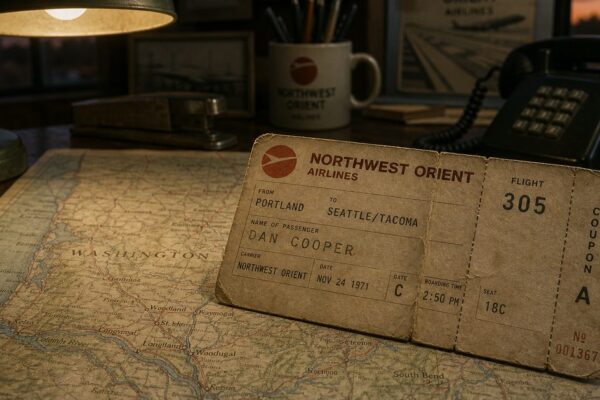
The day before Thanksgiving, November 24, 1971, began in the most ordinary way. A middle-aged man using the name Dan Cooper bought a one-way ticket with cash for Northwest Orient Airlines Flight 305 from Portland, Oregon, to Seattle, Washington.
The Boeing 727-51, tail number N467US, took off at 2:50 p.m. PST. On board were 36 passengers, six crew members, and a man who looked forgettable on purpose.
Not long after takeoff, he handed flight attendant Florence Schaffner a note. At first, she thought he was making a pass and slipped it into her purse unopened. Then he leaned toward her and told her she had better read it. The message said he had a bomb.
When Schaffner sat beside him, he opened his briefcase just enough for her to see what appeared to be red cylinders, wires, and a battery. Whether it was a real bomb has never been proved. What mattered in that moment was that the crew believed the threat.
His instructions were precise: $200,000 in $20 bills, four parachutes, and a fuel truck waiting in Seattle.
The crime was extortion and air piracy. But what made the hijacking so strange was its restraint. He did not terrorize the passengers. He did not rush the cockpit. He used the fact that the plane was already airborne, and he let the tension do the work.
A quiet standoff over Seattle
As Flight 305 circled in the air, the crew relayed his demands. Tina Mucklow, another flight attendant, became the main go-between, carrying messages from the hijacker to the cockpit and back again. On the ground, the FBI and airline officials scrambled to put together the ransom and the parachutes.
By the time the plane landed at Seattle-Tacoma International Airport, the situation had become a race between caution and compliance. The priority was simple: get the passengers off safely.
That part worked.
Northwest’s Seattle operations manager, Al Lee, brought the money on board. The amount was exact: $200,000, all in $20 bills. For anyone asking how much money did D.B. Cooper steal, that is the answer. Not an estimate. Not a legend. Two hundred thousand dollars.
He also received the parachutes.
Then, in one of the most unsettling turns in the case, he let the 36 passengers go.
The exchange should have ended the ordeal. Instead, it only opened the second act.
Into the night
After the plane was refueled, the hijacker ordered the remaining crew to take off again. His destination was Mexico City, with a refueling stop in Reno, Nevada. He also dictated the flight conditions: low altitude, reduced speed, landing gear configuration adjusted, and the cabin left unpressurized in a way the crew considered manageable.
Those details have fueled decades of argument about what he knew and what he only thought he knew. He clearly understood enough about the Boeing 727 to focus on its most unusual feature: the aft airstair at the rear of the plane.
That stairway became the center of the mystery.
Sometime after 8:00 p.m. PST, while the aircraft flew through bad weather over southwestern Washington, a warning light in the cockpit signaled that the aft stairs had been activated. The crew later felt a noticeable change in the plane’s movement. Cooper had sent Tina Mucklow to the cockpit and was alone in the cabin.
No one saw him jump.
That is one of the reasons the story still grips people. There was no dramatic eyewitness moment, no final confrontation, no body on the ground. Just a man, a ransom, two parachutes missing from the plane, and open darkness below.
At 10:15 p.m. PST, Flight 305 landed safely in Reno. The hijacker was gone.
What happened to the ransom money?
Most of it vanished with him.
That is the hard center of the case. He received $200,000. Investigators recorded the serial numbers on the bills. Yet only a tiny portion ever resurfaced.
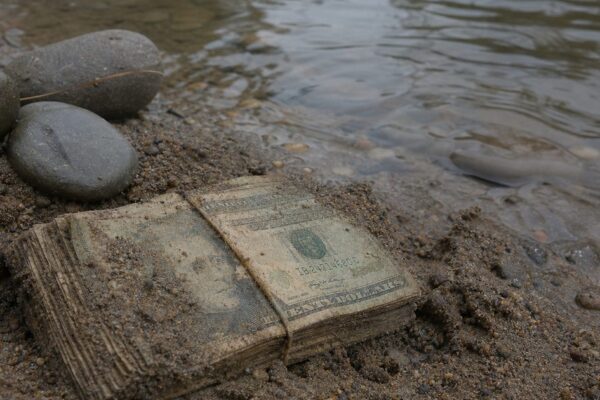
In February 1980, a boy named Brian Ingram was digging in the sand along the Columbia River at Tena Bar, near Vancouver, Washington, when he found three decaying bundles of cash. The total was $5,800. The bills were identified as part of the Flight 305 ransom.
It was the kind of break that should have cracked a case open.
Instead, it deepened the mystery.
The money’s location did not neatly fit the FBI’s original search area. It raised questions about the jump route, the river, and whether the hijacker ever made it out alive. But it answered none of them. The rest of the ransom was never recovered.
So when people ask, was any of D.B. Cooper’s money ever found, the answer is yes, but only a fraction. Almost everything else disappeared into the same darkness that swallowed the man who took it.
The evidence he left behind
For someone who vanished so completely, he did leave traces.
On his seat, investigators found a black clip-on tie with a mother-of-pearl tie clasp. They also collected fingerprints from the aircraft. Cigarette butts from the Raleighs he smoked were reportedly recovered at the time, though those were later lost, a frustrating detail in a case built on fragments.
The tie became one of the most discussed pieces of evidence. Decades later, investigators were able to obtain a partial DNA profile from it, but not one strong enough to identify the hijacker with certainty. It could help exclude suspects. It could not tell the world who he was.
That gap invited theories, and there were plenty of them.
Some writers cast him as a seasoned military parachutist. Others argued the opposite. The FBI long suggested he may not have been an experienced skydiver after all, pointing to the equipment he chose and the brutal conditions of the jump: night, rain, cold, heavy wind, rugged terrain, and loafers on his feet. He also appears to have taken one of the reserve parachutes and left behind another that contained useful instructional markings, a choice often cited as evidence that he was not the flawless professional later myth made him into.
Whether he survived remains unproved.
That distinction matters. In a case like this, myth grows fastest where facts run out.
How “Dan Cooper” became D.B. Cooper
Even the name most people know is a mistake.
The hijacker identified himself as Dan Cooper. Somewhere in the early reporting, a mix-up with a suspect’s name led to the label “D.B. Cooper,” and it stuck. The error became part of the folklore, turning a real extortion case into something larger and stranger in the public imagination.
It happened at a moment when airline security was thin and hijackings were far more common than they would later become. A man could pay cash for a ticket, walk onto a plane with little scrutiny, and hold an entire flight hostage with a note and a briefcase.
That context is important. The Cooper hijacking feels unbelievable now partly because the world that allowed it has disappeared.
The case that changed air travel
The man vanished, but the consequences did not.
In the aftermath, airport security tightened. Airlines and federal authorities moved toward passenger screening, baggage inspection, and closer scrutiny of suspicious ticket purchases. The Boeing 727 was eventually fitted with a device known as the “Cooper vane,” designed to prevent the aft stairs from being lowered in flight.
The hijacking did not create modern aviation security on its own, but it became one of the events that pushed the system in that direction.
That is part of why the case endured. It was not only a mystery. It was a turning point.
An unsolved case, and a stubborn one
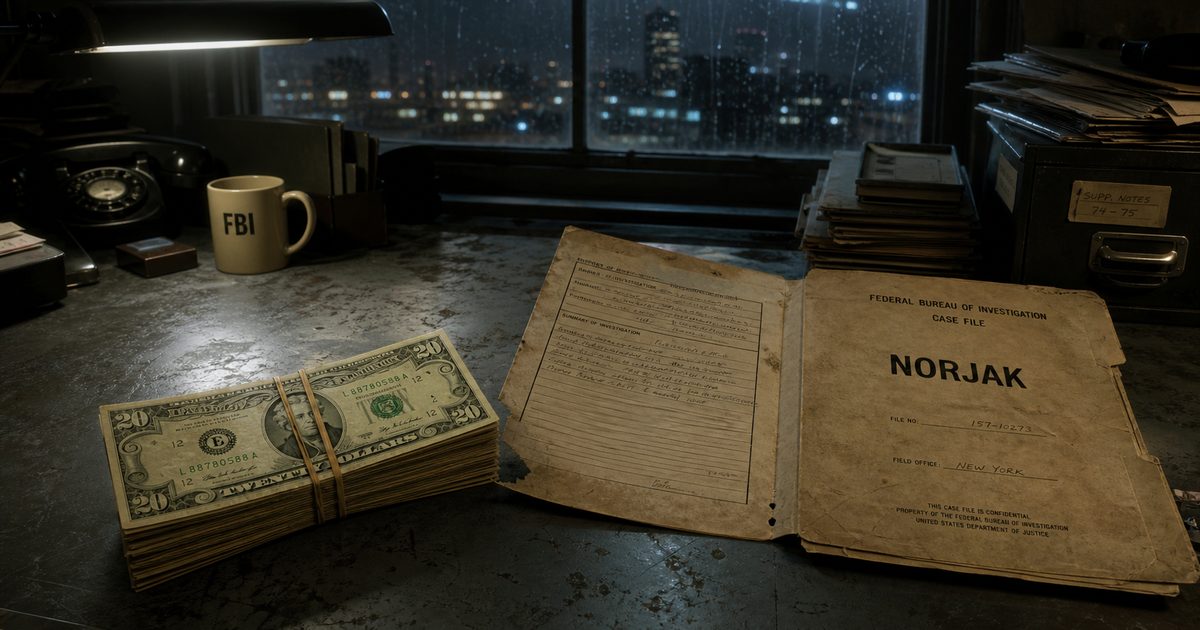
The FBI’s investigation, known as NORJAK, stretched across decades. Agents examined physical evidence, tracked the ransom bills, and looked into hundreds of suspects. None was ever charged. None was ever proved to be the man who boarded Flight 305 in Portland.
In July 2016, the FBI announced it was suspending active investigation to focus resources elsewhere, though the case itself remains unsolved and the files continue to draw public interest.
That official decision did not end the fascination. If anything, it sharpened it.
Who was he really? Did he survive the jump? Where did he land? What happened to the rest of the money?
Those questions remain. So do the few facts no theory can move around.
A man calling himself Dan Cooper hijacked a commercial flight on November 24, 1971. He demanded and received $200,000. He ordered the plane back into the air. Somewhere over the Pacific Northwest, he went down the rear stairs of a Boeing 727 and disappeared.
Only $5,800 ever came back.
FAQ
How much money did D.B. Cooper steal?
He took $200,000 in ransom money, all in $20 bills, from Northwest Orient Flight 305.
Was any of the ransom ever recovered?
Yes. In 1980, Brian Ingram found $5,800 of the ransom near the Columbia River at Tena Bar, close to Vancouver, Washington.
What was D.B. Cooper’s real name?
It is still unknown. The hijacker used the alias Dan Cooper. “D.B. Cooper” came from an early reporting error.
Did D.B. Cooper survive the jump?
No one knows for certain. Investigators have long questioned whether he could have survived the weather, terrain, and conditions, but it has never been proved either way.
Is the D.B. Cooper case still open?
It remains unsolved. The FBI suspended active investigation in July 2016 but did not identify the hijacker.