At first, a murder investigation is all motion.
Detectives knock on doors until porch lights go dark. Patrol officers run down tips that seem urgent at midnight and thin by morning. Lab requests pile up. Family members answer the same terrible questions again and again because everyone still believes the next interview, the next fingerprint, the next test result might be the one that breaks the case open.
Then, slowly, the noise drops away.
The calls stop coming in. The witness who said he might remember something never calls back. The promising lead turns out to be nothing. Detectives circle back through the same names, the same streets, the same timeline, and find only the fact they have already learned the hard way: they are no longer moving forward.
That is how a cold case begins. Not with a dramatic announcement, but with silence.
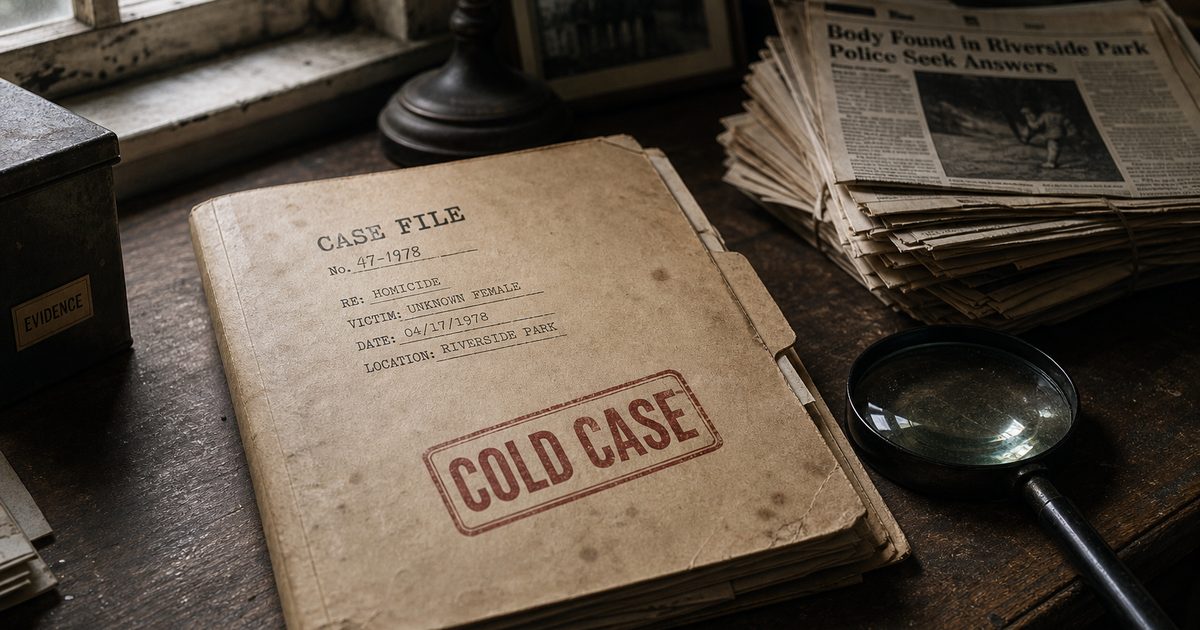
The National Institute of Justice puts it plainly: a case is considered cold when all promising investigative leads have been exhausted. In practice, many unsolved murders reach that point after a year or more, though there is no single national deadline that turns an open case into a cold one. What matters is not the calendar. It is the stall.
And in the United States, that stall happens far too often.
According to national clearance data, roughly one in three murders has gone unsolved over the long term. Researchers have estimated that from 1965 to 2020, about 331,000 homicides in the U.S. were not solved. Other estimates have put the number of open murder cases since 1980 above 200,000. However you measure it, the picture is the same: a vast number of families are left waiting while a file that once carried urgency is moved to a shelf, a box, or a database.
Those numbers can sound abstract until you picture what each one really is. A body at a scene. A family in shock. A detective sure that if he just gets one more break, he can name the person responsible.
Then the case goes quiet.
Why cold cases happen
Most cold cases are violent crimes, especially homicide and sexual assault. They do not go unsolved because no one cared. Most go cold because urgency is not enough.
A fresh investigation burns resources fast. Detectives need time. Crime labs need capacity. Witnesses need to be found and re-interviewed. Evidence has to be collected, preserved, logged, tested, and sometimes tested again. When a department is stretched thin by newer crimes and immediate public pressure, older investigations begin to lose momentum.
That practical reality is behind many unsolved murders. Lack of manpower. Limited funding. Lab backlogs. Evidence that sits too long before it can be examined. A witness who moves away. A tip that should have been pushed harder but was not, because there were only so many hours in the day.
Then there are the mistakes that do not look fatal at first.
A detective locks too quickly onto one suspect and misses another path. Notes are incomplete. A statement is summarized instead of recorded in detail. A piece of evidence is collected but not recognized for what it might later mean. Those early decisions matter because the first days of a homicide investigation are often the most important. If something is missed then, later investigators may spend years trying to recover ground they can never fully get back.
That is one of the cruel truths behind famous cold cases and forgotten ones alike. Time does not just pass. It damages the evidence around a case.
The missed break
From the outside, an unsolved case can look almost mythic, as though it defeated every possible effort. The truth is usually less dramatic and more frustrating.
Sometimes a case was one good break away from moving.
One witness held back a detail out of fear. One informant decided to stay silent. One fingerprint was entered when comparison systems were far less powerful than they are now. One biological sample was too small, too degraded, or simply beyond what the science of the time could do with it.
That does not mean the evidence was useless. It means the case and the available tools were out of step.
This is why some old investigations suddenly come back to life years later. The crime has not changed. What changes is what detectives can do with what was left behind.
Advances in DNA testing have transformed many cold case investigations, though not all. Fingerprint databases have improved. Evidence once considered too limited to help may become testable. A profile that could not be developed in the 1990s may be possible now. In some cases, forensic genetic genealogy has also opened new leads, though that method depends on the quality of the sample, legal limits, and whether comparison data exists.
Even then, there are no guarantees. DNA is powerful, but it is not magic. Some samples are too damaged. Some profiles do not match anyone in law enforcement databases. Some cases simply never had biological evidence to begin with.
Still, one late match can change everything.
When a cold case reopens
The reopening of an investigation rarely begins with a dramatic confession or a detective having a sudden flash of insight.
More often, it starts small.
A cold case unit reviews an old file and notices that a witness was never re-interviewed after changing part of a statement. A lab supervisor realizes an item collected years ago can now be tested with newer methods. A retired detective mentions a lead that never sat right with him. A family member keeps pushing, keeps asking, keeps making sure the victim’s name is not forgotten. Then a new detective looks at the same case without the assumptions that shaped it the first time.
That fresh set of eyes matters.
Many police agencies now use dedicated cold case squads or review teams, though resources vary widely from one department to another. Their work is slower and more methodical than the rush of a brand-new homicide. They go back through old reports, old photographs, old evidence logs, old interviews. They look for what was missed, what can be tested, what was taken at face value but should not have been.
In other words, they try to undo the damage caused by time.
Sometimes the shift comes from people, not science. A witness who was terrified at 19 may be willing to talk at 49. A former friend, spouse, cellmate, or accomplice may decide the secret is no longer worth keeping. A detail that once seemed minor may suddenly matter when it is placed next to everything else in the file.
That is often how cold case detectives make progress: not by finding one giant clue, but by seeing how smaller pieces finally fit.
What time does to a case
By the time a case has gone cold, time has become an active obstacle.
Memories fade first. A witness may still want to help but no longer remember whether the car was blue or black, whether the argument happened on Tuesday or Thursday, whether the man she saw was tall or only seemed tall because he was standing on a curb. Human memory is fragile even in the best circumstances. Trauma makes it worse. Years make it worse still.
Records can also fail. Files get moved. Notes are incomplete. Evidence storage practices that were accepted decades ago may look careless now. A detective reopening an old murder may have only photographs, lab submissions, and reports written by people who are retired, dead, or impossible to locate.
And then there is money.
Cold case work is expensive in a way that is easy to underestimate. Testing old evidence costs money. Reinvestigating old leads takes time away from current cases. Travel, interviews, forensic review, and expert analysis all compete with present-day emergencies. Some agencies have strong cold case programs. Others have one detective trying to revisit years of unsolved murders while still handling new work.
That is why some cases remain open in theory but untouched in practice.
The public sometimes imagines a cold case as a sealed mystery waiting for one brilliant detective. More often, it is a file waiting for resources.
The cases that make headlines, and the ones that do not
When people hear the phrase famous cold cases, they tend to think of notorious names, headline crimes, and documentaries. But the mechanics are often the same whether the victim’s name became national news or barely made the local paper.
An investigation loses momentum. Leads dry up. Early assumptions harden. Evidence waits for technology that does not yet exist. Witnesses stay silent until they do not. A department gets overwhelmed. The file sits.
The difference between a famous case and an almost forgotten one is often not the quality of the evidence or the depth of the loss. It is attention.
That matters because publicity can bring tips, pressure, and funding. But it can also distort the story, shifting focus toward the mystery itself and away from the person who was killed. The better way to understand unsolved murders is not as puzzles for public consumption, but as interrupted lives and unfinished investigations.
Every cold case started as somebody’s worst day. Every one of them belongs to a family that expected answers.
When the file opens again
There is no magic moment that erases the years.
A detective opens a box from storage. An evidence envelope is sent back to a lab. An old fingerprint is scanned again. A witness finally agrees to talk. A name that once floated at the edge of the case moves to the center. Piece by piece, the silence breaks.
Sometimes that leads to an arrest. Sometimes it leads only to a clearer understanding of what happened. Sometimes it confirms what detectives long suspected but could never prove. And sometimes, despite all the work, the case stays unsolved.
That uncertainty is part of the truth of unsolved murders in America. Some will be solved decades later. Some may never be solved at all.
But a case going cold is not the same as a case being finished.
It means the momentum ran out. It means time, technology, fear, error, or lack of resources got there first. And it means that if the file ever moves again, it will probably happen the same way most breakthroughs do in real life: quietly, stubbornly, and because someone refused to let silence be the final word.
FAQ
What makes a case a cold case?
A case is generally called a cold case when all promising investigative leads have been exhausted. There is no single national time limit, though many cases are labeled cold after remaining unsolved for a year or more.
What kinds of crimes usually become cold cases?
Most cold cases involve violent crimes, especially homicide and sexual assault.
Why do cold cases go unsolved?
Common reasons include limited staffing, funding shortages, lab delays, fading witness memories, poor documentation, early investigative mistakes, and evidence that could not be fully tested at the time.
How are cold cases reopened?
They are often reopened because of new forensic technology, renewed witness cooperation, a review by a cold case unit, or new information that changes how older evidence is understood.
Does DNA solve most cold cases?
No. DNA can be crucial, but it does not exist in every case, and not every sample produces a usable or searchable profile.