
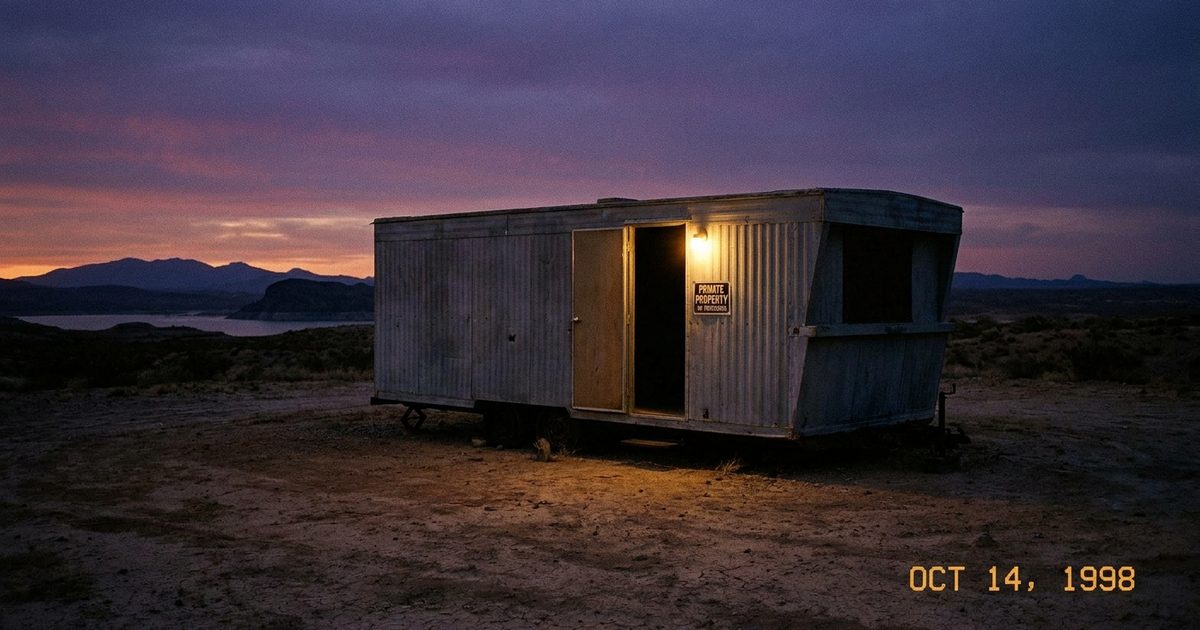
In March 1999, a woman ran barefoot through Elephant Butte, New Mexico, wearing nothing but a metal chain locked around her neck.
She was Cynthia Vigil, and she was trying to stay alive.
Her escape shattered the secrecy around a case that had been hidden in plain sight for years. By the end of that day, police would be looking at a man named David Parker Ray, a state parks maintenance worker and mechanic who had spent years presenting himself as ordinary. What they found behind that ordinary life turned the Toy Box Killer case into one of the most notorious criminal investigations in New Mexico history.
Cynthia Vigil’s escape in Elephant Butte
The case did not begin with a body or a missing-person report finally solved. It began with a survivor.
In March 1999, Cynthia Vigil managed to escape from Ray and run for help through Elephant Butte. Her account gave investigators what they had long lacked: a living witness who could describe what had happened and point them to the place where it happened.
That place was a trailer near Elephant Butte Lake.
Inside, investigators found what would give the case its name: the Toy Box, a soundproofed trailer that had been outfitted for captivity and abuse. It was not a chaotic crime scene or a spur-of-the-moment setup. Authorities said it had been carefully prepared. There were restraints, instruments, and audio recordings apparently meant to control and terrorize victims.
Those recordings mattered. They suggested routine. Planning. Repetition.
And once police stepped inside, Cynthia Vigil’s story no longer stood alone.
The trailer that made the David Parker Ray case infamous
David Parker Ray was born on November 6, 1939, in Belen, New Mexico. By the time of his arrest in 1999, he was in his late fifties and had worked as a mechanic and maintenance employee for the New Mexico State Parks system. People who knew him often described him as quiet, even pleasant.
That contrast became one of the most unsettling parts of the case.
Authorities said the trailer in Elephant Butte had been modified over time into a place built for control. Reports have long stated that Ray referred to it as his “Toy Box.” Investigators found evidence that victims had been restrained there and that recorded tapes were played for them. The details were disturbing enough without embellishment: this was not random violence, but something prosecutors argued had been prepared for and repeated.
For years, investigators came to believe Ray had abducted and abused women, often using drugs to overpower them and, in some cases, to cloud their memories afterward. Some claims around the case grew far beyond what could be proved in court. Ray was widely suspected in multiple disappearances and has often been linked in media reports to dozens of possible victims, but many of those suspicions were never established as homicide cases.
That distinction matters. The proven crimes were horrific on their own. They do not need myth added to them.
The people around him
As the investigation widened, it became clear that Ray had not always acted alone.
His girlfriend, Cindy Hendy, was charged in connection with the kidnapping and abuse of Cynthia Vigil. Another name that surfaced was Ray’s daughter, Glenda Jean “Jesse” Ray. Dennis Roy Yancy, who had been married to Glenda, was also drawn into the broader investigation.
That made the case more troubling, not less. It suggested a circle of people who knew parts of what was happening, helped with it, or were later accused of participating in related crimes.
One of the most haunting details is that warnings had surfaced long before 1999. Glenda Ray reportedly contacted the FBI in 1986 with allegations about her father. The warning did not stop him.
By the time Cynthia Vigil escaped, the chance to intervene had already been missed years earlier.
What investigators could prove, and what they could not
The David Parker Ray case has always existed in two layers.
There is the part that was proved: kidnappings, sexual torture, the trailer in Elephant Butte, the recordings, the testimony of survivors, and the role of accomplices in specific crimes.
Then there is the darker outer ring of suspicion.
Ray has often been described as a suspect in the disappearances or deaths of many women, with some estimates in books and documentaries reaching as high as 60 victims. But no such total was ever proved in court, and no confirmed body count matching those claims was established. No murder conviction was ever secured against him.
That uncertainty is part of why the case still lingers. Investigators believed there were likely more victims than the criminal charges reflected. But belief, suspicion, and proof are not the same thing.
The absence of bodies did not erase the danger he posed. It simply limited what the justice system could formally count.
The investigation inside the Toy Box
Once police had access to the trailer, the case changed shape.
Before Cynthia Vigil’s escape, there had been rumors, fragments, and allegations. Afterward, there was a physical scene to examine. The trailer itself became a central piece of evidence. So did the tapes found inside.
Investigators believed the recordings were used to intimidate victims and lay out what Ray intended to do. That suggested a grim kind of script, something practiced rather than improvised. The setup inside the trailer reinforced that impression.
Years later, the case was still active in another sense. In 2011, the FBI released photographs of items recovered during the investigation in hopes that the public might help identify possible victims or connect belongings to missing women. It was a sign that even after Ray’s death, authorities were still trying to answer basic questions: who had been there, how many women had crossed his path, and how much of the story remained buried.
Arrest, trial, and sentence
Ray was arrested in March 1999 after Cynthia Vigil escaped.
The legal proceedings that followed did not produce a murder trial. Instead, they focused on crimes prosecutors could directly prove. In 2001, David Parker Ray accepted a plea agreement in cases involving kidnapping and torture-related charges. He was sentenced to 224 years in prison.
That sentence was effectively the state’s final answer to the evidence it had.
He did not serve much of it. On May 28, 2002, Ray died of a heart attack before he could spend many years behind bars. He was 62.
His death closed the door on any future prosecution against him. It also left many questions permanently unresolved.
Why the Toy Box Killer case still holds attention
The Toy Box Killer story has remained lodged in public memory for a simple reason: the facts that are confirmed are already difficult to absorb.
A woman escaped in chains and ran for help.
Police found a soundproof trailer prepared for abuse.
Recordings suggested planning and repetition.
Other people around Ray were charged or implicated in related crimes.
And hovering over all of it was the possibility that the known victims were only part of the picture.
Still, the case is strongest when told plainly. Not as legend. Not as internet folklore. As a criminal case in which a survivor’s split-second chance to run exposed years of hidden violence in Elephant Butte.
Cynthia Vigil’s escape is the reason the world knows the name David Parker Ray at all. Without her, the trailer might have remained shut, the evidence inside undiscovered, and the women who survived him unheard.
FAQ
Who was David Parker Ray?
David Parker Ray was a New Mexico mechanic and state parks maintenance worker born on November 6, 1939, in Belen. He was arrested in March 1999 after Cynthia Vigil escaped and later became widely known as the Toy Box Killer.
What was the Toy Box?
The Toy Box was a soundproof trailer in Elephant Butte, New Mexico, that investigators said had been outfitted for captivity and torture. Evidence found inside became central to the case against David Parker Ray.
How was David Parker Ray caught?
He was caught after Cynthia Vigil escaped in March 1999 and ran for help. Her testimony led police to Ray and to the trailer authorities called the Toy Box.
Was David Parker Ray convicted of murder?
No. Although he was suspected in other possible crimes, David Parker Ray was not convicted of murder. In 2001, he took a plea deal and received a 224-year sentence on kidnapping and related charges.
How many victims did David Parker Ray have?
The exact number is unknown. Investigators believed there were more victims than the charged cases reflected, and media reports have cited estimates as high as 60, but those figures were never proved in court.