A package on a desk can look harmless right up to the moment it isn’t.
That was the terror at the heart of the Unabomber case. For nearly 17 years, from May 1978 to April 1995, bombs arrived through the mail or were left where someone would pick them up without a second thought. A professor’s office. An airline route. A computer store. A home. By the time the campaign ended, three people were dead and 23 others had been injured.
For investigators, the nightmare was not just the violence. It was the absence of a pattern that made ordinary sense. The victims did not know one another. The attacks were spread across the country. The devices were handmade from common materials and often yielded little that could be traced. The man later identified as Ted Kaczynski seemed to appear, vanish, and then strike again.
The first blast, and the first confusion
The opening attack did not announce itself as the start of one of the longest manhunts in FBI history.
On May 25, 1978, a package addressed to a Northwestern University engineering professor was returned and eventually opened at the University of Illinois at Chicago. It exploded and injured campus police officer Terry Marker. At that stage, authorities had no reason to see a long campaign. It looked like a single bombing, ugly and dangerous, but not yet part of a national pattern.
Then came a far more alarming escalation.
On November 15, 1979, a bomb exploded aboard American Airlines Flight 444 after the plane left Chicago for Washington, D.C. Twelve passengers were treated for smoke inhalation. The device failed to cause the catastrophe it might have, but the message was unmistakable: the bomber was willing to attack in places where strangers gathered and where panic could spread fast.
That same year, the FBI created the UNABOM task force, its name drawn from the early target pattern: universities and airlines. Even then, the case resisted easy theories. Investigators considered whether the bomber might have ties to aviation or science. For a time, even the bomber’s sex was uncertain.
On June 10, 1980, another package bomb injured Percy Wood, president of United Airlines, at his home in Lake Forest, Illinois. The list of targets was growing, but the person behind them remained a shadow.
A bomber with no obvious personal motive
What made the Unabomber investigation so difficult was not only the technical care behind the devices. It was the emotional distance.
These were not revenge attacks in the usual sense. The victims were not former friends, lovers, business partners, or neighbors. They were selected, prosecutors later argued, because of what they represented: universities, airlines, computers, industry, modern systems. The bombs were carrying an argument long before the public knew exactly what that argument was.
Years sometimes passed between attacks. That did not calm fear. It deepened it. A long silence meant the bomber could be anywhere, building, waiting, choosing the next moment.
On December 11, 1985, the campaign turned fatal. Hugh Scrutton, who owned a computer rental store in Sacramento, California, was killed by a bomb left in the parking lot behind his business. He was the first person to die in the series of attacks.
The next major clue came after another bombing on February 20, 1987, when Gary Wright, a computer store owner in Salt Lake City, Utah, was injured. A witness reported seeing a hooded man leaving the area. From that account came the first widely circulated sketch: sunglasses, mustache, hood. It became one of the most recognizable images in the case, and one of the most frustrating. It gave the public a face, but not a name.
Investigators also recovered bomb parts marked with the initials “FC,” which they believed stood for “Freedom Club.” It sounded like a signature, but it still did not identify the bomber.
Silence, then a return with deadly precision
After the 1987 attack, the bombings stopped for years.
That gap might have suggested the case had gone cold for good. It had not. When the campaign resumed, it did so with chilling control.
On June 22, 1993, a bomb injured Charles Epstein, a geneticist, at his home in Tiburon, California. Two days later, on June 24, 1993, another device badly injured Yale computer science professor David Gelernter in New Haven, Connecticut. The timing felt deliberate, almost taunting. Whoever had built the bombs had not changed course. He had simply waited.
Then the killings resumed.
On December 10, 1994, Thomas J. Mosser, an advertising executive with Burson-Marsteller, was killed when he opened a package at his home in North Caldwell, New Jersey.
On April 24, 1995, Gilbert P. Murray, president of the California Forestry Association, was killed by a mail bomb in Sacramento. The package was addressed to another executive at the association, William Dennison, but Murray opened it.
By then, the attacks no longer looked random in the ordinary sense. They still lacked personal ties, but a worldview was beginning to show through. The future Ted Kaczynski manifesto would make that worldview explicit: hostility toward industrial society, modern technology, and the systems he believed were stripping human beings of freedom.
That ideology was real. So was the violence used to enforce it.
The manifesto that changed the case
In September 1995, the investigation took a turn that would have seemed improbable at the start: the government agreed to help publish the bomber’s words.
His essay, Industrial Society and Its Future, ran to about 35,000 words and was published jointly by The Washington Post and The New York Times after federal officials approved the move. It was an extraordinary decision, made under pressure and with the hope that someone, somewhere, would recognize the voice behind the argument.
That is exactly what happened.
David Kaczynski read the manifesto and felt something deeply unsettling. The phrasing, the ideas, the cadence of the writing reminded him of his brother Theodore. David’s wife, Linda Patrik, urged him to take that fear seriously. He eventually contacted investigators and provided family letters and other writings for comparison.
The breakthrough did not come from a fingerprint lifted off a bomb fragment. It came from language.
FBI analysts compared the manifesto with earlier writings by Theodore Kaczynski and found strong similarities. The linguistic evidence was not the only basis for the investigation, but it gave agents a path they had lacked for years: from anonymous ideology to a specific suspect.
The cabin near Lincoln, Montana
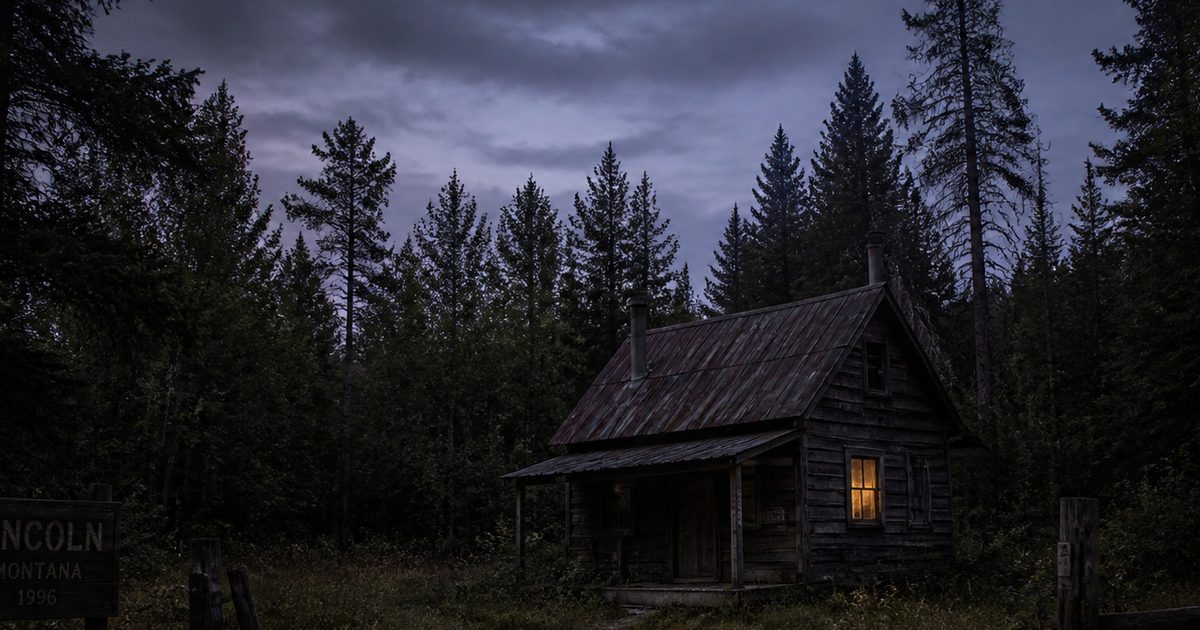
On April 3, 1996, FBI agents arrested Theodore John Kaczynski at his remote cabin outside Lincoln, Montana.
By then, the image of the isolated shack had already begun to harden into legend. In reality, what mattered was not the symbolism of the place but what agents found inside it.
The cabin was small, roughly 10 by 12 feet, and lacked electricity and running water. Inside, investigators found bomb-making components, a live bomb ready for mailing, and a large body of handwritten journals. According to prosecutors, those journals documented experiments, plans, and details of the bombing campaign. Agents also recovered the original typed manuscript of Industrial Society and Its Future.
After years of dead ends, the search produced what the investigation had always needed: direct physical evidence tying the suspect to the crimes.
The man arrested there was not an unknown drifter. Ted Kaczynski had once been celebrated for his intellect. He entered Harvard at a young age, earned a PhD in mathematics from the University of Michigan, and later taught at the University of California, Berkeley. He resigned from Berkeley in 1969. In 1971, he moved to Montana, where he lived in increasing isolation.
Those facts have often been treated as the dark irony of the case, and they are. But they should not distract from the people whose lives were shattered by the bombs. Intelligence did not make the crimes mysterious or noble. It only made them harder to stop.
The legal fight that never became a full trial
The federal case against Kaczynski moved toward trial, but it never reached a jury verdict in the usual way.
He was charged with multiple bomb-related offenses and three counts of murder in connection with the deaths of Hugh Scrutton, Thomas Mosser, and Gilbert Murray. A fierce dispute developed between Kaczynski and his lawyers. His defense team considered presenting evidence of mental illness. He resisted that strategy and insisted he was competent and sane.
That conflict became one of the most discussed parts of the Ted Kaczynski case. Was he best understood as an ideologue, a deeply disturbed man, or both? The legal system never fully tested that question before a jury, because the case ended in a plea.
On January 22, 1998, Kaczynski pleaded guilty to all federal charges as part of an agreement that spared him the death penalty. On May 4, 1998, he was sentenced to four life terms plus 30 years, without the possibility of parole. He was also ordered to pay more than $15 million in restitution.
He later tried to withdraw the plea, arguing that he had been coerced and wrongly portrayed as mentally ill. Courts rejected those efforts.
Kaczynski died in federal custody on June 10, 2023.
Why the Unabomber case still matters
What lingers about the Unabomber bombings is not only their length, but their method. The campaign exploited trust in ordinary routines. Open the mail. Receive a package. Do your job. Step into a store. The attacks turned routine acts into moments of doubt.
The case also showed how difficult it can be to identify a lone domestic terrorist who leaves little forensic evidence and chooses targets by symbolism rather than personal grievance. In the end, the decisive clue was not hidden in metal fragments or a dramatic pursuit. It was in the bomber’s own sentences.
A brother recognized the voice. A family made the call. And after years of fear, that was what finally brought the bombing campaign to an end.
FAQ
How many people did the Unabomber kill?
Three people were killed: Hugh Scrutton, Thomas J. Mosser, and Gilbert P. Murray.
When was Ted Kaczynski arrested?
He was arrested on April 3, 1996, at his cabin near Lincoln, Montana.
How was the Unabomber caught?
Theodore Kaczynski’s brother, David Kaczynski, recognized similarities between the published manifesto and his brother’s writing, then contacted the FBI. That tip helped lead to a search warrant and arrest.
What was the Unabomber manifesto?
It was a roughly 35,000-word essay titled Industrial Society and Its Future, published in September 1995 in The Washington Post and The New York Times.
What was Ted Kaczynski’s motive?
His writings showed a sustained ideological opposition to industrial society and modern technology. Prosecutors argued that belief system was central to the attacks.