
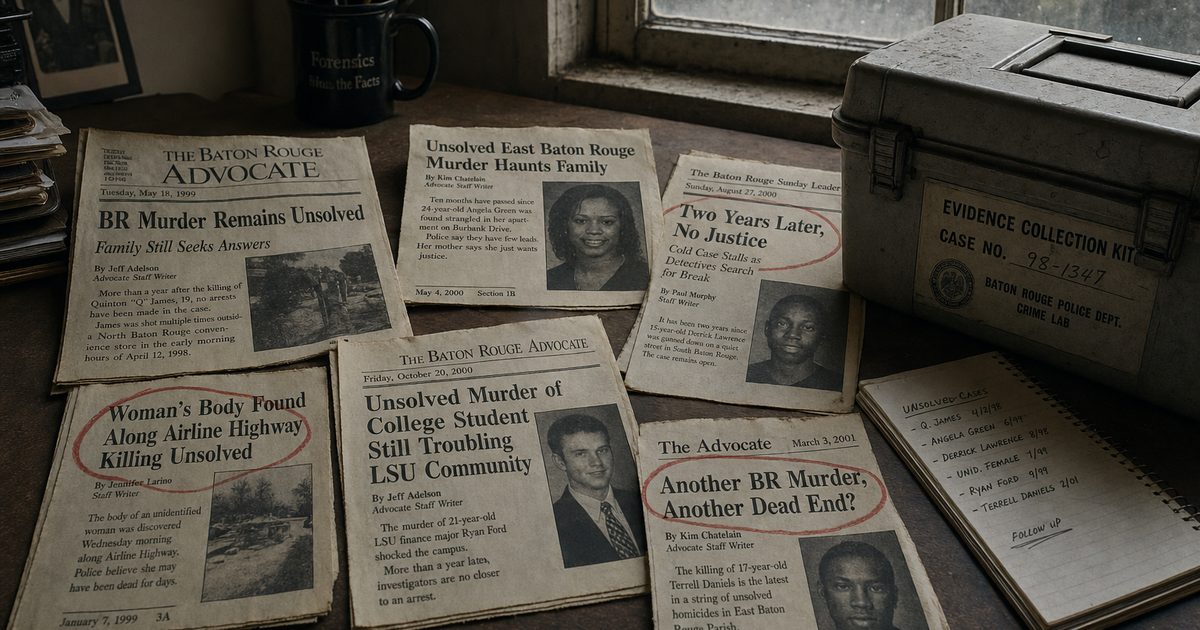
A telephone line cut off in the middle of ordinary life can say more than a broken window ever could.
That detail kept surfacing in southern Louisiana. A woman vanished. A home showed no obvious sign of forced entry. Then another woman was attacked, and another. Across Baton Rouge and the nearby towns, fear settled into daily routines. Women changed how they parked, how they jogged, how they answered the door. Families stopped assuming home meant safe.
What investigators eventually uncovered was not one isolated killing, but a years-long hunt for a man who moved through neighborhoods with terrifying ease. The case that came to define the Baton Rouge serial killer investigation led to Derrick Todd Lee, a Louisiana man later tied by DNA evidence to the deaths of seven women between 1998 and 2003. He was convicted in two murders. He never confessed.
The first signs that something was very wrong
The names at the center of this story should come first.
Randi Mebruer, a 28-year-old mother from Zachary, disappeared in April 1998. Gina Wilson Green, a 41-year-old nurse, was killed in September 2001. Geralyn Barr DeSoto, a 21-year-old college student, was murdered in Addis in January 2002. Charlotte Murray Pace, 22, an LSU graduate student, was killed in May 2002. Pamela Kinamore, 44, an antique store owner, was abducted in July 2002. Trineisha Dene Colomb, 23, a former Army service member planning to join the Marines, was killed in September 2002. Carrie Lynn Yoder, 26, another LSU graduate student, was killed later that year.
At first glance, the cases did not line up neatly. The women were different ages. They lived different lives. They were taken from different places. That made the pattern harder to see, and easier to miss.
But fear was already spreading. The Baton Rouge area was dealing with an alarming number of unsolved killings of women. Residents did not know whether one predator was responsible or several. In fact, another serial killer, Sean Vincent Gillis, was operating in the same region during part of that period, a grim overlap that added confusion to an already tangled investigation.
Still, certain details kept returning. In some cases, there was no forced entry. In others, phones had been disabled or removed. Sexual assault was part of the pattern investigators were tracing. The scenes were not identical, but they were not random either.
Derrick Todd Lee was not the man police focused on first
One of the most damaging turns in the case came early: investigators initially worked from the belief that the killer was white.
Lee, who was Black, did not fit that assumption. Time was lost.
That mistake matters because by the time authorities corrected course, women had already died. The investigation had been shaped by witness accounts, profiling, and the natural pressure to find order in chaos. But the profile was wrong.
Lee had a criminal record long before his name became known across Louisiana. Public records showed arrests and convictions for crimes including burglary and other offenses tied to stalking, trespassing, and voyeuristic behavior. He worked various jobs, including as a laborer and truck driver, and he was married. Nothing about his daily life made him stand out to a frightened public at first.
Not until the forensic evidence began to speak more clearly than the assumptions did.
DNA changed the direction of the hunt
This was the turning point in the Baton Rouge killer case.
Investigators recovered DNA from multiple crime scenes and used it to link several attacks to the same offender. Just as important, the testing indicated the suspect was African American, forcing police to abandon the racial profile that had steered the case in the wrong direction.
That correction did not solve everything overnight. It did, however, give the investigation a spine.
There were other clues. A surviving victim from an attempted rape gave police a description and helped produce a sketch. A footwear impression was recovered. In one attack, a computer cord used in an attempted strangulation later became significant because of its similarity to evidence in a murder case. Piece by piece, the separate files began to look less like isolated tragedies and more like one man’s path through the region.
By then, the pace of the killings had become impossible to ignore. Geralyn DeSoto was murdered in January 2002. Charlotte Murray Pace was killed in May. Pamela Kinamore was abducted in July. Trineisha Colomb was killed in September. Carrie Yoder was murdered in late 2002, her body found in March 2003.
For investigators, every new case raised the stakes. For families, each one deepened the grief. For women in south Louisiana, it reinforced the same awful thought: he was still out there.
The net tightened in the spring of 2003
The final break came through a combination of old-fashioned police work and forensic science.
Authorities had begun looking more closely at Lee’s history and movements. A DNA warrant was obtained after investigators connected his background and the developing evidence. According to reporting from the time, police used discarded items to obtain a sample for comparison. When the results came back, the case shifted fast.
The DNA match put Derrick Todd Lee at the center of the investigation.
An arrest warrant was issued on May 26, 2003. The next day, May 27, he was arrested near Atlanta, Georgia, after leaving Louisiana. For the public, the news landed with the force of release more than triumph. The fear that had hung over Baton Rouge for years finally had a face, but that did not make the losses easier to bear.
Lee was linked by DNA to seven killings. He was also considered a suspect in other cases, including the 1992 murder of Connie Warner and the disappearance of Randi Mebruer. But suspicion and proof are not the same thing. In some of those cases, he was never tried or convicted.
That distinction matters in a story like this. The known facts are heavy enough.
What the courts proved
The first murder trial centered on Geralyn Barr DeSoto.
In August 2004, Lee was tried for her killing. The trial was brief, and the jury returned a guilty verdict after less than two hours of deliberation. He was convicted of first-degree murder and sentenced to life in prison without parole.
A second major trial followed in the case of Charlotte Murray Pace. On October 14, 2004, Lee was convicted of first-degree murder and rape in her death. He was sentenced to death.
He continued to maintain his innocence. There was no confession, no courtroom admission, no final explanation that tied everything into a neat ending. The evidence presented against him was forensic, circumstantial, and cumulative, built from the links between scenes and the DNA that connected them.
His appeals continued for years. In January 2008, the Louisiana Supreme Court upheld his conviction and death sentence in the Pace case. He remained on death row until January 21, 2016, when he died of heart disease.
Why the Baton Rouge serial killer case still lingers
Some murder cases are remembered for one night, one house, one mistake. This one is remembered for something broader and more unsettling: a predator moved through a frightened community while investigators were looking in the wrong direction.
It is also remembered because the region was dealing with more than one killer at the same time. That overlap blurred patterns, complicated timelines, and made public fear even worse. Without DNA, some of these crimes might have remained disconnected in the public mind and in the case files.
But the forensic evidence did more than identify a suspect. It corrected a false assumption. It separated rumor from proof. It gave prosecutors enough to win convictions in court.
Even so, the story does not belong to the man who was caught. It belongs to the women whose lives were cut short, and to the families who spent years waiting for answers that came too slowly.
Randi Mebruer. Gina Wilson Green. Geralyn Barr DeSoto. Charlotte Murray Pace. Pamela Kinamore. Trineisha Dene Colomb. Carrie Lynn Yoder.
Those are the names that remain.
FAQ
Who was the Baton Rouge serial killer?
Derrick Todd Lee was a Louisiana man tied by DNA evidence to seven murders committed between 1998 and 2003. He was convicted in two of those killings.
How many victims did Derrick Todd Lee have?
He was linked by investigators to seven murdered women. In court, he was convicted of killing Geralyn DeSoto and Charlotte Murray Pace.
When was Derrick Todd Lee caught?
Police issued an arrest warrant on May 26, 2003, and he was arrested the next day, May 27, near Atlanta, Georgia.
How did police identify Derrick Todd Lee?
The breakthrough came from DNA recovered at multiple crime scenes, along with witness information from a surviving victim and other investigative links.
Did Derrick Todd Lee ever confess?
No. He maintained his innocence and never confessed to the murders.