
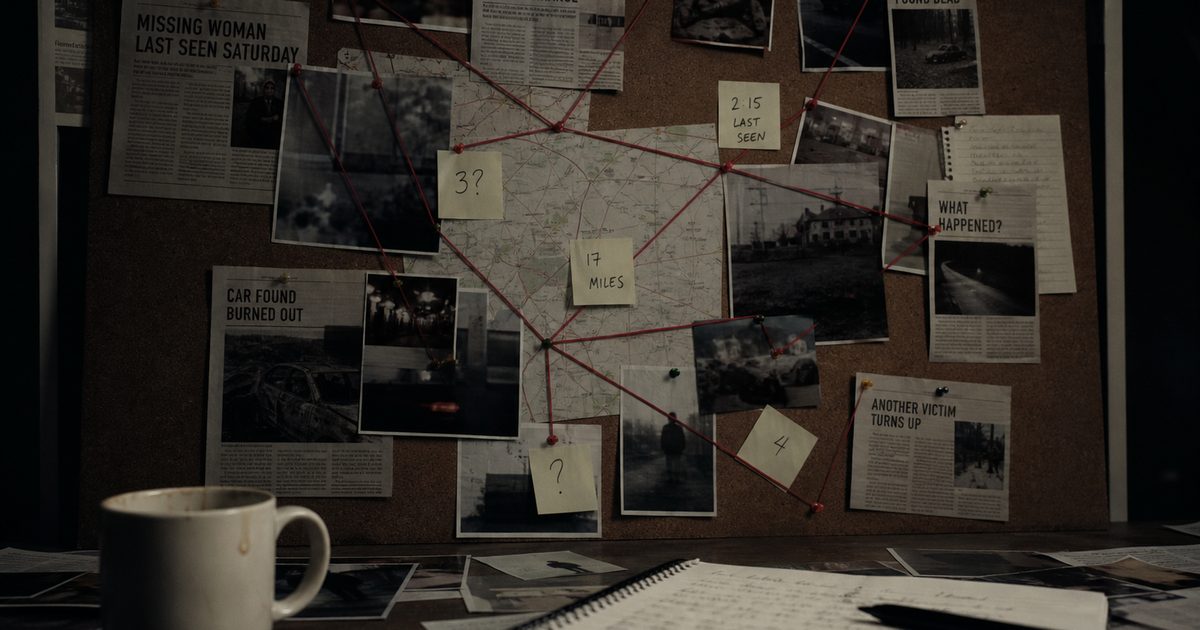
A body on its own can look like one terrible night.
That is the first problem in a serial killer investigation. One victim is mourned, one scene is processed, one file is opened. Detectives focus on the obvious questions: who was this person, where were they last seen, who had reason to hurt them? Nothing about that first case necessarily announces what may come next.
Then another killing happens weeks later. Or months later. In another neighborhood, another town, another jurisdiction. The victims may not know each other. The methods may not match perfectly. There may be no witness who can say, with certainty, that the same person was there both times.
The pattern, if there is one, usually reveals itself slowly. And by the time it does, several lives may already have been lost.
When separate murders start to look connected
That is what makes serial killings so difficult to detect in real time. They do not usually arrive as one obvious event. They arrive in fragments.
Criminologists and law enforcement agencies generally define a serial killer as someone who murders multiple victims in separate incidents, with a break, often called a cooling-off period, between the crimes. Some sources have long used “three or more victims” as the benchmark, though more recent U.S. federal definitions have at times used two or more. The exact threshold can vary by agency, but the core idea stays the same: repeated killings over time, not one single burst of violence.
That distinction matters. A mass murderer kills multiple people in one event. A spree killer commits multiple killings over a short period without that meaningful pause. Serial murder is different. The gap between crimes is part of the story.
It is also what allows the offender to disappear back into ordinary life, at least for a while.
The pause between crimes is where cases are lost
In films, a detective spots a clue, pins photographs to a board, and suddenly sees the whole design.
Real investigations are rarely that clean.
Most homicide cases begin with the victim, not the theory. Detectives work the scene. They establish a timeline. They collect trace evidence, phone records, CCTV, witness statements, vehicle sightings, digital trails. They look at injuries, location, and whether the victim appears to have been targeted or encountered by chance.
Only later does comparison begin to matter.
Did another victim vanish under similar circumstances? Was there a repeated approach, the same kind of ruse, the same kind of location, the same kind of vulnerability? Did the offender return to a familiar hunting ground? Did the timing suggest random violence, or something more deliberate?
That is often the turning point in a serial murder case: not a confession, not a dramatic arrest, but recognition.
One detective notices that two victims fit the same pattern. Another realizes the scenes share details that had seemed unimportant on their own. A supervisor asks for old files to be reopened. Suddenly, what looked like isolated tragedies begins to read as one unfolding story.
Why vulnerable victims are so often overlooked
One of the bleakest truths in serial killer investigations is that many offenders target people they believe will not be missed quickly or investigated urgently enough.
Victims in known serial murder cases have often included sex workers, homeless people, migrants, runaways, elderly patients, and others living at the edges of public attention. That does not mean every case follows that pattern, but it is common enough to shape how detectives think once links begin to emerge.
The reason is brutally practical. Vulnerable people can be easier to approach, easier to isolate, and, in some cases, slower to trigger a coordinated response when they disappear.
That is why missed connections matter so much. If one victim’s life is treated as less urgent, the offender may get the time needed to kill again.
What investigators actually look for
Once police suspect a pattern, the case changes shape. It is no longer just about solving one homicide. It becomes a race to understand behavior before another attack.
Investigators start comparing everything they can:
- victim age, sex, lifestyle, and routines
- where bodies were found versus where victims were last seen
- method of killing
- signs of planning or control
- whether personal items were taken, moved, or staged
- whether the offender appears organized, chaotic, or somewhere in between
Those labels, organized, disorganized, mixed, are not there to make the case sound dramatic. They are working tools, and imperfect ones. They help investigators think through practical questions: Did the offender bring a weapon? Did they choose the location? Did they try to avoid forensic evidence? Did they know the victim, or select a stranger?
Behavioral analysis can help here, but it is not magic. The FBI’s Behavioral Science Unit became famous for trying to interpret crime-scene behavior, and profiling still plays a role in some major cases. But no profile solves a murder by itself. Evidence does that. A profile is useful only if it helps narrow options, prioritize leads, or anticipate what the offender may do next.
Motive is rarely simple
People always ask the same question: why?
There is no single answer, and any article that offers one neat explanation is overselling certainty.
In documented serial killings, motives have included sexual gratification, power and control, anger, financial gain, revenge, attention-seeking, and thrill-seeking. Some offenders kill as part of fantasy. Some for domination. Some for money. Some because they believe they are entitled to decide who lives and who dies.
A few cases involve caregivers who murder those in their care. Others involve hate, delusion, or a deeply repetitive ritual. Some offenders show clear signs of planning. Others are erratic. Some fit no clean category at all.
That is why investigators do not start with a stereotype. They start with the facts and build outward.
The myths that get in the way
Popular culture has done real damage to public understanding of serial killers.
The myth is that they all look alike: male, brilliant, socially invisible, monstrous in some instantly recognizable way. The reality is less tidy. Most known serial killers have been men, but beyond that, there is no single face, class background, ethnicity, or life story that reliably identifies one before the evidence does.
Another myth is that psychology alone can explain everything. It cannot.
Researchers have found recurring traits in many offenders, lack of empathy, manipulation, shallow affect, disregard for social rules, absence of remorse. Some have histories of childhood abuse or neglect. Some have personality disorders or severe antisocial traits. But none of those factors creates a simple formula, and plenty of people with traumatic childhoods never commit violence.
The danger in oversimplifying motive or personality is that it turns a real investigation into a cartoon.
The moment a homicide inquiry becomes a serial case
There is a distinct shift when detectives stop asking whether a murder is linked and start working from the assumption that it probably is.
Resources expand. Old case files are reviewed. Jurisdictions that may not have shared information before are pushed to compare notes. Analysts build timelines across months or years. Media strategy changes. Public warnings may be issued. Interview tactics become more focused, especially if police believe the offender is following a routine or returning to familiar areas.
That stage is often where progress is made, but it is also where pressure becomes intense. If the pattern is real, then every day without an arrest carries the possibility of another victim.
This is the part of the story that keeps public attention. Not because the killer is fascinating, but because the structure of the case is so tense: confusion, then suspicion, then pattern, then the hard work of proving that pattern in court.
And court is where speculation has to stop. Detectives may suspect links long before prosecutors can prove them. Some deaths remain strongly suspected but never formally charged. In other cases, an offender is convicted of a handful of murders while investigators believe the true number is higher. The difference between alleged and proven matters.
Why these cases stay with people
People do not keep reading about serial murder only because they are frightened. They read because these cases unfold like a grim puzzle built from real lives, real absences, and real missed chances.
But the most important truth is also the simplest one: the story is not about the offender’s mythology. It is about the victims, the families waiting for answers, and the investigators trying to spot a pattern before it repeats.
Every serial case begins with someone whose death should have mattered on its own.
The tragedy is how often it takes another death to make the world see the connection.
FAQ
What is the definition of a serial killer?
A serial killer is generally understood to be someone who commits multiple murders in separate incidents, with cooling-off periods between them. Some agencies use three or more victims; others use two or more.
How are serial killings different from mass murder or spree killing?
Mass murder happens in one event. Spree killing involves multiple murders over a short period without a meaningful break. Serial killings involve separate crimes over time.
How do police link serial killings?
Investigators compare victim profiles, timelines, locations, methods, forensic evidence, and offender behavior. Links are usually built gradually, not through one dramatic clue.
Are serial killings common?
No. They are rare, including in the Netherlands. That rarity is one reason early cases may not immediately be recognized as connected.
Do serial killers all fit one profile?
No. While many known offenders share traits such as lack of empathy or manipulativeness, there is no single background or personality type that identifies every serial killer.