
A single shoe print kept turning up in houses where lives had been shattered.
Not a dramatic clue at first glance. Just the tread of an Avia sneaker, stamped into the aftermath of attacks that seemed to have no logic at all. Different neighborhoods. Different victims. Different weapons. For months, Southern California was trying to make sense of crimes that refused to line up neatly. By the time police publicly acknowledged a serial killer was moving through the state, fear had already settled into bedrooms, living rooms, and late-night routines.
The man behind that panic was Richard Ramirez. The crimes later tied to the Night Stalker case stretched from the Los Angeles area to the Bay Area, and they left investigators chasing a predator who chose victims at random and struck with unnerving speed.
The first killing linked to Richard Ramirez
Long before the name Richard Ramirez was known statewide, a 9-year-old girl named Mei Leung was killed in San Francisco on April 10, 1984. At the time, her murder was not connected to the spree that would later terrify California. That link came much later, when DNA evidence identified Ramirez as her killer.
The first murder tied to the main Los Angeles investigation came on June 28, 1984. Jennie Vincow, 79, was found dead in her Glassell Park apartment after a sexual assault and stabbing. Detectives could not know then that one fingerprint recovered at her home would eventually help break the case open.
For a while, the trail seemed to go cold. Then, months later, the violence returned with force.
A spree with no pattern the public could trust
On March 17, 1985, Dayle Okazaki, 34, was shot and killed in Rosemead. Maria Hernandez, 22, was also shot but survived. Later that same day, in Monterey Park, Tsai-Lian Yu, 30, was dragged from her car and shot. She died the next day.
Ten days later, on March 27, Vincent Zazzara, 64, was shot to death in Whittier. His wife, Maxine Zazzara, 44, was also killed in an attack that showed just how brutal the spree had become.
That was part of what made the Richard Ramirez murders so hard to grasp. There was no clear victim profile. Elderly women living alone. Married couples. People in apartments and people in houses. Some victims were shot, others stabbed or beaten. The randomness was not a side detail. It was the reason the fear spread so widely.
No one could tell themselves they were outside the pattern, because there barely seemed to be a pattern at all.
Detectives start to see what others missed
At first, many of the crimes were handled as separate investigations. On paper, that made sense. A shooting in one city did not automatically point to a stabbing in another. But detectives Gil Carrillo and Frank Salerno of the Los Angeles County Sheriff’s Department began pulling the threads together.
They had witness accounts from survivors. They had ballistics linking some of the shootings to a .22-caliber revolver and a .25-caliber handgun. They had strange details left behind at scenes, including pentagrams and Satanic references. And they had those Avia shoe prints.
Meanwhile, the attacks kept coming.
On May 14, 1985, William “Bill” Doi, 66, was shot to death in Monterey Park. On May 29, Mabel Bell Keller, 83, and Florence Lang, 81, were attacked in Monrovia; Keller later died from her injuries on July 15.
Then came a grim run through early summer. Patty Elaine Higgins, 32, was killed in Arcadia on June 27. Mary Louise Cannon, 75, was killed in Arcadia on July 2. Joyce Lucille Nelson, 61, was beaten to death in Monterey Park on July 7.
People began changing how they lived. Windows were checked twice. Guns sold quickly. Neighbors compared locks, dogs, porch lights, and rumors. The press gave the unknown attacker a name that stuck: the Night Stalker.
The summer when California understood the danger
By July, the scale of the crimes was becoming impossible to dismiss.
On July 20, 1985, Chainarong Khovananth, 32, was shot and killed in Sun Valley. His wife, Somkid Khovananth, survived a sexual assault and beating. That same day, in Glendale, Max Kneiding, 68, and his wife, Lela Kneiding, 66, were shot to death.
Then, on August 6, Christopher Peterson, 38, and Virginia Peterson, 27, were shot in Northridge and survived. Two days later, on August 8, Elyas Abowath, 35, was shot to death in Diamond Bar, while his wife, Sakina Abowath, survived an assault.
That same day, Los Angeles County Sheriff Sherman Block publicly announced that Southern California was hunting a serial killer. The official warning changed the mood at once. What had felt like rumor and dread was now confirmed.
And still the attacks did not stop.
On August 18, Peter Pan, 66, was killed in San Francisco. His wife, Barbara Pan, survived a beating, sexual assault, and gunshot wound. The geography of the case had widened. This was no longer only a Los Angeles story.
Mission Viejo and the break investigators needed
In the early hours of August 24, 1985, Ramirez entered the Mission Viejo home of William Carns, 30, and Inez Erickson, 29. Carns was shot. Erickson survived a sexual assault and gave investigators something they desperately needed: a close account of the attacker.
Another survivor in the broader investigation had already provided a crucial lead by noting the license plate of a stolen car connected to the crimes. That vehicle, an orange Toyota, was found abandoned on August 28 in Wilshire Center, Los Angeles.
Ramirez had left in a hurry. Inside and around that car, investigators found more evidence. But the biggest break was still waiting in a file from the Vincow murder.
The fingerprint recovered from Jennie Vincow’s home was run through a computerized database. That mattered. Earlier methods often required police to have a suspect in mind before a comparison could be made. This time, the system produced a name: Richard Ramirez, whose prior arrests included auto theft and drug offenses.
After more than a year of scattered terror, the killer was no longer a ghost.
Richard Ramirez gets a face
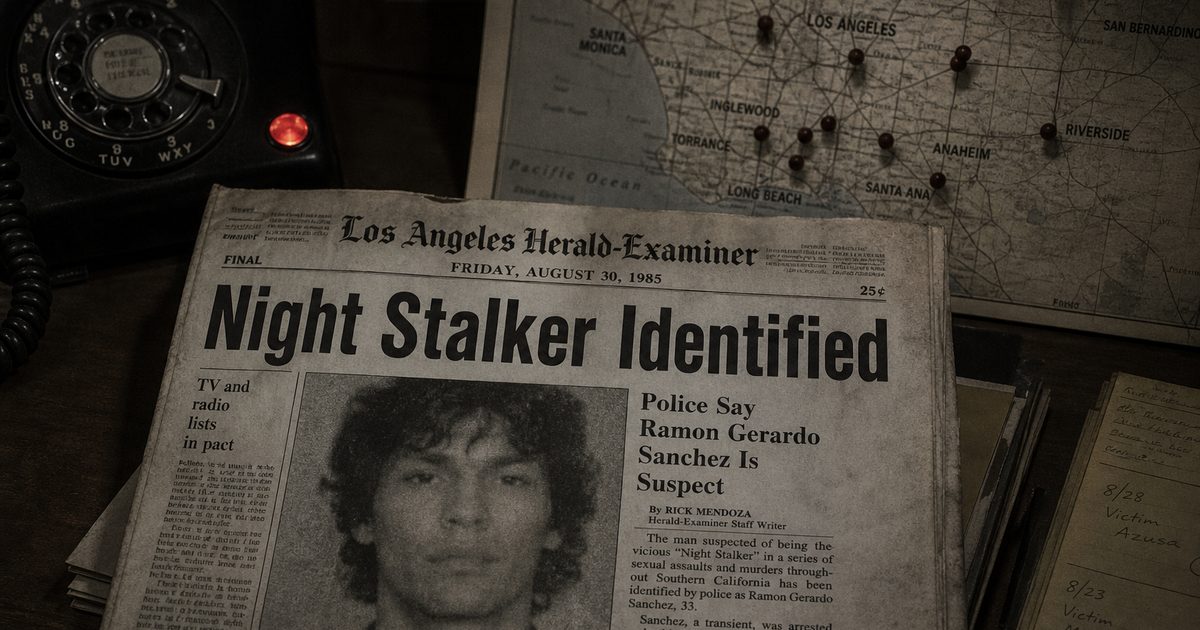
On August 30, 1985, authorities released the name and photograph of Richard Ramirez to the public.
It was a risky moment. Detectives had a suspect, but not a man in custody. Once his face was everywhere, he would know the hunt had closed in.
The next day, August 31, the manhunt ended not in a carefully staged arrest but in the street.
Ramirez had returned to East Los Angeles and was recognized by residents who had seen his image in the news. He tried to flee. A group chased him, pulled him from a car after he attempted another escape, and held him until police arrived. In a case built on fear and randomness, the ending came through instant public recognition.
That scene became one of the most remembered parts of the Richard Ramirez case. Not because it was cinematic, but because it showed how quickly the balance had shifted. For months, he had moved through other people’s homes under cover of darkness. Now the public knew exactly who he was.
Trial, conviction, and sentence
Prosecutors charged Ramirez with 13 counts of murder, 5 attempted murders, 11 sexual assaults, and 14 burglaries in the Los Angeles case.
His trial began in Los Angeles Superior Court on July 22, 1988, though jury selection and delays made the process long and chaotic. In court, Ramirez behaved in ways that drew heavy attention, including displaying a pentagram on his hand and shouting “Hail Satan.” Those moments fed the image already attached to the case, but the heart of the trial was the evidence: survivor testimony, ballistics, fingerprints, stolen property, and the web detectives had built across multiple crime scenes.
On September 20, 1989, he was convicted on all charges. On November 7, 1989, he was sentenced to death.
The California Supreme Court upheld the convictions and death sentence on August 7, 2006. Appeals were still pending when Ramirez died on June 7, 2013, from complications related to B-cell lymphoma while on death row.
Why the Night Stalker case still holds its grip
Some serial cases are remembered because the offender followed a recognizable pattern. This one lingers for the opposite reason.
The Night Stalker attacked across age, class, and neighborhood lines. He did not need a single type. That made ordinary life feel unstable. A locked door did not seem like enough. Neither did a quiet street, a spouse in the next room, or the assumption that violence belonged somewhere else.
The investigation also marked a turning point in how old-fashioned detective work and newer forensic tools could meet in the middle. Survivors mattered enormously. So did shoe prints, ballistics, stolen property, and a car left behind. But the fingerprint from Jennie Vincow’s apartment was the hinge. Once it was run through the right system, the case moved from terror without a face to a suspect with a name.
Ramirez was convicted of 13 murders in the Los Angeles trial. He was later linked by DNA to Mei Leung’s killing in San Francisco. Investigators and reporters have long suspected the full number of victims may be higher, but only proven and charged crimes belong at the center of the story.
And that story is grim enough on its own: a state on edge, survivors who helped stop a killer, and one sneaker print that kept appearing where it should not have been.
FAQ
How many people did Richard Ramirez kill?
He was convicted of 13 murders in the Los Angeles case. He was later linked by DNA to the murder of Mei Leung in San Francisco.
When was Richard Ramirez caught?
He was captured on August 31, 1985, after residents in East Los Angeles recognized him from his publicly released photograph.
How was the Night Stalker case solved?
Investigators connected the crimes through survivor testimony, ballistics, Avia shoe prints, a stolen vehicle, and a fingerprint recovered from Jennie Vincow’s home that identified Richard Ramirez.
What was Richard Ramirez’s motive?
No single clear motive was established in court. The crimes showed burglary, sexual violence, domination, and lethal violence, but many attacks appeared opportunistic and random.
How did Richard Ramirez die?
He died on June 7, 2013, from complications related to B-cell lymphoma while on death row in California.