Three envelopes landed in Bay Area newsrooms on July 31, 1969. Inside were pages of cramped handwriting, a third of a cipher, and a claim that turned two seemingly separate attacks into one of the most notorious unsolved murder cases in America.
Until that morning, detectives in Northern California were working two brutal crimes against young couples. After the letters, they were dealing with something else entirely: a killer who wanted an audience.
A few days later, in a letter postmarked August 4 and sent to the San Francisco Examiner, he introduced himself in a line that would outlive every lead, every suspect, every false hope: “This is the Zodiac speaking.”
A lonely road near Benicia
The first attack later tied to the Zodiac happened on December 20, 1968, on Lake Herman Road, a dark stretch between Benicia and Vallejo.
David Arthur Faraday, 17, and Betty Lou Jensen, 16, had gone out together that night. By the time police found them, both had been shot to death. Investigators recovered .22-caliber shell casings and tried to make sense of a scene that offered no obvious explanation. Early theories included drug-related possibilities, but that line did not hold up.
At the time, there was no symbol, no codename, no taunting message in the mail. There were only two teenagers killed on a quiet road and a case with no clear suspect.
For months, that was all it was.
Blue Rock Springs changed everything
Just after midnight on July 4, 1969, another couple was attacked at Blue Rock Springs Park in Vallejo.
Darlene Elizabeth Ferrin, 22, and Michael Renault Mageau, 19, were sitting in a parked car when a man approached and opened fire. Ferrin was killed. Mageau survived, badly wounded, and became the first living witness to an attack later claimed by the Zodiac Killer.
Police found 9mm shell casings at the scene. Not long afterward, a man called police from a pay phone and reported the shooting. He also said he wanted to report the earlier killings on Lake Herman Road. That call mattered, but it was the letters that followed that truly changed the case.
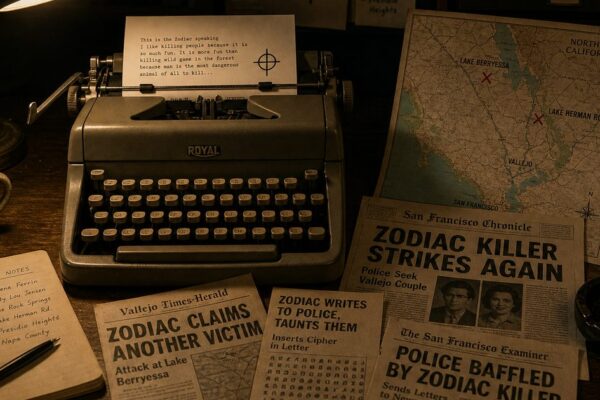
On July 31, nearly a month after Blue Rock Springs, three nearly identical letters were mailed to the Vallejo Times-Herald, the San Francisco Chronicle, and the San Francisco Examiner. The writer claimed responsibility for both attacks and included details investigators had not released publicly. He also enclosed a 408-symbol cryptogram, split into three parts, and demanded that each paper print its section.
It was not just a confession. It was proof of access, and a performance.
“This is the Zodiac speaking”
On August 8, 1969, schoolteacher Donald Harden and his wife Bettye solved the 408-character cipher, now known as Z408. Its message did not reveal a name. Instead, it offered a glimpse into the writer’s thinking: he described killing as pleasurable and wrote about collecting “slaves” for an afterlife.
That same week, the killer sent another letter and gave the case its permanent name.
The phrase was simple, almost theatrical. It worked. From then on, the murders were no longer just a string of attacks in different jurisdictions. They became the Zodiac case, with the public reading each new message as if the killer were stepping onto a stage.
That was part of what made the investigation so difficult. He was not only trying to avoid capture. He was trying to control the story.
Lake Berryessa brought a new kind of fear
The pattern shifted on September 27, 1969.
At Lake Berryessa in Napa County, Bryan Calvin Hartnell, 20, and Cecelia Ann Shepard, 22, were relaxing by the water when a man approached them wearing an executioner-style hood marked with the now-familiar crosshair symbol. He bound them and stabbed them.
Hartnell survived. Shepard died two days later, on September 29.
The attack was terrifying not because it was random in some abstract sense, but because it was so personal. The earlier crimes had involved gunfire in the dark, quick violence and escape. At Lake Berryessa, the killer got close. He spoke. He took time.
Investigators found a shoe print consistent with a Wing Walker military-style boot, size 10.5. On Hartnell’s car door, the attacker had written dates linked to the earlier crimes, along with the Lake Berryessa date, as if he were keeping score.
Then came another phone call. A man phoned police and said he wanted to report a murder, adding that he was the one who did it. The call was not recorded, but it fit the now familiar pattern: violence followed by contact, as if the crime was incomplete until he had claimed it.
Paul Stine and the piece of shirt
The final attack widely accepted as a confirmed Zodiac murder happened in San Francisco on October 11, 1969.
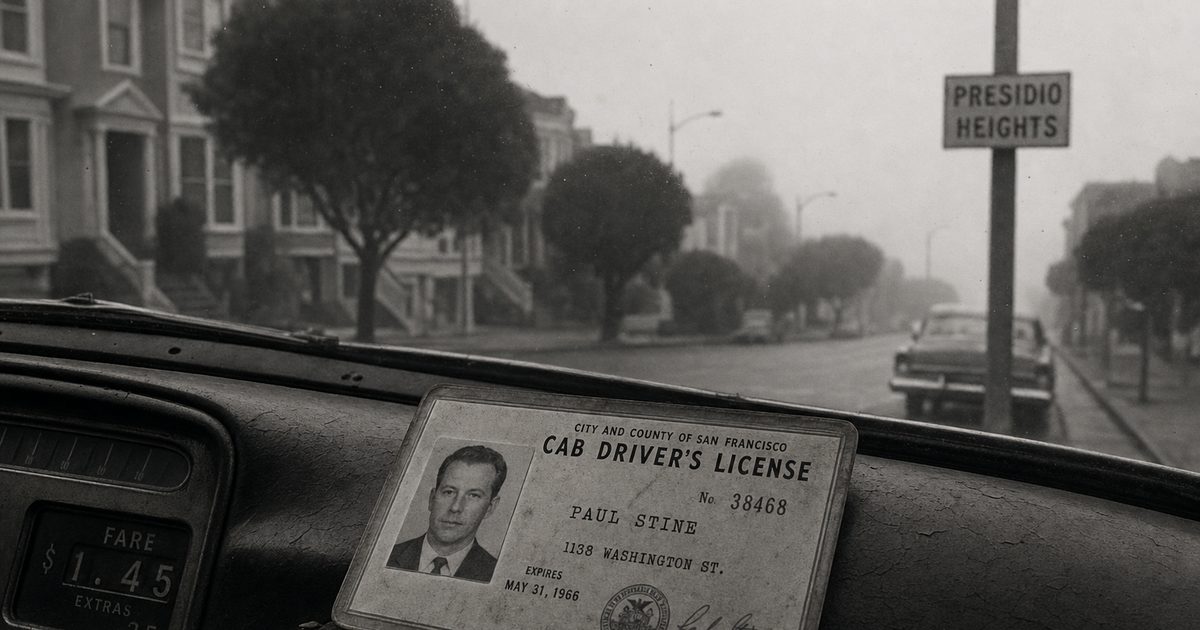
Paul Lee Stine, 29, was working his cab shift that night when he picked up a passenger in downtown San Francisco. The ride ended in Presidio Heights. There, Stine was shot and killed in his taxi.
This time, there were witnesses. Teenagers in a nearby house saw part of what happened and called police. Their observations helped produce the famous composite sketch. Investigators also recovered fingerprints from the cab, though debate over which prints belonged to the killer and how useful they were has followed the case ever since.
Two days later, on October 13, the Chronicle received a letter that included a piece of Paul Stine’s shirt. That detail removed any real doubt that the writer was connected to the killing.
The shirt fragment changed the status of the letters. They were no longer only taunts or claims. They were evidence.
More letters followed quickly. On November 8, 1969, the Chronicle received the 340-character cipher known as Z340. On November 9 came a long letter that included a threat about attacking a school bus. On December 20, another letter was mailed to attorney Melvin Belli, again including a piece of Stine’s shirt.
By then, fear had spread far beyond the crime scenes. Parents worried about school routes. Readers scanned headlines for the next message. The killer had found a way to enter homes without ever being invited in.
The ciphers, the letters, and the public trap
The Zodiac letters remain central to the case because they did two things at once: they authenticated the killer and obscured him.
Some messages contained details known only to investigators. Others were packed with threats, boasting, or cryptic language. Four ciphers are generally associated with the case: Z408, Z340, Z13, and Z32. Of those, Z408 and Z340 have been solved; Z13 and Z32 remain unsolved.
For decades, Z340 resisted every attempt. Then, in December 2020, a team made up of David Oranchak, Sam Blake, and Jarl Van Eycke announced they had cracked it. Like the earlier cipher, it offered more taunting than revelation. It did not identify the killer.
That has been the rhythm of this case from the start: a breakthrough, then a wall.
The known victims, and the names still debated
Law enforcement generally attributes five murders and two surviving victims to the Zodiac.
The dead were David Faraday, Betty Lou Jensen, Darlene Ferrin, Cecelia Shepard, and Paul Stine. The survivors were Michael Mageau and Bryan Hartnell.
Other cases have long been discussed in connection with the killer, but they are not confirmed Zodiac crimes. Among the most frequently mentioned are the June 4, 1963 murders of Robert Domingos, 18, and Linda Edwards, 17, near Gaviota, and the October 30, 1966 killing of Cheri Jo Bates, 18, in Riverside. Those links have been debated for years, but they remain unproven.
The killer himself inflated the number. In later correspondence, he claimed far more victims than police could verify. One 1974 letter, often treated as the last confirmed Zodiac letter received by the Chronicle, included a claim that his total had reached 37.
That number has never been substantiated.
Suspects, dead ends, and why the Zodiac was never identified
No shortage of names has surfaced over the years, but none closed the case.
Arthur Leigh Allen became the best-known suspect. He drew intense scrutiny and has loomed large in books and films about the Zodiac murders. But suspicion is not proof. Allen was never charged, and investigators never established a definitive link through fingerprints, handwriting, or DNA.
Much later, private investigators and online sleuths pushed other names, including Gary Francis Poste. Law enforcement did not confirm those claims, and they have not resolved the case.
That is the hard truth at the center of all the mythology. There was evidence: shell casings, witness accounts, the Lake Berryessa boot print, the Stine shirt pieces, fingerprints, ciphers, and letters. There were experienced investigators, including San Francisco detectives Dave Toschi and Bill Armstrong. There was enormous public attention.
Still, no one was ever prosecuted for the confirmed Zodiac attacks.
Part of the reason is practical. The crimes crossed multiple jurisdictions: Benicia, Vallejo, Napa County, and San Francisco. Part of it is evidentiary. Some physical evidence was limited, contested, or collected under standards far different from modern forensic practice. And part of it lies with the killer himself, who revealed enough to terrify the public while withholding enough to remain unknown.
Why the case still holds people
The Zodiac Killer case endures because it never delivered the ending people expect. There was a name, a symbol, a voice in letters, even a cipher trail. But there was no unmasking.
What remains is not just mystery. It is the record of real people whose lives were cut apart by a man who treated murder like correspondence. Teenagers on a date. A young woman and a friend in a parked car. Two college students by the lake. A cab driver finishing a shift.
The killer made himself famous. The victims paid the price.
And that is why the case still unsettles people. Not because of legend, but because the basic facts are bad enough on their own: at least five people were killed, two survived, the murderer wrote to newspapers, and he was never identified.
FAQ
Who was the Zodiac Killer?
The Zodiac Killer was an unidentified murderer who attacked people in Northern California in the late 1960s and early 1970s and sent taunting letters and ciphers to newspapers.
Was the Zodiac Killer ever caught?
No. No one was ever charged with the confirmed Zodiac murders, and the case remains unsolved.
How many victims were confirmed in the Zodiac case?
Law enforcement generally confirms five murders and two surviving victims connected to the case.
What were the Zodiac ciphers?
The four best-known cryptograms are Z408, Z340, Z13, and Z32. Z408 and Z340 were solved; Z13 and Z32 remain unsolved.
Was Arthur Leigh Allen the Zodiac?
He was a major suspect, but he was never charged, and investigators never proved he was the killer.