On some stretches southeast of Houston, the land seems to keep secrets badly.
A body is found near Interstate 45. Then another, years later. Then another. In other parts of the city, families wait for boys who do not come home, or for daughters whose last known movements turn into cold, stubborn mysteries. Over time, one question keeps surfacing in different forms, in police files, in headlines, and in late-night searches: who was the Houston serial killer?
The unsettling truth is that there was never just one.
Houston’s darkest true-crime history is not a single story with a single name at the center. It is a chain of cases: one of the worst mass murder investigations in American history, a drifter who killed along the rails, a local predator who strangled girls and women over nearly a decade, and a corridor of dumped bodies that still refuses to resolve into one neat answer. If you are asking about a Houston Texas serial killer, the answer depends on which chapter of the city’s history you mean.
The case that changed Houston: Dean Corll and the Houston Mass Murders
In the early 1970s, boys and young men were disappearing from Houston and nearby Pasadena. They were teenagers, many from working-class neighborhoods. Some were runaways. Some were last seen with friends. Some simply did not make it home.
At first, the disappearances did not present themselves as one obvious pattern. Then, on August 8, 1973, everything broke open.
That night, 17-year-old Elmer Wayne Henley shot and killed Dean Arnold Corll inside Corll’s Pasadena home. It was a sudden, violent end to a relationship that had already drawn in another teenage accomplice, David Owen Brooks. But Corll’s death was not the end of the story. It was the beginning of the truth.
After the shooting, Henley told police what had been happening. Investigators began digging at boat sheds and remote burial sites. What they uncovered stunned Houston. By the time the search was over, Corll had been linked to the murders of at least 28 boys and young men, though some sources and later summaries put the number at 29. The generally accepted confirmed count is 28 victims killed between 1970 and 1973.
At the time, the case became known as the Houston Mass Murders and was widely described as the deadliest known serial murder case in the United States.
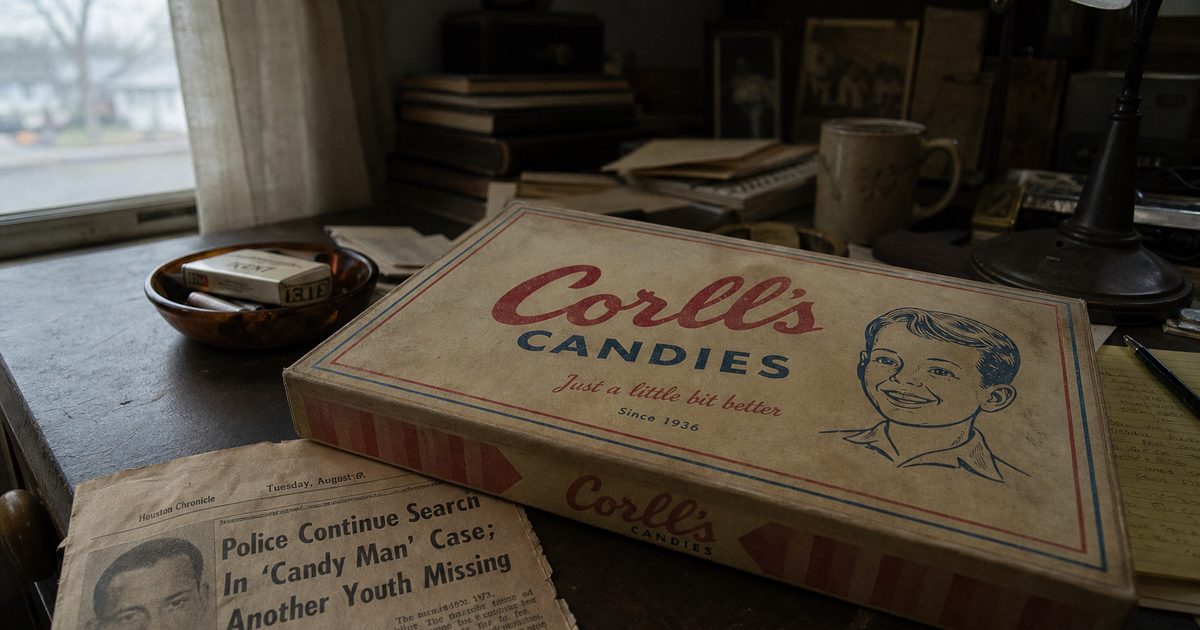
Corll, later nicknamed the “Candy Man” because his family had operated a candy business, had used Brooks and Henley to help lure victims. That detail made the case even harder for the city to absorb. The danger had not come from some shadowy stranger alone. It had moved through neighborhoods, through teenage friendships, through ordinary summer days.
When people still ask about a serial killer Houston has never forgotten, this is usually the name they mean first. Not because the case was the only one, but because of its scale, the youth of the victims, and the way it shattered any sense that such crimes belonged somewhere else.
A killer passing through: the Railroad Killer
Decades later, another name became tied to Houston, though he did not belong to the city in the same way Corll did.
Angel Maturino Resendiz traveled by freight train, moving across state lines and attacking near railroad corridors. By the late 1990s, investigators in multiple jurisdictions were trying to connect killings that at first looked isolated. The man eventually identified as the Railroad Killer was linked to at least 15 murders in the United States, including two in the Houston area.
His crimes were not concentrated in one neighborhood or one short burst. They were scattered across the South and beyond, connected by movement, opportunity, and a pattern that only became fully visible once agencies compared notes.
Resendiz was arrested after surrendering to authorities in July 1999. He was convicted in Texas and executed on June 27, 2006.
His case added another layer to Houston’s violent history. He was not the kind of local predator who embeds himself in one community for years. He was a transient killer whose route repeatedly crossed through the region, leaving Houston to reckon with crimes that were both local and part of something much larger.
The Tourniquet Killer: Anthony Allen Shore
If Corll’s case exploded into public view all at once, the crimes of Anthony Allen Shore unfolded more slowly, over years.
Between 1986 and 1995, girls and young women were killed in Houston and Harris County. Shore, a telephone repairman, would later confess to the murders of four victims: 15-year-old Maria Del Carmen Estrada, 19-year-old Linda Woods, 21-year-old Sandra Garcia, and 9-year-old April Tinsley? No, that last name does not belong here. To keep the record straight: Shore was convicted in Texas for the murders of Maria Del Carmen Estrada, Linda Woods, Sandra Garcia, and 16-year-old Diana Rebollar. He became known as the Tourniquet Killer because he used a ligature device in the attacks.
The victims ranged from 15 to 21 years old. Some older summaries incorrectly widen that range, but the four murders for which Shore is most directly known involved teenage girls and young women, not a 9-year-old child.
For years, the case sat in fragments. Then DNA evidence and Shore’s own statements helped close the circle. He was convicted, and on January 18, 2018, he was executed in Texas.
For many people, Shore is one of the first names that comes up when the phrase Houston serial killer is used. His crimes happened in the city and county, stretched across nearly a decade, and left families living with uncertainty long before they got answers.
When the label blurs: Jose Gilberto Rodriguez
Not every notorious Houston murder case fits the classic serial-killer pattern.
In July 2018, Jose Gilberto Rodriguez carried out a string of robberies and killings in north Houston over the course of about a week. Three people were killed: 62-year-old Martha Medina, 28-year-old Michael Seaman, and 33-year-old Ronald Haskell Jr. The crimes created fear quickly because they were fast, public, and unpredictable.
But this was not a long-running pattern of murders spread over years with cooling-off periods in the usual sense. It was a spree.
Rodriguez was captured in July 2018 after a manhunt. In 2022, he was convicted of capital murder and sentenced to life in prison without parole. Some reports later summarized the punishment date differently because of subsequent proceedings, but the key point is that his case is generally classified as a spree killing, not a traditional serial murder case.
That distinction matters. In a shaken city, people often reach for the nearest label. But not every multiple-homicide case belongs in the same category.
The place that became its own mystery: the Texas Killing Fields
Then there is the case that is not really one case at all.
Along the Interstate 45 corridor between Houston and Galveston, especially near League City, the remains of numerous girls and women have been found over decades. The area became known as the Texas Killing Fields, and the name stuck because the pattern was impossible to ignore even when the explanation remained out of reach.
Among the victims found in the League City area were Laura Miller, Audrey Cook, Donna Prudhomme, and Heidi Fye, discovered between 1984 and 1991. More broadly, dozens of bodies have been found along or near the I-45 corridor since the 1970s, though exact totals can vary depending on how investigators and documentaries define the area and which cases they include.
That uncertainty is important. The Texas Killing Fields is real as a geographic cluster of disappearances and body dumps. What has never been proven is that all of those deaths were the work of one offender.
Over the years, several suspects have been examined. Clyde Hedrick was found civilly liable in connection with the death of Laura Miller, but civil liability is not the same as a criminal murder conviction. James Elmore Jr. was also investigated and later charged in connection with some cases tied to the corridor. Yet the larger mystery has not collapsed into one final answer.
That is why the question of a single Houston serial killer becomes so slippery here. The killing fields may reflect more than one predator, more than one era, and more than one unresolved investigation. The dread comes not from a tidy solution, but from the absence of one.
What police confirmed, and what remains unresolved
If you strip away the myths and the catch-all labels, the picture becomes clearer.
Dean Corll was the central figure in the Houston Mass Murders, with 28 widely recognized victims between 1970 and 1973. He was aided by David Brooks and Elmer Wayne Henley, and he died when Henley shot him on August 8, 1973.
Angel Maturino Resendiz, the Railroad Killer, was linked to at least 15 murders in the 1990s, including two in the Houston area. He surrendered in 1999 and was executed in 2006.
Anthony Allen Shore, the Tourniquet Killer, was convicted in the murders of four girls and young women in Houston and Harris County committed between 1986 and 1995. He was executed in 2018.
Jose Gilberto Rodriguez was responsible for a 2018 weeklong killing spree in north Houston, but his case is not usually classified as a serial murder case.
And the Texas Killing Fields remains what it has long been: a real corridor of death, a collection of solved and unsolved cases, and one of the most haunting unresolved chapters in Texas crime history.
So who was the Houston serial killer?
There wasn’t one all-purpose answer. There were several killers tied to Houston, and there was also a stretch of land that became a mystery in its own right.
FAQ
Was Dean Corll the Houston serial killer?
He is the name most people mean. Dean Corll was responsible for the Houston Mass Murders, in which 28 boys and young men were killed between 1970 and 1973.
Who was the Candy Man killer in Houston?
The “Candy Man” was Dean Arnold Corll. The nickname came from his family’s candy business.
Was the Texas Killing Fields one serial killer case?
No one has proved that all the killings were committed by one person. The Texas Killing Fields refers to a broader corridor of cases along I-45, some solved and some still unresolved.
Who was the Railroad Killer in Houston?
Angel Maturino Resendiz was known as the Railroad Killer. He was linked to at least 15 murders, including two in the Houston area.
Who was the Tourniquet Killer?
Anthony Allen Shore was the Tourniquet Killer. He was convicted of murdering four girls and young women in Houston and Harris County between 1986 and 1995.