On a summer night in Anchorage, a teenage girl ran with handcuffs still locked to her wrists.
It was June 13, 1983. Cindy Paulson, 17, had just escaped from a car near Merrill Field. The man she was fleeing had abducted her, taken her to his house, and assaulted her. Now his small plane sat waiting at the airfield. As he prepared the aircraft, she saw a chance and took it.
She ran toward Sixth Avenue before he could stop her.
A driver named Robert Yount saw her and pulled over. He got her into his vehicle, took her to safety, and called police. In that frantic stretch of minutes, one terrified survivor did what investigators had not yet managed to do: she brought a hidden pattern into the open.
The report police should have understood
When officers responded, Paulson gave them more than panic and fragments. She described her attacker. She described his house. She described the plane he had planned to use and gave details that could be checked, including its tail number.
Officer Gregg Baker took the report. On paper, it was the kind of statement detectives hope for after a violent crime: immediate, specific, and tied to physical facts.
The suspect was Robert Hansen, an Anchorage baker and family man who did not fit the image many people expected of a serial predator. He owned a bakery, hunted, flew his own plane, and moved through the city without drawing much notice. He also had a criminal record that went back years, including earlier offenses involving arson and assault, but in public he still looked ordinary enough to be believed.
When police questioned him in June 1983, he denied Paulson’s accusation. He claimed she was trying to extort him. A friend, John Henning, backed him with a false alibi. Investigators accepted too much of what Hansen said and too little of what Paulson had survived. He was released.
That decision would hang over the case.
Because by then, women had already been disappearing for years.
Anchorage, the missing women, and a pattern no one fully saw
To understand why the Robert Hansen case went unchecked for so long, it helps to look at Anchorage as it was in the 1970s and early 1980s. The oil boom had brought money, movement, and a large transient population. Among those living on the margins were dancers, sex workers, and young women who could vanish without the kind of urgent, coordinated response their disappearances deserved.
Many of Hansen’s victims came from that vulnerable world. Several were teenagers or in their early twenties. Some had left home. Some were working the streets. Some were last seen getting into cars with men they did not know.
Over time, investigators would connect Hansen to the deaths of women including Paula Golding, Teresa Watson, DeLynne “Sugar” Frey, Angela Feddern, Robin Pelkey, Sue Luna, Joanna Messina, Sherry Morrow, Malai Larsen, Tamara Pederson, Lisa Futrell, and an unidentified woman often referred to as Eklutna Annie.
The details that emerged later were chilling enough without embellishment. Hansen abducted women, assaulted them, and flew or drove them into remote areas of Alaska. There, prosecutors said, he treated them as prey. That image would come to define the Alaska serial killer case, but in the summer of 1983 it was not yet a proven public narrative. It was still a scattering of bodies, disappearances, rumors, and one survivor insisting that police had the right man.
Cindy Paulson escaped, and the case still stalled
That is one of the hardest facts in this story to sit with.
Cindy Paulson had escaped. She had identified Robert Hansen. She had given police details about his home and plane that were not vague guesses. Yet the case did not immediately break open.
Part of that failure came down to credibility. Paulson was young and involved in sex work. Hansen was a businessman with a wife, children, and a practiced appearance of normalcy. The imbalance mattered. It shaped how each was heard.
For a time, her account sat in that dangerous space between truth and official doubt.
Then a body was found.
Paula Golding changed the direction of the investigation
On September 2, 1983, the body of 17-year-old Paula Golding was discovered near the Knik River. Her death forced a harder look at what had been happening around Anchorage.
By then, Alaska State Troopers and Anchorage police were under pressure to make sense of multiple cases that no longer looked isolated. Investigators sought help from the FBI. Special Agent John Douglas worked on a profile of the unknown killer, and the portrait that came back pointed toward a local man who hunted, had low self-esteem, held grudges against women, and sought control over vulnerable victims.
The profile did not solve the case by itself. Profiles never do. But placed beside Cindy Paulson’s statement, it sharpened attention on Hansen again.
This time, investigators looked more closely.
The search that closed in on Robert Hansen
As detectives and troopers built the case, they found what Paulson had been trying to tell them all along: this was not a misunderstanding, and it was not a one-off assault.
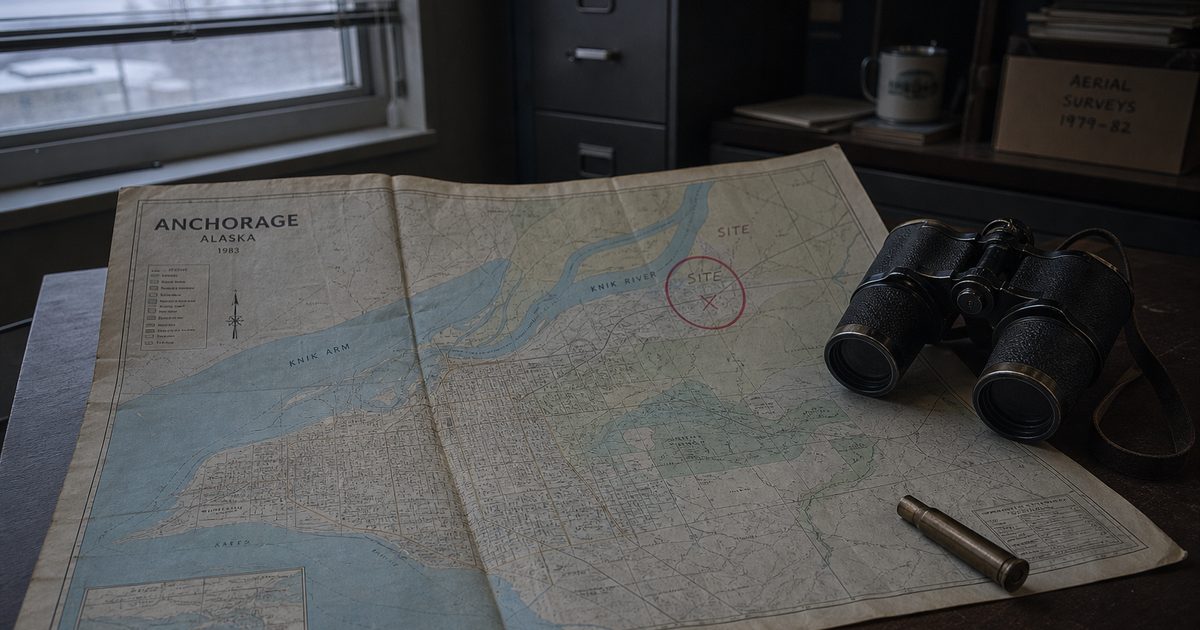
A search of Hansen’s property turned up deeply incriminating evidence. Investigators found jewelry linked to victims. They found identification belonging to women who had disappeared. They also found an aviation map marked with symbols at remote sites, places that matched locations where bodies had been recovered or would later be found.
Then came the forensic evidence. Shell casings recovered near some victims were linked to Hansen’s Ruger Mini-14 rifle.
That mattered because it moved the case beyond suspicion and profile work. Now there was physical evidence connecting the suspect to crime scenes in the wilderness.
On October 27, 1983, Hansen was arrested.
The confession, the charges, and what was proven
Once in custody, Hansen eventually confessed to a long series of attacks. He admitted killing 17 women and raping many others. Not every claim tied to him could be prosecuted, and not every suspected victim could be conclusively attributed to him in court. That distinction matters.
In the criminal case, Hansen was charged with four counts of first-degree murder: the killings of Paula Golding, Teresa Watson, Sherry Morrow, and Lisa Futrell. He was also charged with kidnapping, sexual assault, and related crimes connected to Cindy Paulson and other victims.
In February 1984, he entered a plea agreement. He pleaded guilty or no contest to multiple charges, including the four murders, and agreed to assist authorities in locating some victims’ remains. He was sentenced to 461 years plus life in prison, effectively ensuring he would never be released.
So how many victims did Robert Hansen have? The clearest proven number is four murder convictions. The number he confessed to was 17 killings. Some writers and investigators have suspected more, but those higher estimates remain unproven.
That is the line worth holding: what was alleged, what was confessed, and what was established in court are not always identical.
The women at the center of the story
The nickname “Butcher Baker” has followed this case for decades, but it can pull attention in the wrong direction. It makes the killer memorable. It risks making the women less so.
They were not a backdrop to his crimes. They were young women whose lives were cut short, often after being overlooked in life and then flattened in death into a list of names. Some were daughters. Some were sisters. Some were trying to get through one more night in a city that could be unforgiving to anyone without money, safety, or support.
And one of them survived.
That is why the Cindy Paulson escape remains the hinge of the whole story. She did not just get away from Robert Hansen. She forced the case into the light, even though the system initially failed to act on what she said.
Without her, the investigation might have taken much longer. More women might have disappeared before police caught up to the man responsible.
What happened to Robert Hansen
Hansen spent the rest of his life in prison. He died on August 21, 2014, at Alaska Regional Hospital in Anchorage after being transferred from prison because of declining health. He was 75.
His death closed nothing for the families of the women he killed. Cases like this do not end neatly. There is a conviction, a sentence, a date of death. And then there is everything left behind.
What remains most striking is not the false normalcy Hansen hid behind, or even the remoteness of the Alaska wilderness he used. It is the image from the beginning: a frightened teenager in handcuffs, running for her life near Merrill Field, and telling the truth before anyone was ready to fully hear it.
FAQ
Who was Robert Hansen?
Robert Hansen was an Anchorage baker and serial killer who targeted women in Alaska over many years. He confessed to 17 killings and was convicted of four murders in 1984.
Who was Cindy Paulson?
Cindy Paulson was a 17-year-old survivor who escaped from Hansen on June 13, 1983. Her report to police became a crucial break in the case.
How did Cindy Paulson escape?
She escaped near Merrill Field while Hansen was preparing his plane. Still wearing handcuffs, she ran to the road, where driver Robert Yount stopped and helped her.
How was Robert Hansen caught?
After Paulson identified him, investigators later revisited the case following the discovery of Paula Golding’s body. A search of Hansen’s property, victim belongings, marked maps, and shell casings linked to his rifle helped build the case that led to his arrest on October 27, 1983.
How many victims did Robert Hansen have?
He confessed to killing 17 women. In court, he was convicted of four murders. Higher victim estimates have been suggested, but they were not proven.