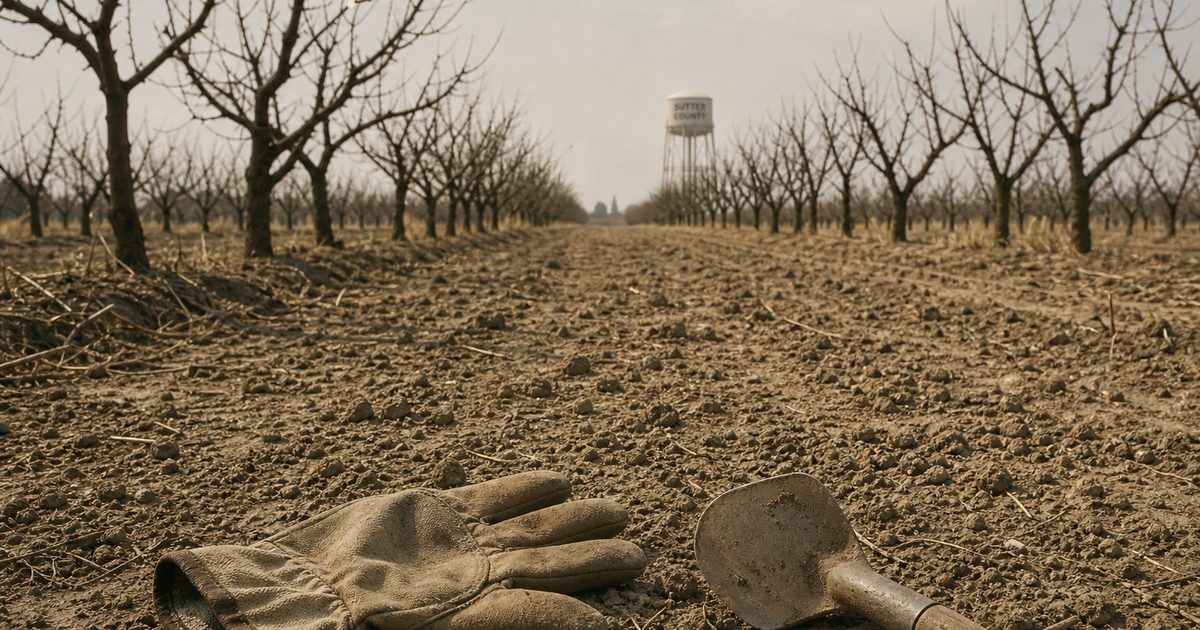
A patch of fresh earth stood out in the orchard.
On May 19, 1971, farmer Goro Kagehiro was in his peach trees along the Feather River in Sutter County, California, when he noticed a newly filled hole that should not have been there. He called the sheriff. Deputies came out, started digging, and uncovered a body.
Then they found another grave. And another.
By the time the search ended on June 4, the orchards near Yuba City and Marysville had given up 25 dead men. Most were laborers, drifters, older men living on the edge of notice, and migrant farmworkers who had come to the area looking for work. Some had families far away. Some were not identified for a long time. Four were never identified at all.
The man eventually convicted of those murders was Juan Vallejo Corona, a labor contractor whose job put him in direct contact with the kind of men who could vanish without setting off immediate alarm. The nickname that attached itself to the case, the Machete Killer, captured the brutality. It did not capture the deeper truth: this was a case about vulnerable men buried where they had come to earn a living.
The first grave in Sutter County
The first identified victim was Kenneth Whitacre, found on May 20, one day after Kagehiro reported the disturbed ground. As deputies widened the search, the scale of the crime became impossible to ignore. Bodies were buried in shallow graves in peach orchards along the Feather River, in the heart of farm country.
Yuba City was not a place people associated with a mass murder case. It was an agricultural community, orderly on the surface, built around seasonal work and the movement of labor through the fields. That setting mattered. The victims were not taken from one house or one roadside motel. They were found scattered through working orchards, hidden in the same landscape where they had sought jobs, food, and a place to sleep.
Investigators soon saw a pattern in the dead. Most were men between about 40 and 64. Many were transient or poor. Many were Mexican immigrants. Several had been hired for farm work. These were men who often moved on quickly, who might not have close family nearby, and whose absence could go unreported.
That vulnerability sat at the center of the Juan Corona case.
Juan Corona moved through the same world as the victims
Corona was born on February 7, 1934, in Ayutla, Jalisco, Mexico. He entered the United States in 1950 and worked in the fields before becoming a licensed labor contractor in California. That role gave him something investigators later viewed as crucial: access.
He knew which men needed work. He knew where they gathered. He knew who was sleeping rough, who had little money, and who might follow a promise of a job into an orchard without anyone asking questions.
His history also included serious mental illness. After the devastating Yuba and Feather River floods in December 1955, Corona suffered a breakdown. Court records and reporting on the case describe a 1956 diagnosis of paranoid schizophrenia and treatment that included electroshock therapy. He was later deported to Mexico and returned legally in 1962 as a permanent resident. In March 1970, he was briefly institutionalized again during another psychiatric episode.
Those facts became part of the background to the case, but they did not answer the central question investigators faced in the orchards: who had killed these men and buried them in rows of dirt?
The clues in the graves
As deputies dug, they found more than bodies.
Near some of the graves were paper receipts, including meat-market slips bearing Corona’s name, address, or handwriting. Those scraps of paper were small, ordinary things. In a murder investigation, they were dynamite. They suggested that the killer was not a stranger passing through. He was someone tied to the victims’ daily lives.
On May 24, more bodies were discovered, and receipts linked to Corona were again found near one of the graves. The evidence did not stand alone, but it pointed in one direction with increasing force.
Two days later, on May 26, 1971, officers searched Corona’s home in Yuba City with a warrant.
Inside, they found bloodstained clothing, two knives, a machete, and a pistol. They also found a work ledger containing 34 names and dates, including several of the known victims. The prosecution would later use that ledger as one of the strongest pieces of evidence in the case, arguing that it tied Corona directly to men who ended up dead in the orchards.
He was arrested that same day.
What was proven about the killings
The murders took place over a relatively short period, from about February to May 1971. The victims had been attacked with sharp-force weapons; one had been shot. Accounts of the injuries were horrifying enough without embellishment. What mattered in court was that the pattern was consistent, the graves were numerous, and the evidence pointed back to one man.
At the time, the number of victims made the case nationally notorious. But the numbers alone can flatten what happened. Each grave represented a person whose life had narrowed to a few possessions, a day’s labor, and the hope of getting through another season. Some had names that were recovered and returned to their families. Four did not.
Fourteen of the 25 victims, including the unidentified men, were buried in a common grave in Sutter after the investigation. That detail still gives the case its weight. Even in a solved serial killer case, not every victim got his name back.
The question that never fully cleared: motive
One of the most unsettling parts of the Juan Corona murders is that the motive was never firmly established at trial.
Later statements attributed to Corona suggested contempt for some of the men he killed, describing them as “winos,” trespassers, or “crazy.” But those remarks did not amount to a clear, proven motive, and prosecutors did not present a single neat theory that explained all 25 murders.
There were also later allegations of a sexual motive. Those claims have to be treated carefully. They were not the basis of the prosecution’s case, and early examinations of the bodies were limited. The coroner did not conduct the kind of forensic inquiry that would have settled that question. So while the theory has appeared in discussions of the case, it was never proved in court.
What was proved was the killing itself.
The first trial of Juan Corona
On July 12, 1971, Corona was indicted on 25 counts of first-degree murder.
His first trial began on September 11, 1972, in Fairfield, in Solano County. By then, the case had already become one of the most talked-about murder prosecutions in California. The prosecution’s case rested on the graves, the receipts, the weapons, the bloodstained clothing, and the ledger linking Corona to several victims.
The defense, led by attorney Richard Hawk, argued that Corona’s half-brother, Jose Natividad Corona, was the real killer. Natividad was a troubling figure in his own right, and the defense tried to plant reasonable doubt by shifting suspicion onto him.
The jury did not accept it.
On January 18, 1973, Juan Corona was convicted on all 25 counts of first-degree murder and sentenced to 25 consecutive life terms. California’s death penalty was not in play; the state’s high court had struck it down before that conviction.
The conviction overturned, then the second trial
For a time, it looked finished. It was not.
In 1978, an appellate court overturned the conviction, ruling that Corona had received inadequate legal representation. That decision did not declare him innocent. It meant the state would have to try him again.
The second trial began on February 22, 1982, in Hayward, Alameda County. The broad shape of the case remained the same. Prosecutors returned to the same hard facts: the shallow graves in the orchards, the receipts bearing Corona’s name, the bloodstained items found in his home, and the ledger that connected him to several of the dead.
Again, the defense argued that Natividad Corona was responsible.
Again, the jury rejected it.
On September 23, 1982, Corona was convicted on all 25 counts a second time. This time he received 25 concurrent life sentences.
The final years and the shadow left behind
Corona spent the rest of his life in prison. He was denied parole repeatedly. On March 4, 2019, he died of natural causes in a hospital near Corcoran State Prison.
The case remains one of the most notorious murder cases in California, but its lasting force does not come only from the body count or the old nickname. It comes from where the victims were found and who they were: men living close to the margins, men who worked temporary jobs, men who could be overlooked in life and nearly lost in death.
That is the part worth holding onto in the Juan Corona story. Not the label. Not the mythology that grows around serial murder. The men in those orchards were real, and for some of them even a name could not be restored.
FAQ
Who was Juan Corona?
Juan Vallejo Corona was a labor contractor in California who was convicted of murdering 25 men in Sutter County in 1971.
How many victims were found in the Juan Corona case?
Authorities found 25 male victims buried in shallow graves in orchards near Yuba City and Marysville.
How was Juan Corona caught?
Investigators were led toward him after receipts bearing his name or handwriting were found near graves. A May 26, 1971 search of his home uncovered bloodstained items, weapons, and a ledger containing names that included several victims.
What was Juan Corona’s motive?
No definitive motive was proved at trial. Later statements and theories exist, but none fully explained the murders in a way established in court.
Was Juan Corona’s brother ever convicted?
No. Corona’s defense claimed his half-brother, Jose Natividad Corona, was the real killer, but juries rejected that argument in both trials.