In the winter of 1974, a quiet Wichita neighborhood woke to sirens and disbelief.
Inside the Otero family home on North Edgemoor Street, police found 38-year-old Joseph Otero, his wife Julie, 33, and two of their children, 11-year-old Joseph Jr. and 9-year-old Josephine, dead. It was 15 January 1974, and before the day was over, the city understood something terrible: whoever had done this had moved through an ordinary house on an ordinary street and left almost no one prepared for what came next.
For Wichita, that morning was not just the start of a murder investigation. It was the beginning of the BTK murders.
The first shock in Wichita
At first, there was no BTK killer, not by name. There was only fear, rumor and a city trying to make sense of a crime that felt both intimate and impossible. The victims were a family in their own home. That detail mattered. It told Wichita that locked doors and familiar streets were no guarantee of safety.
The killer struck again that year. On 4 April 1974, 21-year-old Kathryn Bright was attacked in Wichita; her brother Kevin survived. Then, on 8 December 1977, Shirley Vian, a 24-year-old mother of three, was killed in her home. Six months later, on 27 June 1977, Nancy Fox, 25, was murdered in her apartment. The dates blurred for the public, but the pattern did not. Women were being stalked, watched and killed by someone who seemed patient, organized and very much at home in the city.
Then he gave himself a name.
In a letter received in October 1974, the killer proposed the label “BTK”, short for “Bind, Torture, Kill.” It was not a police nickname or a newspaper invention. It came from the man responsible. That detail still chills the case. He did not just want to avoid capture. He wanted authorship. He wanted the story told his way.
A killer who kept writing himself into the case
Many murder investigations turn on fingerprints, witnesses or luck. The BTK case became something stranger. It was shaped, again and again, by the killer’s need to be noticed.
Over the years, the BTK killer sent letters and packages to police and local media, describing crimes, claiming responsibility and trying to control how he was seen. The communications were not constant, but when they came, they dragged the fear back into public view. Wichita was not only hunting a murderer; it was being taunted by one.
That need for attention would become one of the most important facts in the Dennis Rader case. It kept the investigation alive in the public imagination long after leads had gone cold. It also gave detectives something they never stopped hoping for: the chance that the man writing those letters would eventually make a mistake.
For a long time, he did not.
The long years of the BTK murders
The known BTK murders stretched from 1974 to 1991, with 10 victims in all. After Nancy Fox came Marine Hedge, 53, killed on 5 May 1985. Then 28-year-old Vicki Wegerle on 16 September 1986. The final known victim was 62-year-old Dolores Davis, killed on 19 January 1991.
That long gap between murders made the case even harder to understand. This was not a spree that burned hot and ended quickly. It was a series that unfolded over nearly two decades, with years of silence in between. Each time the city began to breathe again, another killing reminded everyone that the person responsible had never really gone away.
And all the while, Dennis Rader was building a life that looked steady from the outside.
Born on 9 March 1945 in Pittsburg, Kansas, Rader served in the U.S. Air Force from 1966 to 1970. He married Paula Dietz in 1971, and they had two children. He worked for ADT Security from the mid-1970s into the late 1980s, then later became a compliance officer in Park City, a Wichita suburb. He was active in his church and known in the community. To neighbors, coworkers and fellow church members, he appeared conventional, even dull.
That was part of what made his arrest so difficult for many people to absorb. The BTK killer was not some shadowy outsider passing through town. He had been woven into Wichita-area life for years.
When the case went quiet
After the murder of Dolores Davis in 1991, the killings stopped. Or at least the known killings did. Investigators continued to work the case, but time has a way of wearing down urgency in the public mind. New crimes happen. Headlines move on. Witnesses forget. Evidence sits in storage.
Still, the case was never truly closed. Families of the victims were still waiting. Detectives were still looking. And in Wichita, the name BTK had not been forgotten.
Then, in 2004, the silence broke.
More than a decade after the last known murder, new communications began arriving. The old case was suddenly alive again. For investigators, this was dangerous but promising. A killer who had stayed hidden for so long was reaching back into the world. He wanted attention. He wanted to know whether people still remembered him.
They did.
The floppy disk and the mistake that ended it
The break in the BTK investigation came because the killer trusted his own cleverness too much.
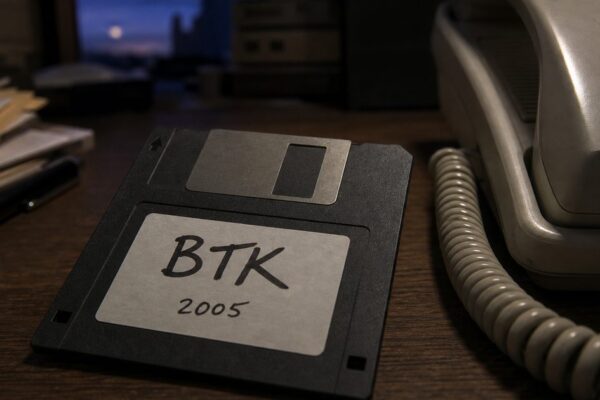
During the renewed exchange with police and media in 2004 and 2005, BTK asked whether a floppy disk could be traced. Investigators, through a newspaper ad, indicated that it could not. He sent one anyway.
That disk became the turning point in the Dennis Rader case.
Metadata on the floppy disk led investigators to Christ Lutheran Church in Wichita and to a user name connected to Dennis Rader. From there, police quietly built the case. They obtained a DNA sample from Rader’s daughter through medical records, according to widely reported accounts from the investigation, and compared it to evidence linked to the BTK murders. The match helped confirm what detectives had begun to suspect.
On 25 February 2005, Dennis Rader was arrested while driving near his home in Park City. He was 59.
After more than 30 years, the man who had spent so much energy trying to control the story had lost control of it in a single, ordinary-looking piece of technology.
The confession and the legal end of the BTK case
Once in custody, Rader confessed.
In June 2005, during court proceedings, he described the murders in a flat, matter-of-fact way that many who heard it found deeply disturbing. There was no mystery left about who had committed the crimes. The question now was how the legal system would close a case that had haunted Kansas for decades.
On 27 June 2005, he pleaded guilty to 10 counts of first-degree murder. On 18 August 2005, he was sentenced to 10 consecutive life terms, with no possibility of parole for 175 years.
Kansas did not seek the death penalty in the BTK case because the murders were committed before the state’s current death penalty law took effect in 1994. That legal detail shaped the ending, even if it did little to soften the weight of what the victims’ families had lived with for so long.
Paula Dietz obtained an emergency divorce in 2005. Their children were left to reckon with the fact that the man they knew as husband and father was also the man Wichita had feared for decades.
Why the BTK killer case still lingers
Some cases stay in public memory because they were never solved. The BTK murders linger for the opposite reason. They were solved, but only after years of dread, silence and the unsettling discovery that the killer had been living an ordinary suburban life all along.
The case still draws attention through documentaries, books and dramatizations, including Mindhunter, Catching Killers and My Father BTK. But the real story is not the mythology Rader tried to build around himself. It is the damage left behind: the Otero family, Kathryn Bright, Shirley Vian, Nancy Fox, Marine Hedge, Vicki Wegerle and Dolores Davis; the survivors; the investigators who spent years chasing a man who kept slipping away; and a city that learned, slowly and painfully, that the threat had been close to home all along.
That is why the BTK killer case still unsettles people. Not because of the nickname he chose, but because of the ordinary lives he shattered and the ordinary face he wore while doing it.
FAQ
Who was the BTK killer?
The BTK killer was Dennis Lynn Rader, a Kansas man who pleaded guilty in 2005 to 10 murders committed between 1974 and 1991 in the Wichita area.
What does BTK stand for?
BTK stands for “Bind, Torture, Kill,” a name Rader used in communications with the media.
When did the BTK murders begin?
The BTK murders began on 15 January 1974 with the killings of four members of the Otero family in Wichita, Kansas.
How was Dennis Rader caught?
He was identified in 2005 after a floppy disk he sent during renewed communications was traced back to him, helping investigators connect him to the case.
Where is Dennis Rader now?
Dennis Rader is serving 10 consecutive life sentences in Kansas.