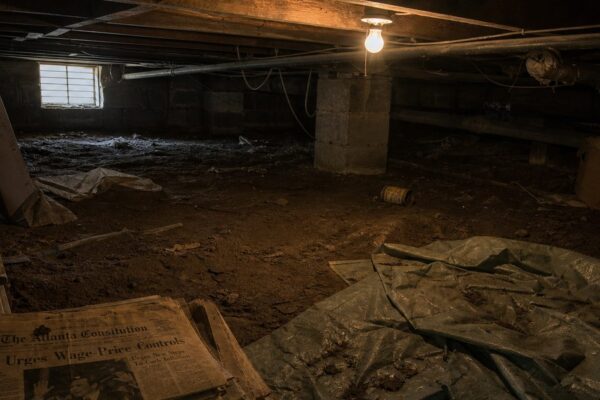
In the first week of October 2002, people around Washington, D.C., began changing the way they moved through the day. At gas stations, they crouched beside their cars while pumping fuel. Parents ran zigzag paths across parking lots with children at their sides. Shoppers glanced over their shoulders in places that had never seemed dangerous before.
The fear came from one terrible fact: people were being shot in ordinary public places, without warning, by someone no one could see.
What became known as the Beltway Sniper case was not a single outburst of violence. It was a rolling series of attacks that turned the region into a landscape of dread. For 23 days in October 2002, the search for the Beltway killer dominated life in the capital region. By the time it ended, 10 people had been killed and three wounded in the D.C. area. Investigators later tied the pair accused in the case to a broader string of shootings and robberies from February to October 2002 that left 17 people dead and 10 injured across several states and Washington, D.C.
At the center of it were two names the country would not forget: John Allen Muhammad, 41, a former U.S. Army sergeant, and Lee Boyd Malvo, 17.
The shootings began before anyone understood the pattern
The panic that gripped Washington in October did not begin there.
Investigators later linked Muhammad and Malvo to earlier shootings in other states, including attacks in Alabama, Arizona, Georgia, Louisiana, and Washington state. At the time, those crimes did not yet form a clear public narrative. It was only after the D.C.-area attacks that law enforcement began fitting the pieces together.
Then came 2 October 2002.
That evening in Wheaton, Maryland, 55-year-old James Martin was shot and killed in a grocery store parking lot. Hours later, on the morning of 3 October, the violence accelerated. In a span of just a few hours, four more people were shot in Montgomery County, Maryland, and Washington, D.C.: landscaper Premkumar Walekar, 54; part-time custodian Sarah Ramos, 34; cab driver Ahmed Ghullam, 54; and FBI analyst Linda Franklin, 47, who was killed outside a Home Depot in Falls Church, Virginia.
There was no confrontation, no visible gunman, no obvious connection among the victims. They were mowing grass, vacuuming a parking lot, loading purchases into a car, standing beside a taxi. Everyday moments. Then a shot, and chaos.
That randomness was what made the case so frightening. People could not tell themselves they were safe if they avoided a certain neighborhood, a certain hour, a certain kind of place. The danger seemed to arrive from nowhere.
John Allen Muhammad and Lee Boyd Malvo
John Allen Muhammad was born John Allen Williams on 31 December 1960 in Baton Rouge, Louisiana. He served in the Army and had marksmanship training. By 2002, he had lived in several states and had become entangled in a bitter custody dispute with his ex-wife, Mildred Muhammad.
Lee Boyd Malvo, sometimes referred to in early coverage as John Lee Malvo, was born on 18 February 1985 in Kingston, Jamaica. He was still a teenager when the shootings happened. During later court proceedings and reporting, Malvo was described as a vulnerable adolescent who had fallen under Muhammad’s control and had also suffered abuse.
That relationship became one of the darkest parts of the case. This was not simply the story of a hidden sniper. It was also the story of an adult man drawing a 17-year-old into a plan that left families shattered across the country.
A blue Chevrolet Caprice and a rifle hidden from view
As the attacks continued, investigators began to understand why witnesses had so little to offer.
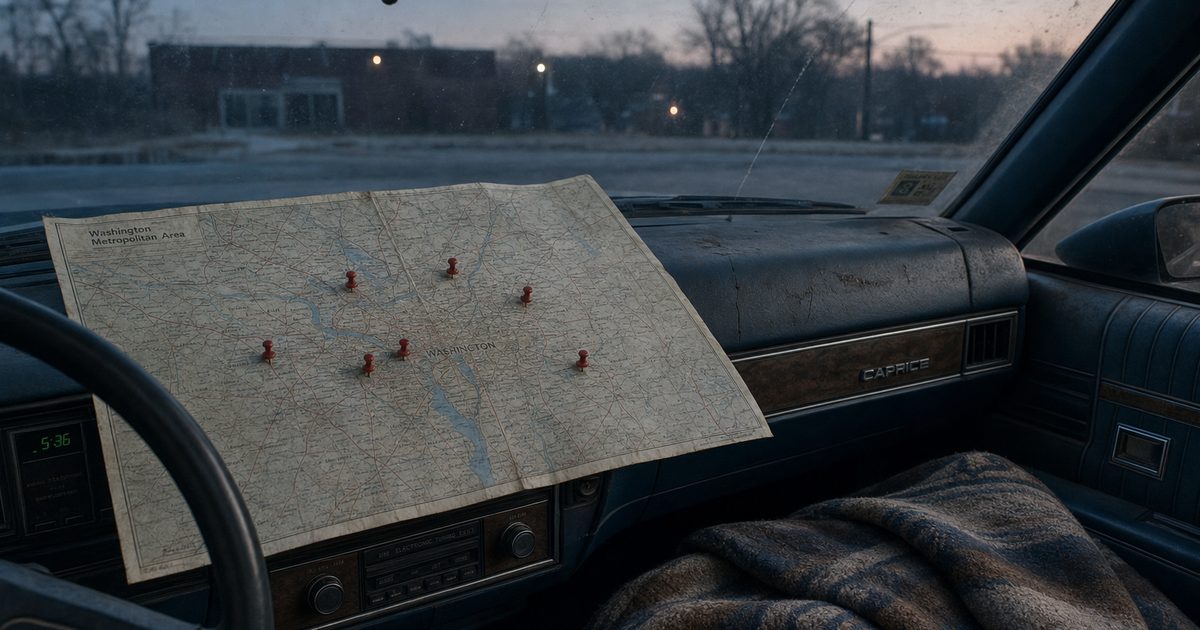
Muhammad and Malvo were traveling in a dark blue 1990 Chevrolet Caprice. Authorities said the car had been modified so shots could be fired from the trunk area through a small opening. The weapon used in the D.C.-area attacks was a Bushmaster XM-15 .223-caliber rifle.
That setup mattered. It meant the shooter did not have to stand in the open or flee on foot. A person could be targeted from a distance while the car sat still or blended into traffic. To the public, there was often nothing to see until someone was already down.
The pair also left behind messages that deepened the sense that the shootings were part of a larger plan. At one scene, investigators found a tarot card with the words “Call me God.” Other communications demanded money. Authorities later said the attacks were tied to an extortion attempt for $10 million.
Prosecutors also argued that Muhammad had a more personal motive: a plan connected to his ex-wife and their children. According to that theory, the wider shootings were meant in part to create cover for eventually killing her without drawing immediate suspicion. That motive was argued in court, but the extortion messages and the broader campaign of terror were the more visible parts of the case as it unfolded.
The region locked itself down
By early October, the Washington area was living differently.
Schools kept children inside. Gas stations draped tarps over pumps so customers could crouch behind them. Police flooded parking lots, highways, and shopping centers. Tips poured in from across the country, many of them wrong. A white box truck became an early focus of public attention, a detail that sent investigators and residents chasing the wrong image while the real vehicle was a blue sedan.
The shootings continued.
On 4 October, 43-year-old Lori Ann Lewis-Rivera was killed while vacuuming her car in Fredericksburg, Virginia. On 7 October, 13-year-old Iran Brown was critically wounded outside a middle school in Bowie, Maryland. He survived. On 9 October, 53-year-old Dean Harold Meyers was killed while fueling his car in Manassas, Virginia. On 11 October, 53-year-old Kenneth Bridges was shot and killed in Fredericksburg. On 14 October, 47-year-old Linda Franklin’s death was followed by the killing of 53-year-old Conrad Johnson on 22 October, a bus driver shot in Aspen Hill, Maryland.
Each shooting widened the fear. The victims were not symbols. They were workers, parents, neighbors, a schoolboy. Their names mattered more than the mythology that quickly grew around the case.
The break that changed everything
For days, investigators chased fragments: ballistics, witness statements, maps, notes left by the shooter, and a stream of calls and threats. The rifle evidence helped connect scenes. So did the messages.
One of the most important breaks came from a witness in the earlier Alabama shooting of 21-year-old Kellie Adams, who survived. That witness had seen Muhammad and Malvo and helped point investigators toward the Chevrolet Caprice. By late October, law enforcement had a far clearer picture of who they were looking for.
In the early hours of 24 October 2002, police found Muhammad and Malvo asleep inside the Caprice at a rest area off Interstate 70 near Myersville, Maryland, in Frederick County. Officers moved in carefully and arrested both without gunfire.
After 23 days of fear in the D.C. region, the manhunt was over almost quietly. No chase. No dramatic last stand. Just two suspects sleeping in the car that had carried them through the attacks.
Inside, authorities found the rifle and the evidence that tied the vehicle to the shootings.
Trials, sentences, and what was proven
The legal aftermath stretched across years and multiple jurisdictions.
John Allen Muhammad was tried first in Virginia for the murder of Dean Harold Meyers. In November 2003, he was convicted of capital murder and related charges. A jury recommended the death penalty, and he was sentenced to death. In 2006, he also pleaded guilty in Maryland, where he received six consecutive life sentences without parole.
Lee Boyd Malvo was tried separately in Virginia for the killing of Linda Franklin. In December 2003, he was convicted, and in 2004 he was sentenced to life without parole. In 2006, he pleaded guilty in Maryland and received six consecutive life sentences.
Muhammad was executed by lethal injection in Virginia on 10 November 2009.
Malvo’s case did not end there. Because he had been 17 at the time of the crimes, later U.S. Supreme Court rulings on juvenile sentencing affected parts of his case. His Virginia sentences were eventually vacated, and in 2022 prosecutors in Virginia reached an agreement that he would not be retried there. He remains imprisoned on his Maryland sentences.
Why the Beltway Sniper case still lingers
Some crimes are remembered for a single location. This one seemed to spread across an entire map.
That is why the Beltway Sniper case still feels so unsettling. It invaded routine. It taught people to fear parking lots, sidewalks, gas pumps, school entrances. The method was calculated, but the victims were ordinary people who had no warning and no chance to prepare.
The names most often remembered are Muhammad and Malvo. But the story belongs just as much to James Martin, Premkumar Walekar, Sarah Ramos, Ahmed Ghullam, Lori Ann Lewis-Rivera, Dean Harold Meyers, Kenneth Bridges, Linda Franklin, Conrad Johnson, and the others killed and wounded before and during October 2002.
For 23 days, the region waited for the next shot. When the arrests finally came, the relief was immediate. The grief was not.
FAQ
Who were the Beltway Snipers?
The two people convicted in the 2002 attacks were John Allen Muhammad, a former Army sergeant, and Lee Boyd Malvo, who was 17 at the time.
How many people did the Beltway Snipers kill?
In the Washington, D.C., area, 10 people were killed and three were wounded in October 2002. Across the broader series of linked shootings from February to October 2002, authorities tied the pair to 17 deaths and 10 injuries.
How did the Beltway Sniper attacks happen?
Authorities said the shootings were carried out with a Bushmaster XM-15 rifle from a modified blue 1990 Chevrolet Caprice, allowing shots to be fired while the attackers remained concealed.
When were Muhammad and Malvo arrested?
They were arrested on 24 October 2002 at a rest area near Myersville in Frederick County, Maryland.
What was the motive in the Beltway killer case?
Prosecutors said the attacks were tied to a $10 million extortion demand and, in Muhammad’s case, a plan connected to his ex-wife. The extortion demand was documented in messages sent during the shootings.