A purple floppy disk landed at a Wichita TV station and looked almost laughably small. Just 1.44 MB. In a case that had stretched across decades, terrified a city, and left 10 people dead, that little square of plastic would do what years of tips, interviews, and dead ends had not.
By the time it arrived at KSAS-TV on February 16, 2005, the man calling himself BTK had been haunting Wichita for a generation. He had killed from 1974 to 1991, then gone silent. When he resurfaced, he seemed to think he was stepping back into a game he still controlled.
He was wrong.
The family murders that changed Wichita
The story begins on January 15, 1974, inside the Otero family home in Wichita.
Joseph Otero, 38, his wife Julie, 34, and two of their children, Josephine, 11, and Joseph II, 9, were killed there. The crime stunned police and the city. It was not only the number of victims. It was the sense of intrusion, of a family attacked in the place where they should have been safest.
Less than three months later, on April 4, 1974, 21-year-old Kathryn Bright was killed in her home. Her brother Kevin Bright was also attacked but survived. His account gave investigators one of their earliest direct descriptions of the man they were hunting.
Then, in October 1974, the case took on a new and deeply unsettling shape. A letter arrived at the Wichita Eagle-Beacon. The writer claimed responsibility for the Otero murders and introduced a name for himself: BTK, short for “Bind, Torture, Kill.”
That was the shift. Wichita was no longer dealing only with a killer. It was dealing with a killer who wanted an audience.
More murders followed. Shirley Vian was killed on March 17, 1977. Nancy Fox was killed on December 8, 1977. After Fox’s murder, a caller directed police to her home. The voice on that call became part of the growing file investigators were building around the same offender.
He kept writing too. In early 1978, letters sent to local media claimed responsibility for more killings and helped police connect cases that had first been worked separately. The communications also deepened the fear. Families locked doors earlier. Neighbors watched each other’s houses. The name BTK spread because the killer wanted it to.
Still, he stayed unidentified.
A suspect who blended into ordinary life
That was one of the hardest things for Wichita to absorb after the arrest: Dennis Rader did not look like the figure people had imagined.
He had served in the U.S. Air Force from 1966 to 1970. He worked for ADT Security Services in the years after some of the early murders. Later, he became a compliance officer in Park City, a suburb near Wichita. He was active in his church and known in his community.
Nothing about that public image erased what he was later proven to have done. If anything, it made the case more disturbing. The man behind the letters and taunts had been living in plain sight, moving through ordinary routines while families of victims waited for answers.
The killings stretched across years. In 1979, he entered a home and later wrote about it after the intended victim returned unexpectedly and survived. On April 27, 1985, Marine Hedge was killed. On September 16, 1986, Vicki Wegerle, a young mother, was killed in her home. On January 19, 1991, Dolores Davis, 62, disappeared from her home; her body was later found in rural Sedgwick County.
Then everything went quiet.
For years, there were no new letters, no public taunts, no arrest. The BTK killer seemed to vanish.
The return that reopened old fear
Silence can be its own kind of torment in an unsolved case. It leaves room for hope, but also for dread. Had the killer died? Moved away? Stopped? Or was he still there, unnoticed?
In March 2004, Wichita got its answer.
A package sent to The Wichita Eagle included copies of Vicki Wegerle’s driver’s license and photographs connected to the crime. Investigators saw it for what it was: proof that the sender had inside knowledge. BTK was back.
The return reopened old wounds for victims’ families and revived a case many had feared would never be solved. But it also revealed something important about the man behind the letters. He still wanted attention. He still wanted to direct the story.
That need would become his weakness.
As the messages continued, investigators looked for a way to keep him talking without tipping their hand. In one communication, he asked a question that now seems almost unbelievable: if he sent a floppy disk, could police trace it?
The answer he received, through a newspaper message, was carefully crafted to reassure him.
It was bait, and he took it.
How the floppy disk led police to BTK
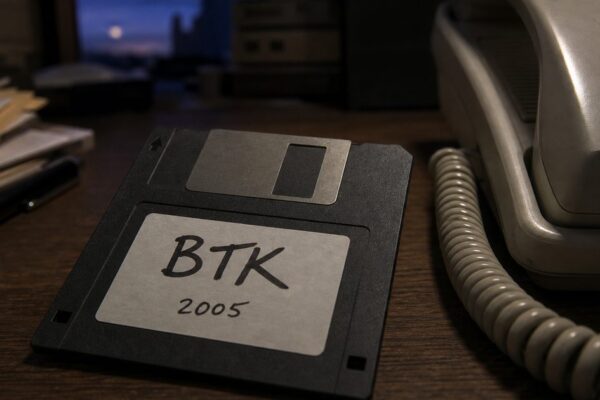
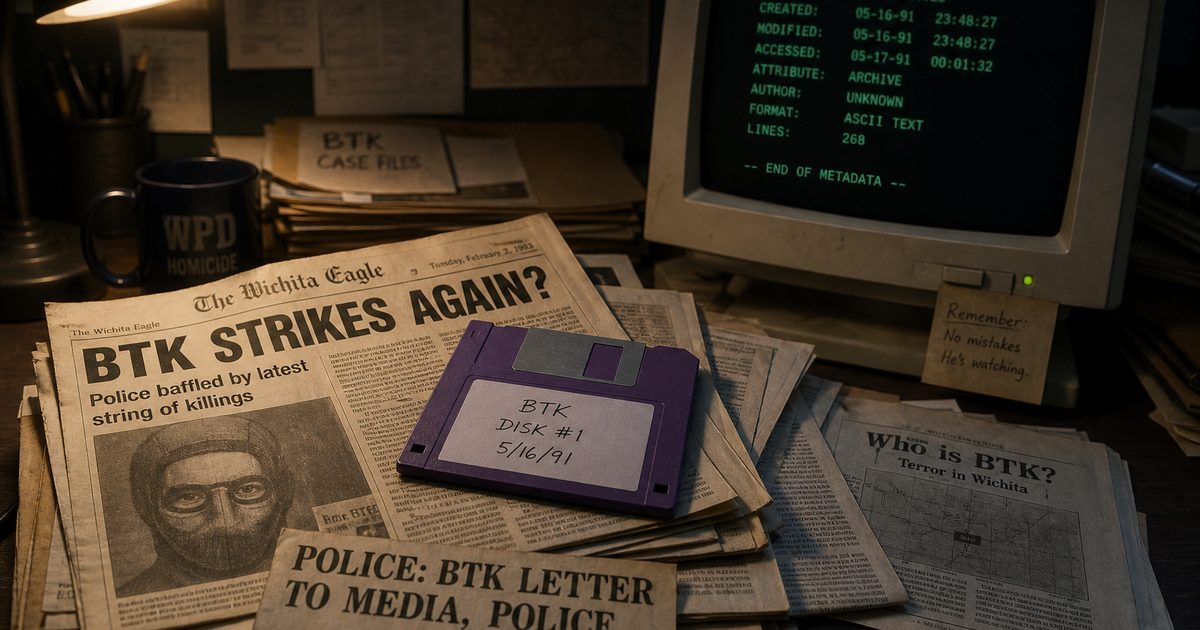
On February 16, 2005, the purple disk arrived at KSAS-TV.
To the sender, it appears to have felt safe. To investigators, it was a chance. Computer forensic examiner Randy Stone analyzed it and found something crucial: a deleted file that had not truly disappeared.
It was a church document, an agenda. More important than the text itself was the metadata attached to it. The file had been last modified by someone identified as “Dennis,” and it was associated with Christ Lutheran Church.
That was no longer a ghost. That was a trail.
Investigators connected the church to Dennis Rader, who was then serving as president of the congregation. Suddenly the distance between the self-created monster called BTK and a real man in Park City had collapsed.
The BTK floppy disk had done what decades of investigation had not. It gave police a name they could test.
Rader would later put it bluntly: “The floppy did me in.”
The evidence police still needed
A name was not enough. Not in a case this large, and not after so many years.
Investigators needed evidence that would stand in court. They turned to DNA. Biological evidence from the Otero crime scene had been preserved. To compare it without alerting Rader, authorities obtained a sample linked to his family through his daughter’s medical records, using a court order. The result was a familial match consistent with Rader being closely related to the source of the crime scene DNA.
That did not stand alone. It fit alongside the letters, the disk, the timeline, and the mounting investigative work.
On February 25, 2005, Dennis Rader was arrested while driving near his home.
For Wichita, the moment brought relief, but not anything as simple as closure. The name BTK had hung over the city for too long. An arrest could stop the fear of what might come next. It could not undo what had already happened.
The guilty plea and what it revealed
The courtroom brought the facts into the open.
On June 27, 2005, Rader pleaded guilty to 10 counts of first-degree murder: Joseph Otero, Julie Otero, Josephine Otero, Joseph II Otero, Kathryn Bright, Shirley Vian, Nancy Fox, Marine Hedge, Vicki Wegerle, and Dolores Davis.
The plea ended any doubt about who had committed the crimes. It also forced families to hear details they had lived beside for years without fully knowing. In August 2005, during sentencing, relatives of the victims addressed the court. Their grief, anger, and exhaustion gave the case its proper center. Not the man who named himself, but the people whose lives he shattered.
On August 18, 2005, he was sentenced to 10 consecutive life terms, with a minimum of 175 years before parole eligibility under Kansas law as it applied to the crimes.
He remains imprisoned in Kansas.
Why this case still stands out
The reason the BTK case stays with people is not only that it lasted so long. It is the contrast at the heart of it.
A killer spent years trying to control the narrative through letters, poems, phone calls, and packages. In the end, that same need to be noticed led him straight into a trap. The thing that finally broke the case was not a dramatic chase or a sudden confession. It was a piece of outdated technology and the false confidence of the man who mailed it.
The floppy disk mistake has become one of the best-known examples of digital forensics helping solve a long-running murder investigation. But the technology is only part of the story. The larger truth is that the case was solved because investigators stayed patient, adapted, and understood the personality they were dealing with.
For the families, none of that changes the losses. Four members of one family were killed in a single morning. Other women were taken from homes where they should have been safe. Survivors and relatives lived for years with uncertainty, then had to watch the killer try to turn his crimes into a performance.
That performance ended in 2005.
Not with another taunting letter. Not with another carefully staged message. With a purple floppy disk, a deleted file, and a name hidden in metadata.
FAQ
How was the BTK killer caught?
Dennis Rader was identified after he sent a floppy disk that investigators traced through metadata in a deleted file. That lead, combined with DNA evidence and other investigative work, led to his arrest.
What was on the BTK floppy disk?
The disk contained a deleted church document. Its metadata pointed to “Dennis” and Christ Lutheran Church, helping investigators connect the communication to Dennis Rader.
When was Dennis Rader arrested?
He was arrested on February 25, 2005.
How many people did BTK kill?
Rader pleaded guilty to 10 murders committed between 1974 and 1991.
Where is Dennis Rader now?
He is incarcerated in Kansas.