
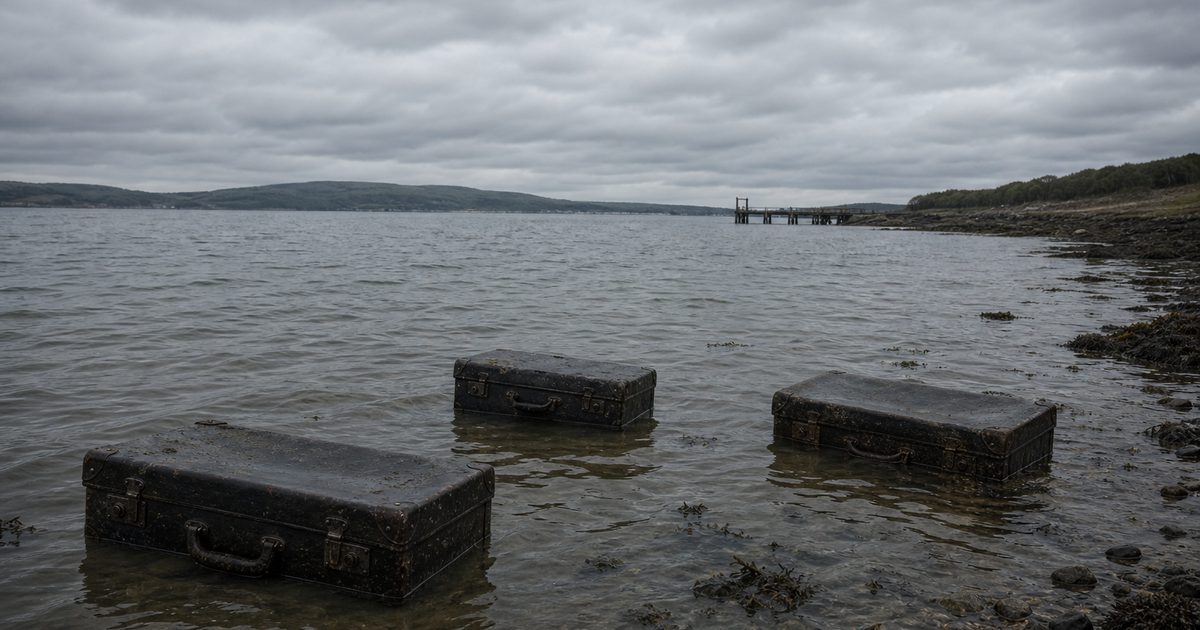
Cold water in the Chesapeake Bay gave up the first clue on May 5, 2004. Fishermen spotted a suitcase floating near the Virginia shore. Inside were human legs.
It did not stay a single, baffling discovery for long. Within days, two more matching Kenneth Cole suitcases turned up, one on Fisherman Island and another in the bay. Together, they held the dismembered remains of William “Bill” McGuire, a 39-year-old father of two, a Navy veteran, a computer programmer, and an adjunct professor at the New Jersey Institute of Technology.
The horror of the find was only the beginning. The investigation would travel north to New Jersey and settle on a home life that, from the outside, looked ordinary enough: a married couple, two young sons, and a recent closing on a new house. Prosecutors said that image hid something else entirely. They alleged Bill’s wife, Melanie McGuire, had been planning his death before he vanished.
The last ordinary evening
On April 28, 2004, Bill and Melanie McGuire closed on a new home in Warren County, New Jersey. It should have been one of those days families remember for happy reasons: paperwork signed, plans made, a fresh start just ahead.
That night, Bill called friends about the house. He was alive, talking about the future.
No one would hear from him again.
Bill and Melanie had married in 1999. He worked in tech and taught on the side. She was a nurse who had worked at a fertility clinic. By the time Bill disappeared, the marriage was under strain. Prosecutors later said Melanie had already begun an affair with Dr. Bradley Miller, a co-worker, and wanted out of the marriage without the financial and personal complications that came with divorce.
What happened inside the couple’s Woodbridge apartment that night was never witnessed. The state’s case rested on what it said the evidence showed afterward. Prosecutors alleged that sometime on April 28 or into the early hours of April 29, Melanie drugged Bill with chloral hydrate, shot him twice, and dismembered his body.
Those were allegations the state had to prove. There was no confession. There was no eyewitness. And that would become one of the central tensions of the case.
The story Melanie McGuire told
The day after Bill was last known to be alive, Melanie McGuire offered a very different account.
She claimed he had become physically abusive, packed bags, and left after an argument. She sought legal help and moved quickly to frame the disappearance as the end of a dangerous marriage. On April 30, 2004, she testified in Family Court that Bill was a threat.
That testimony would later matter in a separate way. At trial, prosecutors argued it was false, and one of the convictions against her was for perjury.
As investigators worked backward, they found details that did not fit a man storming out on his own. Before Bill vanished, Melanie had made internet searches that prosecutors said pointed to planning. Court records described searches between April 11 and April 26 on terms including “how to commit murder,” “undetectable poisons,” “how to illegally purchase guns,” and “chloral hydrate.”
Then came another date that would loom over the trial. On April 26, two days before Bill was last heard from, she bought a .38-caliber handgun and wadcutter ammunition in Easton, Pennsylvania.
The state’s theory was not built on one dramatic piece of proof. It was built on accumulation. Search by search. Purchase by purchase. Mile by mile.
Three suitcases in the bay
The remains were found far from home, which at first made the crime look almost impossible to place.
The first suitcase, recovered on May 5, contained Bill’s legs. A second was found on May 11 on Fisherman Island, holding his torso and head. A third was recovered on May 16 from the Chesapeake Bay and contained his lower torso. The body parts had been wrapped in black trash bags inside the luggage.
An autopsy found that Bill had been shot twice.
Virginia Beach investigators began the work of identifying the victim and tracing the evidence. Once they knew who he was, the case narrowed quickly toward New Jersey. On September 15, 2004, Virginia authorities formally closed their part of the investigation and turned the case over to New Jersey.
By then, the question was no longer only who the victim was. It was who had reason, opportunity, and the ability to move his remains hundreds of miles south.
The case prosecutors built
The state never had the kind of evidence people expect from television crime shows. There was no blood-soaked room preserved exactly as it had been left. In fact, one of the defense’s strongest talking points was the lack of direct forensic proof that Bill was killed in the apartment.
But prosecutors had something else: a chain of circumstantial evidence that, piece by piece, pointed back to Melanie McGuire.
The black trash bags used with the remains were linked to bags from the McGuires’ apartment. According to trial evidence, they matched not just in type but to the same manufacturing source, and tape on the bags contained razor stubble with DNA from both Bill and Melanie.
A bullet recovered from Bill’s chest carried green polyester fibers consistent with stuffing from the couple’s green couch. A medical-style towel wrapped around Bill’s head was consistent with towels from the fertility clinic where Melanie worked.
Then there was Bill’s abandoned Nissan Maxima. Investigators found tiny flesh fragments in the car that experts said were consistent with trauma, not ordinary shedding. Chloral hydrate, the sedative prosecutors said had been used on Bill, was also detected there. The state alleged Melanie had obtained it through a forged prescription.
Records helped fill in the map. E-ZPass data placed Melanie’s car in Delaware and Atlantic City after Bill’s disappearance. Prosecutors argued that on May 3, 2004, she drove to Virginia to dispose of the suitcases. Bill’s car later turned up at the Flamingo Motel in Atlantic City and was towed on May 8. Melanie admitted moving it, though she described that as a prank.
Standing alone, each fact invited argument. Together, the state said, they described planning, killing, transport, and disposal.
Motive: a marriage ending badly
At trial, prosecutors argued the motive was both emotional and practical.
By then, Melanie’s affair with Dr. Bradley Miller was no secret. He testified for the prosecution. The state said she wanted a new life and did not want Bill, or the obligations of their marriage, in the way. The recent home purchase gave that theory a sharper edge: instead of a fresh start, prosecutors portrayed it as a burden she no longer wanted.
The state returned again and again to the days before Bill vanished. The internet searches. The gun purchase. The sedative. The restraining-order story that appeared only after he was gone.
It was not a sudden explosion of violence, prosecutors argued. It was preparation.
The defense pushes back
Melanie McGuire’s lawyers, Joe Tacopina and Stephen Turano, attacked the case where it was most vulnerable: the absence of direct proof.
They argued the prosecution had built a story, not certainty. They said she was physically incapable of carrying out the killing and dismemberment alone. They also floated an alternative theory involving Bill’s alleged gambling debts and possible Atlantic City mob ties.
That suggestion drew attention, but it did not hold up in court. A jailhouse informant who had offered a story about mob involvement later recanted, and an appeal connected to that claim was eventually withdrawn.
There were other strange turns. Anonymous letters surfaced claiming to be from the real killer. Prosecutors alleged Melanie wrote them herself.
Even after the trial, the same divide remained. To some, the case looked overwhelming. To others, it remained unsettling precisely because it depended so heavily on circumstantial evidence.
Trial, verdict, and sentence
Melanie McGuire was arrested on June 2, 2005, after dropping off her children at daycare.
Her murder trial began on March 5, 2007, at the Middlesex County Courthouse in New Brunswick, New Jersey, and lasted about seven weeks. Jurors heard about the affair, the searches, the gun, the ammunition, the sedative, the suitcases, the fibers, the towel, the car, and the toll records.
They also heard from the defense, which insisted the state had not proved where Bill was killed or who had actually carried out every step prosecutors described.
After roughly 14 hours of deliberation over three days, the jury returned its verdict on April 23, 2007.
Melanie McGuire was convicted of first-degree murder, desecration of human remains, perjury, and possession of a weapon for an unlawful purpose. She was acquitted on charges including hindering prosecution, evidence tampering, and possession of alprazolam without a prescription.
On July 19, 2007, Judge Frederick DeVesa sentenced her to life in prison plus five years. Under the sentence imposed, she would not be eligible for parole for more than six decades.
Appeals and the argument that never quite ended
The conviction did not end the case in the public mind.
On March 16, 2011, an appellate court upheld both the verdict and sentence. On September 20, 2011, the New Jersey Supreme Court declined to hear a further appeal. Melanie later sought post-conviction relief, arguing ineffective assistance of counsel and newly discovered evidence, but that effort was denied, and the denial was affirmed on August 7, 2017.
She has continued to maintain her innocence in later media appearances.
That is part of why the Melanie McGuire case still gets discussed. The image is unforgettable: three suitcases in the bay. But the staying power comes from something else too. This was a prosecution built largely on circumstantial evidence, and those cases tend to keep people arguing long after the verdict is in.
For Bill McGuire’s family, though, there was nothing abstract about it. A husband and father disappeared after what should have been an ordinary milestone in family life. Weeks later, he was found in pieces along the Virginia shoreline. The courtroom battle that followed was about whether the state could prove who did that to him.
A jury decided it could.
FAQ
Who was Bill McGuire?
Bill McGuire was a 39-year-old Navy veteran, computer programmer, adjunct professor, husband, and father of two sons.
Who was convicted in the Suitcase Murder case?
Melanie McGuire, Bill’s wife, was convicted in 2007 of first-degree murder, desecration of human remains, perjury, and possession of a weapon for an unlawful purpose.
What happened to Bill McGuire?
Prosecutors said he was drugged with chloral hydrate, shot twice, dismembered, and placed in three suitcases that were later found in and near the Chesapeake Bay.
Was the case based on circumstantial evidence?
Largely, yes. Prosecutors relied on searches, purchases, forensic links, toll records, and other indirect evidence rather than a confession or eyewitness.
Where is Melanie McGuire now?
She is serving a life sentence in New Jersey and has continued to maintain her innocence.