The first officer was not looking for a serial killer.
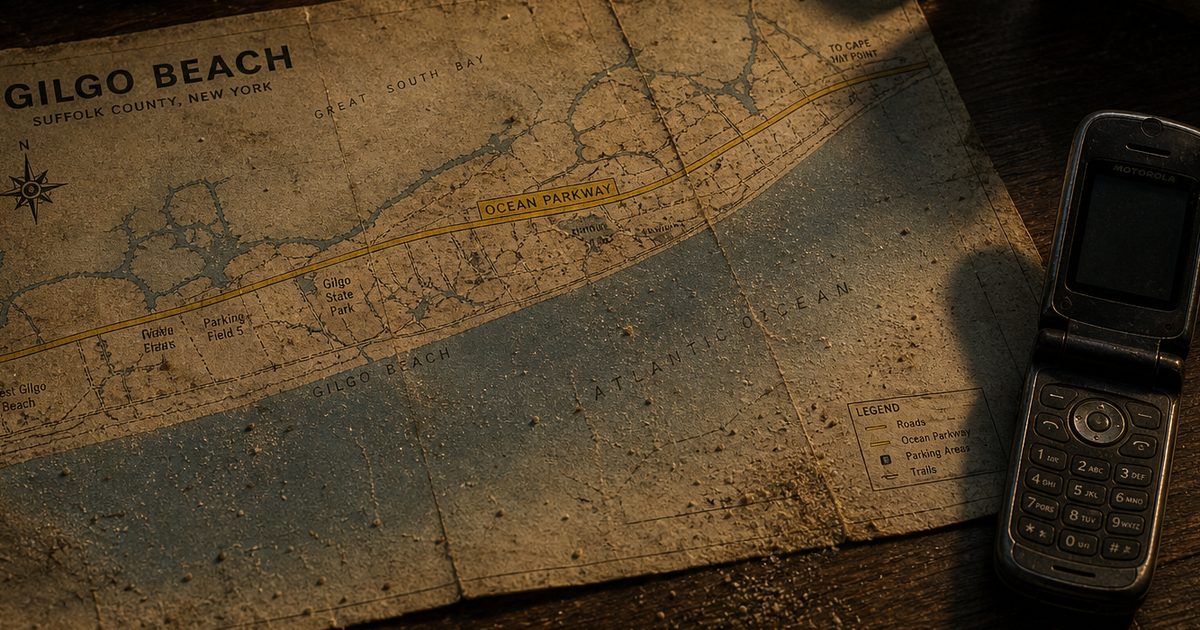
He was walking a police dog through the scrub beside Ocean Parkway, a lonely ribbon of road running past marsh and beach on Long Island’s South Shore. The search that day in December 2010 was for one missing woman, Shannan Gilbert, who had vanished months earlier after a panicked 911 call from Oak Beach. Instead, the dog led police to a set of human remains.
They belonged to 24-year-old Melissa Barthelemy.
Two days later, the search widened. Then it widened again. By the time investigators stepped back from that stretch near Gilgo Beach, they had found the remains of three more women nearby: Maureen Brainard-Barnes, Megan Waterman, and Amber Lynn Costello.
What began as a missing-person search had opened onto one of the most notorious murder investigations in New York: the Gilgo Beach murders, also known to many readers as the Long Island serial killer case.
Four women beside the parkway
The setting made the discovery feel almost unreal. Ocean Parkway is open, exposed, and yet strangely hidden at the same time: dunes, brush, marshland, and long empty stretches where a person could pass by and see nothing.
The four women found in December 2010 were all young. All had families. All had been living complicated lives that too often got reduced to a single label in headlines.
Melissa Barthelemy had worked as a hairdresser and also advertised sex work. Maureen Brainard-Barnes was a mother of two. Megan Waterman was 22. Amber Lynn Costello was 27. Investigators believed they had all been killed and left along the same remote corridor, some wrapped in burlap.
That cluster quickly became known as the “Gilgo Four,” and it changed the scale of the investigation overnight. This was no longer one disappearance. It looked like a pattern.
The beach road was only part of the map
As the search continued in March and April 2011, more remains were found in the wider Gilgo Beach area. The case grew more tangled with each recovery.
Investigators found remains later identified as Jessica Taylor, Valerie Mack, Karen Vergata, and a woman long known only as “Peaches,” whose identity has since been publicly reported as Tanya Jackson. Also found were the remains of Jackson’s young daughter, long called “Baby Doe,” now identified as Tatiana Dykes, and an unidentified Asian male.
Some of those victims had not disappeared recently. In several cases, partial remains had been found years earlier in other parts of Long Island, long before anyone understood they might connect to a larger pattern.
Sandra Costilla’s body had been discovered in North Sea in November 1993. Karen Vergata’s severed legs were found on Fire Island on April 20, 1996. Partial remains later identified as Tanya Jackson were found in Hempstead Lake State Park on June 28, 1997. Valerie Mack’s partial remains were found in Manorville in September 2000. Jessica Taylor’s partial remains were found in Manorville in July 2003.
Only after the discoveries near Gilgo did those older cases begin to line up in a way that suggested one killer might be responsible for at least some of them.
That “some” mattered. From the beginning, one of the hardest questions in the Long Island serial killer investigation was whether all the victims belonged to the same case.
The disappearance that led police there
Shannan Gilbert’s name remains inseparable from Gilgo Beach, even though her death has never been officially classified as a homicide.
She disappeared in the early hours of May 1, 2010, after fleeing a client’s home in Oak Beach and making a frantic 911 call. Her mother, Mari Gilbert, refused to let the case go quiet. She pressed police to keep searching, even as officials initially suggested Shannan might simply reappear.
On December 13, 2011, Shannan Gilbert’s remains were found in a marsh near Oak Beach.
Suffolk County police later concluded she likely died by accidental drowning. Her family strongly disputed that finding, and the circumstances of her death remain one of the most argued-over parts of the Gilgo Beach serial killings. What is certain is this: the search for Shannan led police to the women found along Ocean Parkway.
Years of drift, doubt, and anger
For a long time, the case seemed to stall in public.
There were reasons. The remains had been found over many years and in different places. Some victims had been dismembered. Some had been left intact near the parkway. Identifications took time. Building links between cases took even longer.
But the delay also became part of the story.
Families waited while the investigation appeared to lurch, stop, and restart. Questions grew about whether the disappearances of women involved in sex work had been treated with enough urgency. The anger was not abstract. It came from mothers, sisters, children, and friends who felt they had to fight to keep the victims from being forgotten.
The early years of the investigation were also shadowed by allegations of internal dysfunction and corruption. Former Suffolk County Police Chief James Burke was accused of interfering with aspects of the case, though the exact impact of that alleged interference on the murders investigation has long been debated. Former Suffolk County District Attorney Thomas Spota was also accused of helping shield Burke in unrelated misconduct matters. Those controversies deepened public distrust around the case.
By then, the Gilgo Beach murders had become more than a mystery. They had become a symbol of delay.
The task force that finally moved the case
The breakthrough came after Suffolk County Police Commissioner Rodney Harrison announced a new multi-agency task force in January 2022.
Fresh eyes went back through old evidence. This time, investigators worked the case with a narrower focus and a more modern toolkit. They revisited witness statements, phone records, vehicle descriptions, and location data.
One detail stood out: a witness connected to Amber Lynn Costello’s disappearance had described seeing a large man driving a dark green first-generation Chevrolet Avalanche.
That vehicle became a crucial thread.
Investigators eventually zeroed in on Rex Heuermann, a Massapequa Park resident who worked in Manhattan as an architectural consultant. On the surface, he looked ordinary enough to disappear into commuter life. Prosecutors would later argue that this ordinariness had helped him for years.
Phone evidence was central. According to charging documents, burner phones used to contact several victims were traced through cell-site analysis and linked in pattern and movement to Heuermann’s own phone and to places associated with him. Investigators also alleged that online searches tied to him showed sustained interest in the case, the victims, and violent sexual material.
Then came the DNA evidence that gave the investigation its sharpest edge.
In January 2023, investigators recovered a discarded pizza box that Heuermann had thrown away in Manhattan. A DNA sample taken from the crust was later compared with a male hair recovered from evidence in the case. Prosecutors said it matched. Other hairs found on or near victims were said to be consistent with genetic profiles from members of Heuermann’s household, including his wife and daughter. Authorities did not allege his family was involved; the significance, prosecutors said, was that the hairs helped place items from the household in contact with victims.
The arrest that ended the long wait for a name
On July 13, 2023, police arrested Rex Heuermann in Manhattan.
At first, he was charged in connection with the murders of Melissa Barthelemy, Megan Waterman, and Amber Lynn Costello. In January 2024, prosecutors added a charge in the killing of Maureen Brainard-Barnes.
More charges followed. On June 6, 2024, Heuermann was charged with the murders of Jessica Taylor and Sandra Costilla. On December 17, 2024, he was charged with the murder of Valerie Mack.
By then, the image of the case had changed completely. For years, the Long Island serial killer had been a faceless figure attached to a beach road and a string of dead ends. Now there was a suspect with a house, a family, a job, a truck, and a body of evidence prosecutors said tied him to the killings.
The broader Gilgo story also became clearer in one important respect. In 2025, authorities identified “Peaches” as Tanya Jackson and “Baby Doe” as Tatiana Dykes. Later that year, Andrew Dykes was charged in their murders. Police said those killings were not connected to Heuermann’s case. That mattered because the Gilgo Beach serial killings had long been discussed as if every set of remains found near Ocean Parkway must belong to one offender. Investigators ultimately said that was not so.
Guilty plea in the Rex Heuermann case
The case was expected to go to trial. Instead, it ended with a plea.
On April 8, 2026, Rex Heuermann pleaded guilty to seven murders and admitted to an eighth: Karen Vergata. The murders covered a span from 1993 to 2010 and included Melissa Barthelemy, Maureen Brainard-Barnes, Megan Waterman, Amber Lynn Costello, Jessica Taylor, Valerie Mack, Sandra Costilla, and Karen Vergata.
The plea settled the central question that had hung over the case for years: who had killed the women prosecutors linked to the Gilgo Four and several of the older Long Island cases.
On June 17, 2026, he was sentenced to seven consecutive life terms without parole.
What the Gilgo Beach case left behind
A guilty plea closes a courtroom case. It does not tidy up the damage.
For the families, the years between the disappearances and the arrest cannot be restored. Nor can the years before some victims were identified by name. The women at the center of the Gilgo Beach murders were daughters, mothers, sisters, friends. That should have been obvious from the beginning. Too often, it was not.
The case also left unresolved questions around Shannan Gilbert’s death, and around how much investigative delay and institutional failure shaped the early years. Those questions remain part of the story because they shaped what families endured while the case sat without an arrest.
Still, one thing changed decisively. The line of bodies once treated as a mystery without an end was finally tied to a man who admitted killing eight women.
That does not soften what happened on Ocean Parkway, in Manorville, on Fire Island, or in North Sea.
It answers the question that haunted those places for years.
FAQ
Who was the Long Island serial killer?
Rex Heuermann pleaded guilty to seven murders and admitted to an eighth in the Gilgo Beach case.
How many victims were tied to Rex Heuermann?
He pleaded guilty in seven murders and admitted responsibility for Karen Vergata, bringing the total to eight women.
Was Shannan Gilbert a victim of the Gilgo Beach serial killings?
Her disappearance led to the discovery of remains near Gilgo Beach, but police ruled her death accidental. Her family disputed that conclusion.
How was Rex Heuermann caught?
Investigators linked him through witness evidence about a Chevrolet Avalanche, burner phone analysis, cell-site data, and DNA recovered from discarded food.
Were all the remains found near Gilgo Beach linked to Heuermann?
No. Police later said some victims found in the broader search area, including Tanya Jackson and Tatiana Dykes, were not part of his case.