Headlights cut across the gravel at Lake Herman Road, then disappear into the dark. It was the kind of lonely turnout teenagers knew well: a place to park, talk, and be away from everyone else for a while. On the night of December 20, 1968, that ordinary scene ended with two high school students dead beside their car.
David Arthur Faraday was 17. Betty Lou Jensen was 16. At the time, their murders looked like a terrible local crime on a quiet road near Benicia. Only later did investigators understand what they were looking at: the first confirmed attack in the case that would become known across America as the work of the Zodiac Killer.
What keeps this case alive is not just the violence. It is the way the killer forced himself into public view. He did not simply vanish after the shootings. He called police. He wrote letters. He mailed ciphers. He turned fear into a campaign, and in doing so created one of the country’s most enduring unsolved mysteries.
So when people ask, who did the Zodiac Killer kill, the answer starts with five confirmed deaths, two known survivors, and a long shadow of other names that were claimed, suspected, or debated but never proved in the same way.
The first murders on Lake Herman Road
Faraday and Jensen had gone out together that Friday night. Sometime before 11 p.m., they were attacked near their Rambler station wagon on Lake Herman Road, a remote stretch between Benicia and Vallejo. Both were shot. Both died at the scene.
There was no letter yet. No symbol. No self-appointed name.
For months, the case stood on its own.
Then, on July 4, 1969, the pattern returned.
Just after midnight at Blue Rock Springs Park in Vallejo, Darlene Elizabeth Ferrin, 22, and Michael Renault Mageau, 19, were sitting in a car when another vehicle pulled up. The driver left, then came back. He walked toward them and opened fire. Ferrin was killed. Mageau survived, badly wounded.
That survival mattered. In a case built around dead ends, surviving witnesses were rare. Mageau was one of the few people who could tell police anything at all about the man who attacked them.
About 40 minutes after the shooting, a caller contacted Vallejo police from a payphone and claimed responsibility for Blue Rock Springs. He also said he had killed the two teenagers on Lake Herman Road months earlier.
That call changed everything. What had looked like separate crimes were now linked by the killer himself.
The letters that gave the case its name
The next turn came by mail.
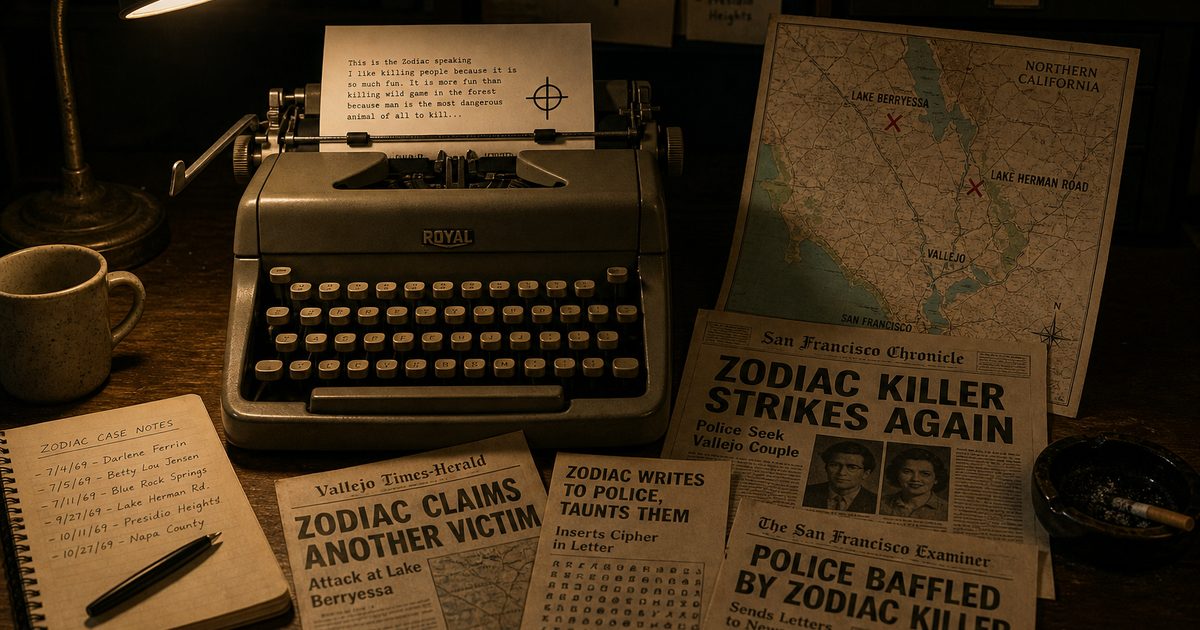
On August 1, 1969, nearly identical letters arrived at the Vallejo Times-Herald, the San Francisco Examiner, and the San Francisco Chronicle. Each claimed responsibility for the shootings and included one part of a cipher, now known as the 408 cipher. The writer demanded publication.
A week later, on August 8, schoolteacher Donald Harden and his wife Bettye Harden solved it. The message was rambling and self-dramatizing. Its most quoted line was plain enough: “I like killing people because it is so much fun.”
The cipher did not reveal a real name. But by then the writer had already given the public something else to remember: a cross-circle symbol and a new identity. In a follow-up letter published on August 4, he began with the words, “This is the Zodiac speaking.”
From that point on, the investigation was no longer just a hunt for a killer. It was also a battle with a man who wanted attention as badly as he wanted control.
Lake Berryessa, in broad daylight
The first two confirmed attacks happened at night and involved gunfire. The third was different, and in some ways more disturbing because of that.
On September 27, 1969, Bryan Calvin Hartnell, 20, and Cecelia Ann Shepard, 22, were relaxing near Lake Berryessa in Napa County. It was daytime. The lake should have felt open, safe, public.
Instead, a man approached wearing a dark hooded costume marked with the same cross-circle symbol seen in the letters. He carried a gun and bound the couple before stabbing them. Hartnell survived. Shepard did not; she died two days later, on September 29.
Hartnell’s account gave investigators one of the most haunting images in the entire case, not because it was rumor, but because a survivor lived long enough to describe it.
The killer made sure police knew he had struck again. That afternoon, at about 7:40 p.m., a man called the Napa County Sheriff’s Office to report the crime and claim responsibility. Earlier, the attacker had also written on Hartnell’s car door, listing dates that appeared to connect Lake Berryessa to the earlier shootings.
By then, the pattern was impossible to miss. The attacks were only part of the crime. The claiming of them was part of it too.
Paul Stine and the move into San Francisco
Then the case moved from dark roads and parkland into a city neighborhood.
On October 11, 1969, cab driver Paul Lee Stine, 29, picked up a fare in San Francisco. Near the intersection of Washington and Cherry Streets in Presidio Heights, he was shot and killed in his taxi at about 9:55 p.m. This time there were witnesses: teenagers in a nearby home saw part of what happened and called police.
The killing of Stine mattered for several reasons. It happened in a residential area, under far riskier conditions than the earlier attacks. It also left behind physical evidence that tied the later letters directly to the crime.
On October 14, the San Francisco Chronicle received a letter from Zodiac containing a piece of Stine’s bloodstained shirt. That was proof the writer had been involved in the murder. The letter also threatened schoolchildren and school buses, helping spread panic far beyond the crime scene itself.
Investigators now had witness descriptions, fingerprints of uncertain value, ballistics, letters, and a shirt fragment taken from the victim. Yet even with all of that, they still did not have a name.
The five confirmed Zodiac Killer victims
The five people widely recognized by authorities as confirmed murder victims are:
- David Arthur Faraday, killed December 20, 1968, on Lake Herman Road
- Betty Lou Jensen, killed the same night at Lake Herman Road
- Darlene Elizabeth Ferrin, killed July 4, 1969, at Blue Rock Springs Park
- Cecelia Ann Shepard, attacked September 27, 1969, at Lake Berryessa and died September 29
- Paul Lee Stine, killed October 11, 1969, in Presidio Heights
Two people survived confirmed attacks:
- Michael Renault Mageau, wounded at Blue Rock Springs
- Bryan Calvin Hartnell, wounded at Lake Berryessa
If the question is strictly who did the Zodiac Killer kill, those are the names at the center of the answer.
The names that remain on the edge of the case
This is where the story gets murkier.
Over the years, other victims have been linked to Zodiac by investigators, by later writers, or by the killer’s own claims. But these cases do not have the same standing as the five confirmed murders.
One of the most discussed is Cheri Jo Bates, an 18-year-old Riverside City College student who was killed in Riverside on October 30, 1966. Her murder happened before the confirmed Bay Area attacks. Some investigators and document examiners once believed there were links between Bates-related letters and Zodiac correspondence. Others disagreed. Riverside police later said they did not believe Bates was a Zodiac victim. In other words, the connection remains disputed, not proven.
Another often-mentioned case is Kathleen Johns, who said she was abducted near Modesto on March 22, 1970, after a driver lured her from her car. She escaped with her infant daughter. Zodiac later appeared to claim the incident in a letter, but Johns was not killed, and whether the attacker was actually Zodiac has never been conclusively established.
Then there is Donna Lass, a 25-year-old nurse who disappeared from South Lake Tahoe on September 6, 1970. Her case has long been discussed in connection with Zodiac because of later communications that may have referenced her disappearance. But her remains were never officially identified in a way that solved the case, and the link to Zodiac remains unconfirmed.
Other names sometimes drawn into the wider orbit include Ray Davis, murdered in Oceanside on April 10, 1962; Robert Domingos and Linda Edwards, killed near Gaviota Beach on June 4, 1963; and Johnny Swindle and Joyce Swindle, shot in San Diego on February 5, 1964. These cases are part of the larger mythology around the investigation, but not part of the confirmed victim list.
That distinction matters. A long-unsolved case attracts theories. The record is narrower than the legend.
Evidence, suspects, and an ending that never came
The Zodiac case sprawled across jurisdictions: Benicia, Vallejo, Napa County, San Francisco, and federal investigators. It produced witness statements, ballistic evidence, letters, ciphers, and fingerprints that have been argued over for decades.
One of the most famous unsolved messages, the so-called 340 cipher, was mailed on November 8, 1969. It was not cracked until December 2020. Even then, it did not reveal the killer’s identity.
Many suspects have been proposed. The best known is Arthur Leigh Allen, a former schoolteacher who drew intense scrutiny for years. But he was never charged, and investigators did not establish him as the killer. Other names have surfaced repeatedly in books, documentaries, and amateur investigations, yet none has produced a definitive resolution.
That is the frustrating truth at the heart of this case. The Zodiac Killer left more behind than many murderers do. He wrote. He boasted. He inserted himself into the investigation again and again. And still, the identity behind the letters was never proved in court.
The San Francisco Police Department later described the case as inactive, though it has never lost its hold on the public imagination. The FBI has also maintained records on the investigation. Officially, it remains unsolved.
And that is why the victim list matters so much. In a case crowded with claims, codebreaking, and suspect theories, the clearest facts are still the lives that were cut short: two teenagers on a dark road, a young woman in a parked car, a college student by the lake, and a cab driver in a San Francisco neighborhood.
FAQ
How many confirmed victims did the Zodiac Killer have?
Five people were killed in attacks widely accepted as confirmed Zodiac murders, and two others survived.
Who were the confirmed Zodiac Killer victims?
David Arthur Faraday, Betty Lou Jensen, Darlene Elizabeth Ferrin, Cecelia Ann Shepard, and Paul Lee Stine.
Did anyone survive a confirmed Zodiac attack?
Yes. Michael Renault Mageau survived the Blue Rock Springs shooting, and Bryan Calvin Hartnell survived the Lake Berryessa attack.
Was Cheri Jo Bates a Zodiac victim?
It has been debated for years, but it has not been proven. Authorities have not treated her case as a confirmed Zodiac murder.
Is the Zodiac Killer case solved?
No. Despite decades of investigation, the killer has never been definitively identified.