At 9:55 on a Saturday night, a Yellow Cab rolled to a stop in Presidio Heights. The neighborhood was quiet, the kind of San Francisco street where porch lights glowed and people noticed unusual things. Within minutes, a cab driver would be dead, three teenagers would be staring out at a killer from across the street, and the Zodiac Killer case would take a turn it never recovered from.
A fare to Presidio Heights
Paul Stine was 29. He drove for Yellow Cab, was married, and was studying at San Francisco State College with plans to pursue advanced work in English. On October 11, 1969, he picked up a passenger near Union Square, at Mason and Geary, at about 9:40 p.m.
The rider asked to go to Washington and Maple in Presidio Heights. The trip did not end there.
Instead, the cab stopped one block farther west, at Washington and Cherry. Sometime around 9:55 p.m., the passenger in the back seat shot Stine once in the head with a 9mm handgun.
At first, nothing about the scene clearly announced the Zodiac Killer. It looked like a brutal city murder, possibly a robbery. Stine’s wallet and keys were gone. The cab sat parked at the curb. For a short time, police treated it that way.
Then the witnesses began to talk.
Three teenagers at the window
Across the street, three teenagers had seen the aftermath unfold. They watched the man in the cab lean forward. They saw him go through Paul Stine’s pockets. They saw him wipe down parts of the vehicle. Most important of all, they saw him tear away a piece of the driver’s shirt before stepping out.
That detail would matter more than anyone knew in that moment.
The teenagers called police almost immediately. Their account helped produce one of the most discussed descriptions in the case: a white man, roughly 25 to 30, about 5‘8” to 5‘9”, heavyset, with a reddish-brown crew cut, heavy-rimmed glasses, and dark clothing.
Later accounts from officers varied somewhat, with one police description placing the man older and broader. That gap has lingered for decades, one more uncertainty in a case built on them. But the central fact did not change: this was the rare Zodiac crime in which witnesses got a look at the killer’s face.
The mistake that changed everything
Then came the error that still hangs over the Paul Stine murder.
Police dispatch put out the suspect description incorrectly, identifying the man as Black rather than white. In the confusion that followed, officers Donald Fouke and Eric Zelms, responding in the area, encountered a white male walking east on Jackson Street, just north of the crime scene.
He should have drawn immediate attention. He was close in time, close in place, and broadly consistent with the witness description. But because of the dispatch error, he was not stopped as the likely suspect.
By the time the mistake was understood, the man was gone.
Whether he vanished into the Presidio or simply melted into the city has never been proved. What remains is the sickening shape of a near miss: if the correct description had gone out, the Zodiac Killer may have been confronted within minutes of killing Paul Stine.
A murder that refused to stay ordinary
The scene inside and around the cab gave investigators more to work with than in most Zodiac cases. There were partial fingerprints reportedly recovered from the cab. There were eyewitnesses. There was a clear timeline. There was even evidence of the killer lingering after the shot, calm enough to search the victim, wipe surfaces, and take a piece of clothing.
That last act changed the case.
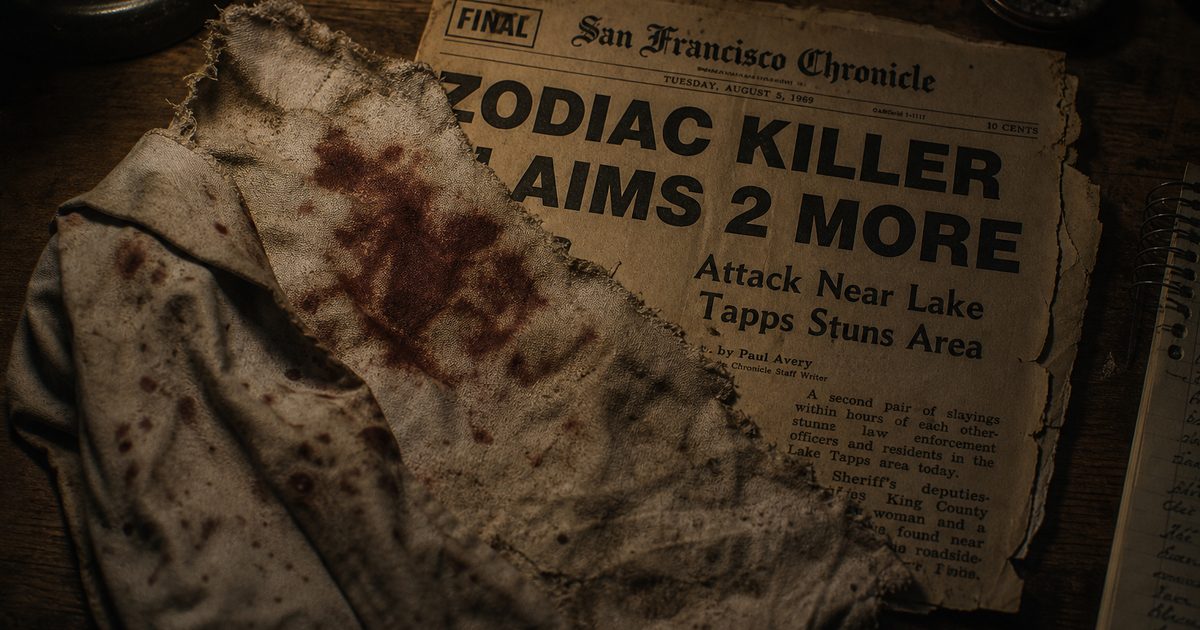
On October 13, 1969, the San Francisco Chronicle received a letter claiming responsibility for the killing. Enclosed was a bloodstained piece of Paul Stine’s shirt.
That was the moment the murder stopped looking like a robbery-homicide and became something else entirely. The shirt fragment was not rumor or boast. It was proof. Whoever sent the letter had been in that cab.
The writer, identifying himself as Zodiac, also threatened to target a school bus. The threat widened fear across the Bay Area. Until then, the known attacks linked to Zodiac had centered on couples in isolated places. Now the killer had struck in San Francisco itself, killed a working cab driver, and written directly to a newspaper with a piece of the victim’s clothing in the envelope.
The city understood, almost at once, that this was no ordinary homicide.
The turning point in the Zodiac case
The killing of Paul Stine is widely regarded as the last confirmed Zodiac murder. It was also the only confirmed fatal Zodiac attack in San Francisco.
That gave the case a different weight. It happened not on a lovers’ lane or a dark roadside turnout, but on a city block with homes, windows, and witnesses. The killer did not vanish into rural darkness. He walked away on foot.
In the weeks that followed, the letters continued. On November 8, 1969, the Chronicle received the message containing what became known as the Z340 cipher. On November 9, another long letter arrived. In it, Zodiac claimed that two police officers had stopped and spoken with him three minutes after the Stine murder.
That claim has to be handled carefully. Zodiac was a taunter, and not everything in his letters can be accepted at face value. He made statements investigators viewed skeptically, including claims about disguising fingerprints. But the broad outline of a police near-encounter was grounded in real events, which is part of what made the letter so unsettling.
He was not just claiming murder. He was claiming proximity to the people hunting him.
The investigation and the dead ends
San Francisco inspectors Dave Toschi and Bill Armstrong became central figures in the city’s side of the investigation. Over time, the Paul Stine case drew intense scrutiny because it seemed to offer what the others did not: a face, physical evidence, and a direct written claim backed by stolen fabric from the victim’s shirt.
And still, no arrest came.
Thousands of leads were examined over the years. Suspects rose and fell. Fingerprints were debated. Statements were re-read. The composite sketch became one of the enduring images of the Zodiac case, but it did not put a name to the man seen leaving the cab.
Even basic points remain frustratingly unsettled at the edges. How reliable were all witness estimates of age and build? Did the man seen on Jackson Street definitely enter the Presidio, or is that only one possibility? Could the physical evidence have identified him if the right suspect had ever been compared?
Those questions have never fully gone away.
The San Francisco Police Department moved the case to inactive status in 2004 and later reopened it in 2006. Other agencies, including the FBI and the California Department of Justice, have also remained involved in the broader Zodiac investigation. No one has been arrested or charged with Paul Stine’s murder.
Why the Paul Stine case still grips people
Some unsolved crimes endure because they are murky from the start. This one is different. The Paul Stine and Zodiac Killer story still grips people because it feels so close to resolution.
A cab ride from downtown. A stop one block off the stated destination. Teenagers looking out a window. A man wiping down a taxi under streetlights. Patrol officers passing someone they had no reason, because of a dispatch mistake, to treat as the killer. Then, two days later, a piece of Paul Stine’s shirt arriving at a newsroom.
That sequence gives the case its terrible force. It was not just another chapter in the Zodiac murders. It was the moment the killer stepped into a San Francisco neighborhood, into view, and still got away.
For the Stine family, of course, the case was never about mythology. It was the loss of a husband, a son, a man working a shift in his cab and never coming home. That human fact can get buried beneath the ciphers, the sketches, and the endless suspect theories. It should not.
The murder of Paul Stine remains one of the clearest windows into how the Zodiac operated: controlled, opportunistic, eager to claim credit, and deeply invested in humiliating police and frightening the public. Yet it is also the case that shows the limits of evidence when timing, confusion, and luck all break the wrong way.
On that October night in Presidio Heights, the investigation came closer than ever to a face, a path, and perhaps even a stop on the street. Close, in this case, was nowhere near enough.
FAQ
Was Paul Stine the Zodiac Killer’s last confirmed victim?
Yes. Paul Stine, killed on October 11, 1969, is widely considered the last confirmed Zodiac victim.
Where was Paul Stine killed?
He was shot in his taxi at Washington and Cherry Streets in San Francisco’s Presidio Heights neighborhood.
How was the murder linked to the Zodiac Killer?
On October 13, 1969, the San Francisco Chronicle received a letter claiming responsibility along with a bloodstained piece of Paul Stine’s shirt.
Did police almost catch the killer after the shooting?
Possibly. Officers encountered a white male nearby shortly after the murder, but a dispatch error had incorrectly described the suspect as Black, so he was not stopped as the likely killer.
Has anyone ever been charged in the Paul Stine murder?
No. Despite eyewitnesses, physical evidence, and decades of investigation, no one has been arrested or charged.