
The first sign was in the snow.
In the final days of March 1922, Andreas Gruber noticed footprints leading toward his remote farmstead in Bavaria. There were no tracks leading away. Then came a newspaper no one in the house had bought. Keys went missing. At night, noises drifted down from the attic.
On an isolated property like Hinterkaifeck, near Waidhofen and roughly 70 kilometers north of Munich, those details would have been unsettling enough on their own. After what happened next, they became the details people could never stop returning to.
By the time neighbors finally entered the farm on April 4, 1922, six people were dead.
The last days at Hinterkaifeck
Hinterkaifeck was small, secluded, and already shadowed by family tension. Living there were Andreas Gruber, 63; his wife, Cäzilia Gruber, 72; their widowed daughter, Viktoria Gabriel, 35; Viktoria’s children, Cäzilia, 7, and Josef, 2; and, from March 31, the family’s new maid, Maria Baumgartner, 44.
The household had long been the subject of gossip. In 1915, Andreas Gruber and Viktoria Gabriel were convicted of incest, a fact that shaped how neighbors and investigators viewed the family afterward. Josef’s paternity was disputed. Some believed the boy was Andreas’s child. Others pointed to neighbor Lorenz Schlittenbauer. That dispute would later help pull Schlittenbauer into the center of suspicion, though suspicion was never the same as proof.
The farm’s previous maid, Kreszenz Rieger, had left shortly before the killings, reportedly saying the place was haunted. It is one of the most repeated details in the Hinterkaifeck murders story, though what matters more is this: by the end of March, several people around the farm had already felt that something was off.
On March 31, Maria Baumgartner arrived for her first day of work. It would also be her last.
A killer seems to have known exactly how to move them
Investigators concluded the murders most likely happened on the evening of March 31, 1922.
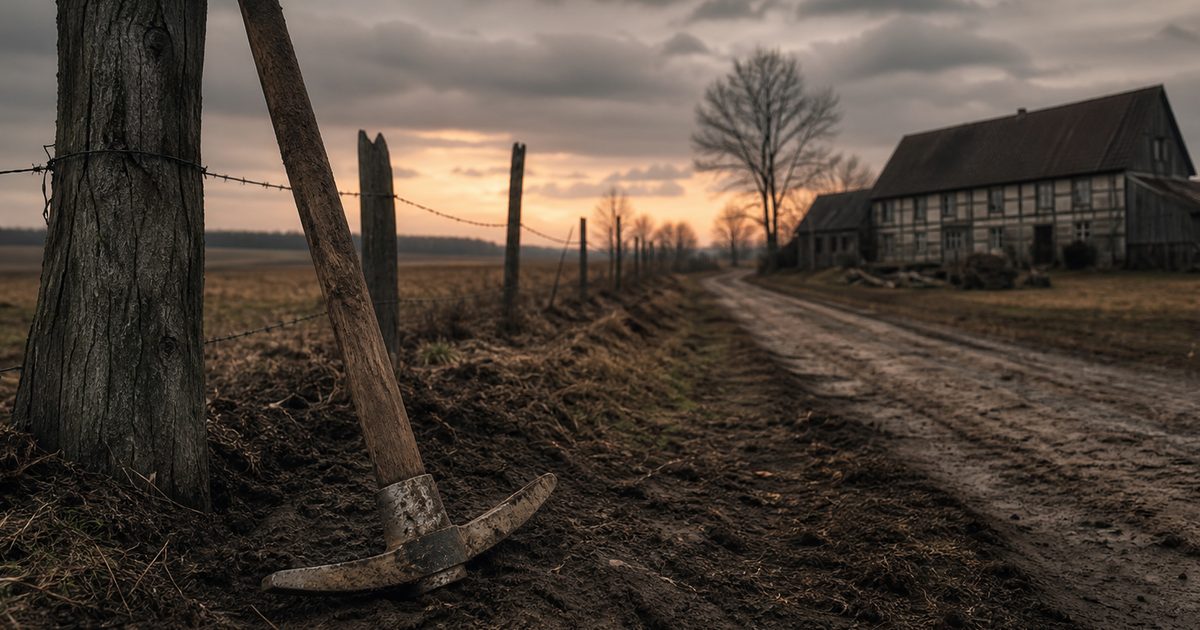
What appears to have happened is chilling in its orderliness. One by one, four members of the family were lured or drawn into the barn: Andreas, Cäzilia, Viktoria, and little Cäzilia. There, they were killed with a mattock, a farm tool with a heavy blade. Inside the house, Maria Baumgartner and two-year-old Josef Gabriel were also killed in their beds.
When the bodies were found, the four in the barn had been covered with hay and a door or board. It looked less like panic than control, as though the killer had time and enough familiarity with the place to move through it without hurry.
Autopsies later showed that all six victims died from blows to the head. One detail has haunted the case for a century: seven-year-old Cäzilia appears to have survived for several hours after the attack. Evidence suggested she tore out clumps of her own hair while she lay dying. Some accounts also mention marks on the older Cäzilia Gruber that may have indicated strangulation, but that point is less firmly established than the blunt-force injuries.
The murder weapon itself was not recovered immediately. In 1923, after the farm had been torn down, a mattock was found hidden in the attic. It had dried blood on it and was identified as the likely weapon.
The days after the murders are what make this unsolved German murder case so unnerving
If the killings had ended on March 31, the case would still be infamous. But the evidence suggests they did not.
From April 1 to April 4, someone appears to have remained at Hinterkaifeck.
The cattle were fed. Bread was cut. Meals were prepared and eaten. Smoke was seen rising from the chimney over the weekend. In other words, the farm did not go silent right away. It continued to function, at least in fragments, while six bodies lay inside.
That single fact changed the shape of the investigation. It suggested a killer, or killers, who knew farm work, knew the buildings, and felt no immediate need to flee. Whether that person had been hiding on the property before the murders or arrived and stayed afterward has never been proved. But the possibility of someone moving through the attic and barn while the family slept is one reason the Hinterkaifeck murders still feel so unnervingly close.
April 4, 1922: the discovery
By Tuesday, April 4, neighbors knew something was wrong.
The family had missed church services and appointments. Mail was piling up. Young Cäzilia had not appeared at school. Concern finally pushed several men to the farm: Lorenz Schlittenbauer, Jakob Sigl, and Michael Pöll.
What they found in the barn turned local worry into one of the most enduring cold cases in Germany. Four bodies lay there under hay. Inside the house were Maria Baumgartner and little Josef, both dead in their beds.
For the people who entered that house, the shock must have been immediate and disorienting. This was not a robbery gone wrong. Money was still in the home. Valuables had been left behind. The violence was intimate, deliberate, and hard to explain.
An investigation damaged almost at once
The Hinterkaifeck timeline is frustrating because the case was compromised from the beginning.
Police from Munich became involved, and Inspector Georg Reingruber led the inquiry. On April 5, 1922, forensic physician Dr. Johann Baptist Aumüller conducted autopsies, reportedly in the barn itself rather than in a proper medical facility. The victims’ heads were later taken to Munich for examination. Those remains were lost during World War II.
Before investigators could properly secure the scene, too many people had already moved through it. Bodies were touched. Objects were disturbed. Accounts from the time even say visitors prepared food in the house. In a modern investigation, that kind of contamination would be catastrophic. In 1922, on an isolated Bavarian farm, it was enough to cripple the case almost immediately.
There was no clear sign of forced entry. A penknife was later found in the hayloft. The missing keys and the earlier attic noises fed the theory that the killer may have had access to the house before the murders. But none of it was enough to produce a charge.
More than 100 suspects were questioned over the years. No one was ever arrested for the killings.
The suspects, the rumors, and what was never proved
No name is more closely tied to the case than Lorenz Schlittenbauer.
He had a complicated relationship with Viktoria Gabriel and was widely discussed as a possible father of Josef. He was also one of the men who discovered the bodies, and some later observers found parts of his behavior at the scene suspicious. But suspicion hardened into folklore faster than it hardened into evidence. He was questioned, scrutinized, and publicly linked to the crime, yet never charged.
Other theories spread in every direction: robbery, revenge, a drifter, a vengeful former soldier, someone hiding in the attic, even bizarre claims involving clairvoyants. The problem was always the same. The case had eerie details, but not enough reliable evidence to turn those details into proof.
That is why the Hinterkaifeck murders remain unsolved. Not because there were no theories, but because there were too many, and the physical evidence was mishandled before it could settle anything.
The farm was demolished, but the mystery stayed
In 1923, the Hinterkaifeck farm was demolished.
That might sound like a practical decision, but it also felt symbolic. The place had become inseparable from what happened there. During the demolition, workers found the hidden mattock in the attic, strengthening the belief that the killer had concealed the weapon on the property before leaving.
Even then, the discovery did not solve the case. Too much had already been lost: the original crime scene, the integrity of the evidence, and later the victims’ remains that might have helped future forensic review.
The investigation continued in various forms for decades. In 1955, the case was officially closed without a solution.
Why the Hinterkaifeck murders still endure
A century later, the case still grips people because it feels unfinished in a way few crimes do.
There is the isolation of the farm. The footprints in the snow. The newspaper from Munich. The missing keys. The noises overhead. A maid who left because she was frightened. Another who arrived on the very day of the killings. Then the terrible stillness after, broken only by signs that someone was still feeding the animals and keeping the fire going.
It is easy to see why this unsolved German murder case has inspired books, documentaries, and films, including the 2009 film Hinter Kaifeck. In 2007, students at the Fürstenfeldbruck Police Academy reportedly reexamined the case as a training exercise using modern methods. According to later accounts, they settled on a likely suspect but did not publicly identify that person out of consideration for surviving relatives. Whatever they concluded, it did not change the official reality: the evidence was too damaged, too incomplete, and too old for a definitive answer.
That is the cruel shape of the Hinterkaifeck murders. The facts are strong enough to disturb, but too broken to resolve. Six people were killed on a farm in Bavaria on March 31, 1922. Their bodies were found on April 4. The killer was never named in court, never convicted, never conclusively identified.
And still, it often begins with those tracks in the snow, heading toward the house and stopping there.
FAQ
Who were the victims of the Hinterkaifeck murders?
The six victims were Andreas Gruber, Cäzilia Gruber, Viktoria Gabriel, Cäzilia Gabriel, Josef Gabriel, and the maid Maria Baumgartner.
When did the Hinterkaifeck murders happen?
The killings are believed to have taken place on the evening of March 31, 1922. The bodies were discovered on April 4, 1922.
Was anyone ever charged in the Hinterkaifeck case?
No. Many suspects were questioned, but no one was ever charged or convicted.
What weapon was used in the Hinterkaifeck murders?
Investigators identified a mattock, found hidden in the attic in 1923, as the likely murder weapon.
Why is the Hinterkaifeck case still unsolved?
The crime scene was heavily contaminated, key evidence was lost, and later forensic review could not overcome the damage done in the original investigation.