
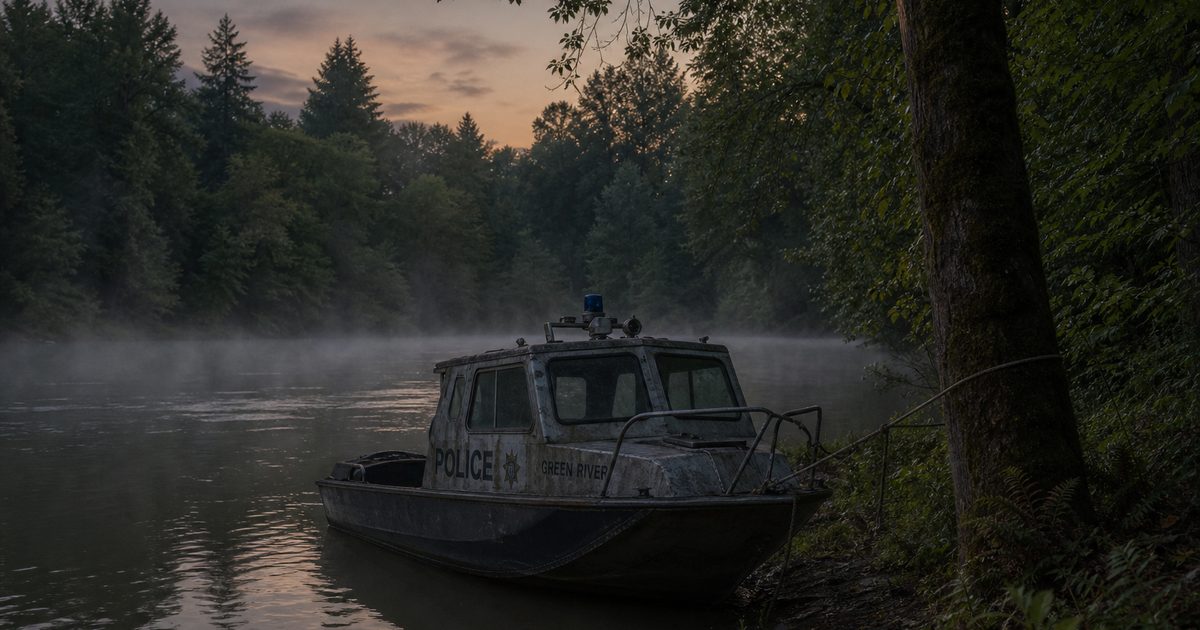
In the summer of 1982, the Green River in Washington became a place detectives kept returning to with dread.
Bodies were being found near the water south of Seattle, and at first the pattern was more frightening than clear. Young women and girls were disappearing. Some had run away. Some were involved in prostitution. Many lived on the margins, which meant there was often a delay before anyone realized they were truly gone. That delay gave their killer time.
The case that followed would become one of the largest murder investigations in American history. For years, the man responsible moved through the Seattle area without drawing much notice, working a steady job, going home at night, and blending into ordinary life. His name was Gary Leon Ridgway. By the time police finally arrested him on November 30, 2001, the Green River Killer case had haunted Washington for nearly two decades.
The missing women no one hurried to look for
What made the Green River murders so hard to solve was not just the number of victims. It was who they were.
Most were young women and girls who were especially vulnerable: runaways, teenagers estranged from their families, and women in prostitution. Ridgway later admitted he chose them in part because he believed they would not be reported missing right away. That was not speculation after the fact; it was part of his own explanation for how he operated for so long.
It meant investigators were rarely starting with a fresh crime scene and a quick timeline. Instead, they were often trying to reconstruct the last days of someone whose disappearance had not immediately triggered a full-scale search. Bodies were found in wooded areas, along roads, and near rivers. The crime scenes were scattered. Time had passed. Evidence was thin.
And still, detectives could see a pattern forming.
By late 1982, King County investigators understood they were likely dealing with a serial killer. The women being found had moved in similar circles. Many had last been seen along the Pacific Highway South strip, a corridor known for motels, truck traffic, and street prostitution. The killer seemed to know the area well. He also seemed patient, methodical, and careful enough to keep leaving police with suspicion but not proof.
Gary Ridgway was on their radar early
One of the most unsettling facts about the Gary Ridgway story is that he was not some unknown ghost who appeared only at the end.
He came to investigators’ attention early in the Green River Killer investigation. Ridgway, born February 18, 1949, in Salt Lake City, Utah, lived in the Seattle area and worked as a truck painter at the Kenworth plant. He had served in the U.S. Navy. He had been married multiple times and had a son. On the surface, he looked like a man with a routine life.
That mattered. People often imagine a serial killer as someone visibly chaotic or obviously dangerous. Ridgway did not present that way. He was ordinary enough to slip past assumptions.
Police interviewed him. He took polygraph tests in 1982 and again in 1986. He passed. Polygraphs are not proof of innocence, and they were never meant to clear him absolutely, but in a case already struggling with limited physical evidence, those results helped him stay out of reach.
So the years kept moving.
The Green River Killer murders continued to cast a shadow over Washington through the 1980s and into the 1990s. Detectives worked leads, compared witness statements, tracked vehicles, revisited dump sites, and tried to connect disappearances across years. But the case remained maddeningly incomplete. They had a widening map of victims and recovery sites. They still did not have a case they could take to court.
Why the Green River Killer went uncaught for so long
The answer is not mysterious, just grim.
Ridgway exploited vulnerability. He targeted women and girls he believed society would not protect quickly. He left bodies in remote places, sometimes returning to those sites later, which further complicated timelines and evidence. And he committed many of the murders in the 1980s, before DNA testing had the power it would later bring to cold cases.
That timing was crucial.
In the early years of the investigation, detectives could build theories and identify suspects, but they could not do what modern forensic science would eventually allow them to do: tie biological evidence to one man with confidence strong enough for prosecution. So even when suspicion circled back to Gary Ridgway, suspicion was not enough.
The case became a lesson in how a murderer can hide not by disappearing, but by appearing normal while institutions fail the people he preys on.
The breakthrough in 2001
The turning point came almost 20 years after the first bodies were found.
By 2001, advances in DNA testing gave investigators another chance to examine evidence collected years earlier. This time, the science was strong enough. DNA linked Ridgway to several victims from the early 1980s.
On November 30, 2001, police arrested him.
After that, the Green River Killer case changed shape overnight. For years the central question had been: who is he? Now it became: how many women did he kill, and how much of the story could still be recovered?
For families, the arrest did not bring relief so much as a different kind of pain. The faceless terror that had hovered over the case now had a name, a face, a work history, old neighbors, ex-wives, and a daily routine. The monster was not hiding in some cinematic darkness. He had been living among everyone else.
The plea deal and the count that still haunts the case
In 2003, prosecutors offered Ridgway a plea agreement. In exchange for avoiding the death penalty, he would plead guilty and help investigators locate remains and explain what he had done. On November 5, 2003, he pleaded guilty to 48 counts of aggravated first-degree murder. A 49th conviction followed in 2011, when he pleaded guilty to the 1982 murder of 20-year-old Rebecca “Becky” Marrero after her remains were identified.
That made Gary Ridgway the most prolific serial killer in U.S. history by number of confirmed murder convictions.
Even that number may not tell the full story. Ridgway claimed he killed far more women, at times suggesting a total in the dozens beyond those for which he was convicted. Those claims helped cement his notoriety, but they should be treated carefully. What is proven in court is 49 murders. Investigators have long suspected the true number may be higher, but not every claim can be verified.
The plea deal was a hard bargain. It spared his life. But it also gave detectives information they had been chasing for years and, in some cases, allowed families to recover remains and finally know where their daughters had been left.
That is the part of the story that matters most.
The victims at the center of the Green River case
The scale of the Green River Killer investigation can make it easy to talk in numbers. But the case was never really about numbers.
It was about girls and women whose lives were often treated as disposable long before they were killed. Many were teenagers. Many were loved. Many were missed immediately by someone, even if the system did not respond with urgency. Some families spent years living in uncertainty, not knowing whether to hope or grieve.
Ridgway’s long run as a killer exposed more than the limits of 1980s forensic science. It exposed how easily vulnerable victims can be pushed to the edge of public concern. That indifference helped him. It slowed the response. It gave him room.
When people ask why the Green River Killer went uncaught for so long, that is the truest answer. Science had not caught up yet, yes. He blended into ordinary life, yes. But he also chose victims he believed the world would overlook.
For too long, he was right.
FAQ
When did the Green River Killer murders begin?
The known series began in 1982, with several victims found in July and August near the Green River in Washington.
Who was the Green River Killer?
The Green River Killer was Gary Leon Ridgway, a Seattle-area truck painter arrested on November 30, 2001.
How was Gary Ridgway caught?
He was identified through DNA evidence re-tested with improved forensic methods, which linked him to several victims.
How many murders was Gary Ridgway convicted of?
He was convicted of 49 murders: 48 through his 2003 guilty plea and one more in 2011.
Did Gary Ridgway receive the death penalty?
No. He avoided the death penalty by agreeing to plead guilty and help investigators locate victims’ remains.