A pair of eyeglasses, left behind after dinner, became one of the last ordinary details in a night that would never feel ordinary again.
On June 12, 1994, Nicole Brown Simpson ate at Mezzaluna in Brentwood with her children and family members. The group left around 8:00 p.m. Later, at about 9:15 p.m., Nicole’s sister called the restaurant to say their mother had forgotten her glasses. Ron Goldman, a 25-year-old waiter at Mezzaluna and a friend of Nicole’s, agreed to bring them over. Around 9:50 p.m., he left the restaurant with the glasses in hand.
Somewhere in the next hour, outside Nicole’s condominium at 875 South Bundy Drive in Los Angeles, both Nicole Brown Simpson and Ronald Lyle Goldman were killed.
That much is certain. The smaller question that still lingers around the edges of the O.J. Simpson case is whether Nicole or Ron was attacked first. It sounds narrow, almost technical. But it matters because it changes how the final minutes are understood. Was Goldman caught in an attack already underway? Or did both victims walk into the same burst of violence within seconds of each other?
The record does not give a final, provable answer. It does, however, show why the question has never quite gone away.
The last known movements before the murders
The broad timeline is clear, even if the final sequence is not.
Nicole returned home after dinner. Goldman left Mezzaluna later to return the glasses. Just after midnight, in the early minutes of June 13, police discovered both bodies in the walkway near Nicole’s front gate and steps.
From there, every minute became important.
At trial, prosecutors argued the killings happened at about 10:15 p.m. Other reconstructions of the night, discussed in later coverage of the case, have placed Goldman’s arrival closer to 10:30 p.m. If that later estimate is right, it would suggest Nicole Brown Simpson may have been attacked before he reached the gate, or that he arrived just as the assault was unfolding.
That possibility is what gives the timeline its weight. Goldman had not spent the evening with Nicole. He was there for a simple errand, returning something her mother had left behind. In many accounts of the case, that detail has always made his death feel especially cruel: he may have stepped into danger without any warning at all.
What the case record actually supports
For all the attention the case has received, the answer to “who died first” remains limited by the evidence.
It was never definitively proven in court whether Nicole Brown Simpson or Ron Goldman was killed first. The prosecution’s theory placed the murders in a tight window around 10:15 p.m. Other timelines, cited later outside the trial itself, put Goldman at the scene somewhat later. Those later estimates can support the idea that Nicole was attacked first, but they do not settle it beyond doubt.
What is firmly established is that both were killed at the same location, in the narrow passageway outside Nicole’s home, and that the attack was treated as one connected event.
That distinction matters. The true story is tragic enough without forcing certainty where the record does not provide it. The evidence allows a careful conclusion: Goldman arrived after Nicole had come home, and some timelines suggest he may have encountered an attack already in progress or its immediate aftermath.
Just after midnight: the scene on Bundy Drive
When police arrived shortly after midnight on June 13, they found a crime scene that would soon become one of the most examined in American history.
The victims were outside Nicole’s condominium. From that moment on, the investigation moved quickly toward one person: O.J. Simpson, Nicole’s former husband.
He was not just any suspect. Simpson was one of the most recognizable men in the country, a former football star turned actor and broadcaster. But behind that public image was a history that prosecutors would later place at the center of their case. In 1989, Simpson pleaded no contest to spousal abuse after an incident involving Nicole. That history of domestic violence became a key part of the prosecution’s theory about motive.
As investigators processed the scene and followed the evidence, the case against Simpson appeared, at least on paper, powerful.
The evidence that shaped the prosecution’s case
Prosecutors built their case around physical evidence collected from the crime scene, Simpson’s home, and his vehicle.
According to the prosecution, blood from the victims was found in Simpson’s Ford Bronco and on a pair of socks in his bedroom. Simpson’s own blood was found at the Bundy crime scene and at his Rockingham estate. Investigators also pointed to hair consistent with Simpson’s on Goldman’s shirt and on a knit cap recovered near the scene. Fiber evidence was said to link the cap to Simpson’s Bronco and to a glove found at the scene. A second glove, described as the mate, was found at Simpson’s estate.
There were also bloody shoe prints, which prosecutors argued matched a rare type of shoe in Simpson’s size.
And then there was the DNA evidence, which became the backbone of the state’s case. Prosecutors argued that dozens of blood drops and stains tied Simpson to the killings.
But the case did not unfold on paper. It unfolded in court, where evidence has to survive attack.
The white Bronco chase changed everything
Four days after the murders, the investigation became a national spectacle.
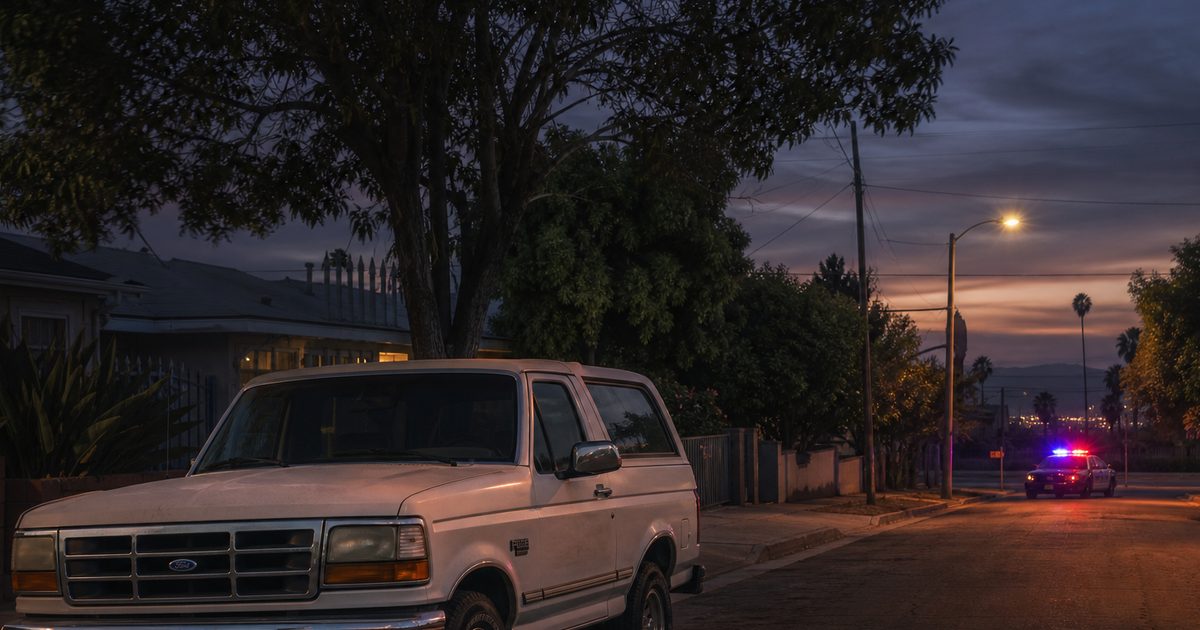
On June 17, 1994, after Simpson had been charged and was expected to surrender, he did not turn himself in as arranged. Instead, he became the subject of a slow-moving police pursuit in a white Ford Bronco driven by his friend Al Cowlings.
Millions watched it live on television.
The images were surreal: freeways, police cars, helicopters overhead, and a suspect so famous that the chase interrupted regular programming across the country. By the time Simpson surrendered later that day at his Brentwood estate, the case had already become something larger than a double-murder prosecution.
From then on, the facts of what happened outside Nicole Brown Simpson’s home would be argued in a courtroom under extraordinary public pressure.
Inside the O.J. Simpson trial
Simpson was arraigned on July 22, 1994, and pleaded not guilty to two counts of murder. His criminal trial began on January 24, 1995, in Los Angeles County Superior Court before Judge Lance Ito.
The lawyers became famous in their own right. Marcia Clark and Christopher Darden led the prosecution. Simpson’s defense team included Robert Shapiro, F. Lee Bailey, Robert Kardashian, and Johnnie Cochran, who emerged as the lead courtroom voice for the defense.
The state presented the physical evidence as a strong, coherent chain. The defense attacked that chain at nearly every link.
Rather than simply denying the evidence existed, Simpson’s lawyers challenged how it had been collected, stored, and tested. They raised questions about contamination, police procedure, and whether key investigators could be trusted. They also argued that racial bias inside the LAPD could not be ignored.
That argument landed in a city already raw from years of conflict over policing. The trial was never only about blood evidence or timelines. It became entangled with celebrity, race, policing, and public distrust. That is one reason the O.J. Simpson trial still occupies such a large place in American memory.
On October 3, 1995, the jury found Simpson not guilty of the murders of Nicole Brown Simpson and Ron Goldman.
A different verdict in civil court
The criminal acquittal did not end the legal story.
In a civil wrongful death case, where the burden of proof is lower than in criminal court, a jury reached a different conclusion. On February 4, 1997, Simpson was found liable for the wrongful deaths of Nicole Brown Simpson and Ronald Goldman.
The Goldman family, who pressed forward with the civil case, was awarded $33.5 million in damages. Much of that judgment went unpaid.
That split result remains one of the defining features of the case: acquitted in criminal court, held liable in civil court. Legally, those are different findings under different standards. In public memory, they left the case feeling unresolved even when the verdicts themselves were final.
Why the question still endures
Some mysteries survive because there is no evidence. This one survives because there is so much evidence, and yet one small part of the story still resists certainty.
Nicole Brown Simpson was home for the night. Ron Goldman was making a brief stop to return a forgotten item. The timing suggests he may have arrived at the worst possible moment. That possibility has kept people asking the same question for years: who died first?
The most honest answer is also the narrowest one. The case record does not definitively prove the order of death. It does show that both victims were killed in the same attack outside Nicole’s home, and that some later timeline reconstructions place Goldman’s arrival late enough that Nicole may have been attacked first.
In the end, the unresolved detail should not overshadow the larger truth. Two people were killed outside 875 South Bundy Drive. One was a woman with a documented history of abuse at the hands of her former husband. The other was a young man running an errand that should have taken only minutes. That is the human core of the case, and it is why the story still holds.
FAQ
Did Nicole Brown Simpson or Ron Goldman die first?
It was not definitively proven. Prosecutors placed the murders around 10:15 p.m., while some later timeline reconstructions suggest Goldman may have arrived later, which could mean Nicole was attacked first.
Was O.J. Simpson convicted of the murders?
No. He was acquitted in the criminal trial on October 3, 1995. In a later civil case, he was found liable for the wrongful deaths.
Why was Ron Goldman at Nicole Brown Simpson’s home?
He had left Mezzaluna to return eyeglasses that Nicole’s mother had accidentally left behind at the restaurant.
Where were Nicole Brown Simpson and Ron Goldman killed?
They were killed outside Nicole’s condominium at 875 South Bundy Drive in Brentwood, Los Angeles.
What was the white Bronco chase?
On June 17, 1994, after failing to surrender, Simpson was a passenger in a white Ford Bronco driven by Al Cowlings during a low-speed police pursuit broadcast live across the country.